
A red light, backed-up traffic, or a turning vehicle can appear quickly on Beach Boulevard. For a driver traveling too fast, there may be only seconds to react—and not enough distance to stop.
After a speeding accident on Beach Boulevard in Huntington Beach, determining how fast the driver was traveling can become an important part of establishing fault. The role speed played may help explain why the collision occurred and who may be responsible.
When speed or fault is disputed, a Huntington Beach car accident lawyer can investigate what happened, preserve evidence of unsafe speed, and help an injured person pursue compensation.
1 in 3 Huntington Beach Unsafe-Speed Crashes Happen on Beach Boulevard
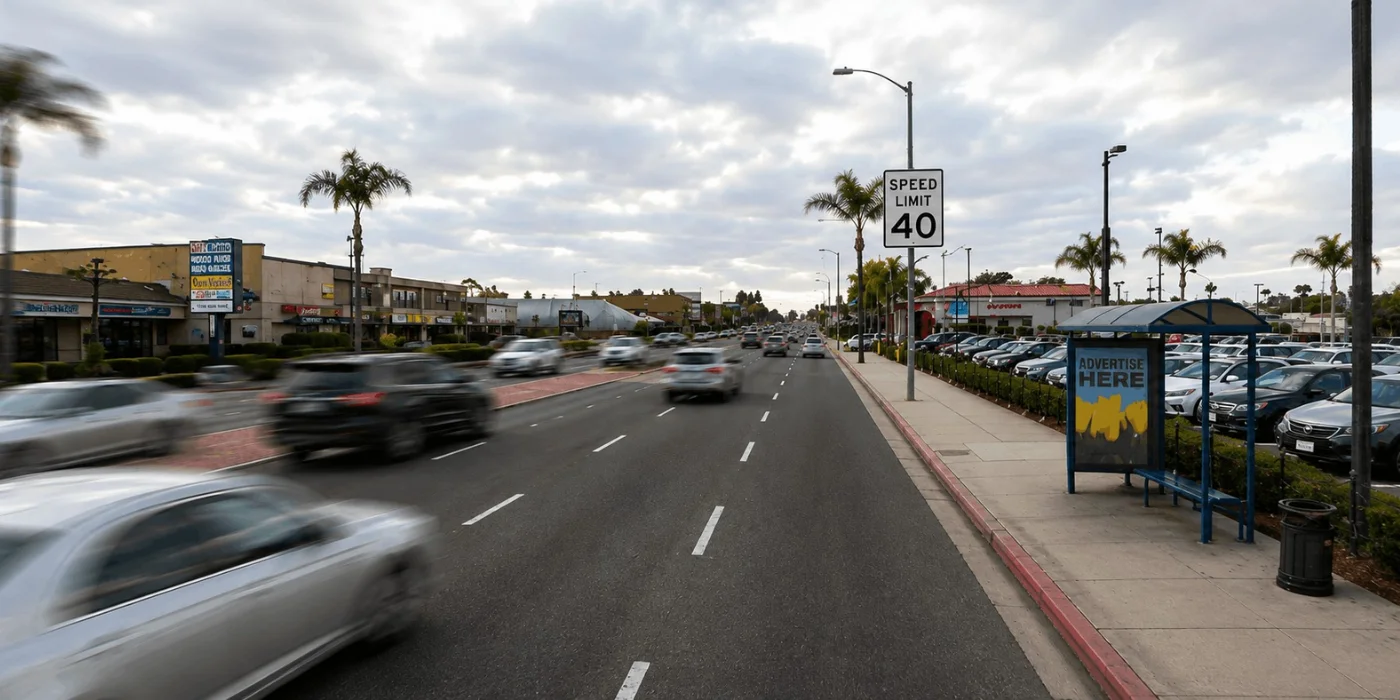
According to California’s Statewide Integrated Traffic Records System (SWITRS), 33 of Huntington Beach’s 93 unsafe-speed crashes occurred on Beach Boulevard—more than one-third of the total. Citywide, these collisions resulted in 137 injuries and one fatality. Across the city, unsafe-speed crashes resulted in 137 injuries and one fatality.
The crash pattern on Beach Boulevard is also striking: 97% of its unsafe-speed crashes were rear-end collisions. This highlights the danger when drivers traveling too fast encounter slowing or stopped traffic. Learn more about how fault may be determined after a rear-end accident in Huntington Beach.
Unsafe-Speed Crashes Occur Throughout Beach Boulevard
The collision data shows that unsafe-speed crashes occurred throughout Beach Boulevard, including near its intersections with Slater Avenue, Stark Drive, and Garfield Avenue. The pattern suggests the problem is not confined to a single intersection or part of the corridor.
Rather than pointing to a single trouble spot, the data suggests unsafe speed is a corridor-wide concern. Along Beach Boulevard, drivers regularly encounter signals, turning vehicles, commercial entrances, and traffic that can shift from moving freely to slowing or stopping.
What Does “Unsafe Speed” Mean Under California Law?
Under California’s Basic Speed Law, Vehicle Code § 22350, drivers must travel at a speed that is reasonable and prudent for the conditions around them. Factors such as traffic, visibility, weather, and the condition and width of the roadway can all affect what qualifies as a safe speed.
In practical terms, drivers are expected to adjust their speed as conditions change. Heavy traffic, poor visibility, wet pavement, or increased pedestrian activity may require a driver to slow down. The same principle can apply after an unsafe-speed accident in Huntington Beach on PCH, where traffic and surrounding conditions can change quickly.
Is Driving the Speed Limit Always Safe?
A driver can obey the posted speed limit and still be traveling too fast for the conditions. Backed-up traffic, construction zones, lane closures, or other changing road conditions may require drivers to slow down well below the posted limit.
This can be especially important on busy Huntington Beach roads such as Beach Boulevard and PCH, where changing traffic or construction can create unexpected slowdowns. In an injury claim, the key question is not simply whether the driver obeyed the posted limit, but whether their speed was reasonable for the conditions immediately before the crash.
Who Is at Fault Under California Law?
Unsafe speed can be strong evidence of fault after a crash. When police identify unsafe speed as the Primary Collision Factor (PCF), it indicates that the driver’s speed was considered a primary factor in causing the collision. This finding can carry significant weight in an injury claim.
An unsafe-speed PCF violation in California can become even more persuasive when supported by vehicle data, video footage, witness statements, or physical evidence from the crash scene.
However, a strong showing of unsafe speed does not necessarily mean only one driver contributed to the crash. For example, one driver may make an unsafe left turn while an approaching driver is traveling too fast to avoid the collision.
These types of disputed intersection crashes can also result in a broadside or T-bone collision. In that situation, responsibility may be divided between both drivers, depending on the crash details.
What If Both Drivers Were Partly at Fault?
California follows a pure comparative negligence system. If an injured person shares responsibility for a crash, they can generally still recover compensation, but their recovery is reduced by their percentage of fault.
For example, someone with $100,000 in damages who is found 20% responsible could recover $80,000.
Evidence That Can Help Prove Unsafe Speed
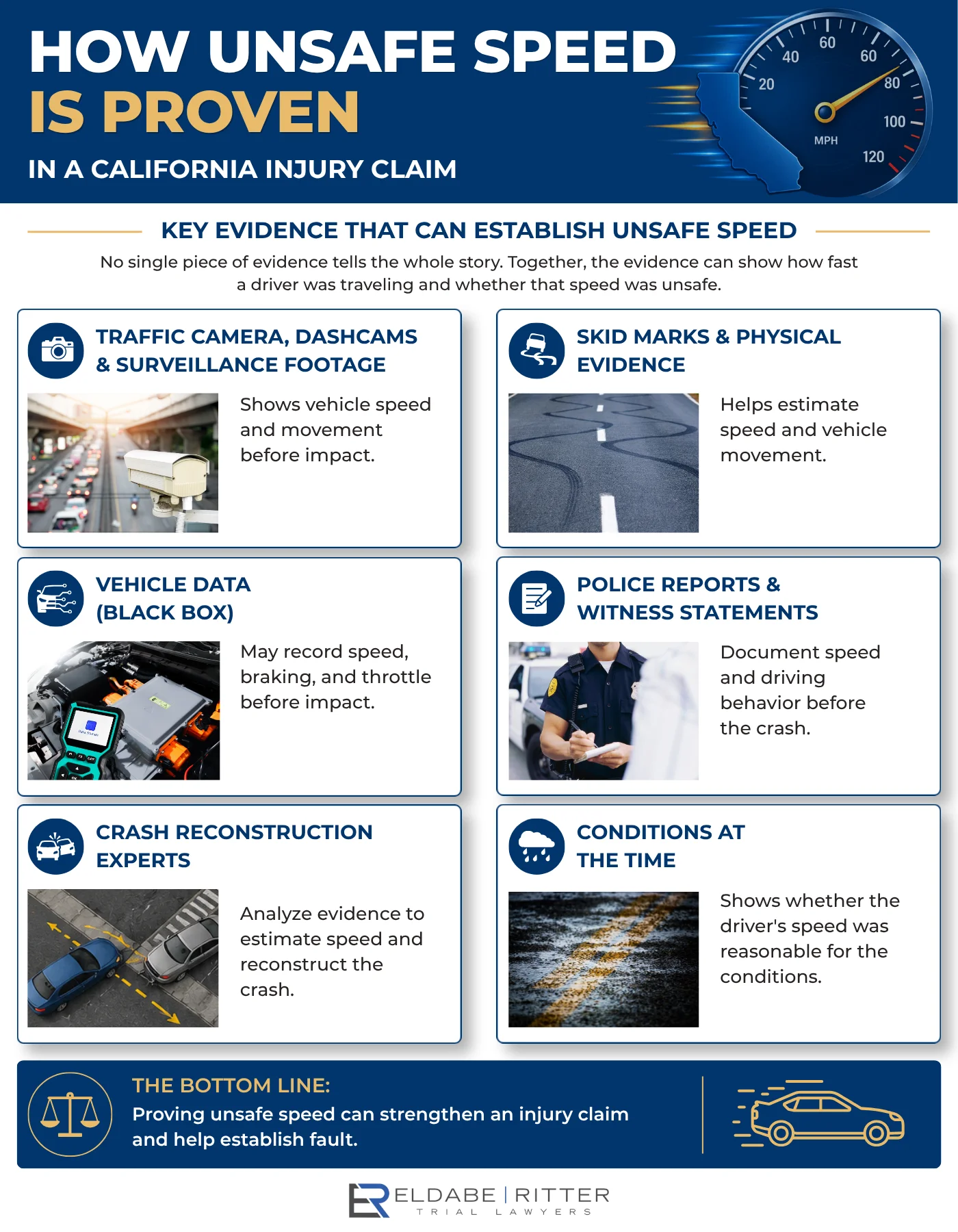
When drivers and insurance companies disagree about what happened in the seconds before a collision, several sources of evidence can help establish whether speed played a role.
Useful evidence may include:
- Video footage: Dashcams, traffic cameras, and nearby business surveillance may capture a vehicle’s speed and movement before impact.
- Event Data Recorder (EDR) data: When available, vehicle data may provide information about speed, braking, throttle use, and other activity shortly before a crash.
- Physical evidence: Tire marks, vehicle damage, impact points, debris, and final vehicle positions can provide clues about how the collision occurred.
- Witness statements: People who saw the crash may describe the vehicle’s speed, braking, or behavior before impact.
- Police reports: Officer observations, measurements, statements, diagrams, and an unsafe-speed PCF violation under California law may provide additional evidence.
How Crash Reconstruction Experts Analyze Unsafe Speed
When speed is disputed, or a serious crash involves complex physical evidence, an accident reconstruction expert may be able to piece together what happened before impact.
Experts can analyze vehicle data, video, roadway evidence, vehicle damage, impact locations, and other information to estimate vehicle speeds and reconstruct how the vehicles moved in the seconds leading up to the collision.
Why Speed Makes Crash Injuries More Severe
Higher speeds can make a collision significantly more destructive. The faster a vehicle is traveling at impact, the greater the forces that can be transferred to the people involved, increasing the risk of serious injury.
Vehicle occupants may suffer fractures, traumatic brain injuries, spinal injuries, internal injuries, and other serious trauma. Pedestrians, bicyclists, and motorcyclists face even greater risks because they have little or no protection from the force of an impact.
As impact speed increases, so can the potential for serious injury. Unsafe speed can therefore affect not only whether a crash occurs, but also the harm it causes.
Common Insurance Company Defenses in Unsafe Speed Claims
An insurance company may challenge more than whether its driver was speeding. It may dispute how the crash happened, how much speed contributed to it, or whether the collision caused the injuries being claimed.
Common arguments include:
- “There is no proof of unsafe speed.” Insurers may question estimates of the driver’s speed or argue that the available evidence does not show the driver was traveling too fast.
- “The driver was within the speed limit.” Being under the posted limit does not necessarily establish that the speed was safe for the conditions at the time of the crash.
- “The other driver caused or contributed to the crash.” An insurer may point to a sudden stop, unsafe turn, lane change, or other action to shift some or all of the fault away from its driver.
- “The crash did not cause these injuries.” Prior injuries, delayed medical care, or gaps in treatment may be used to question whether the collision caused or aggravated the claimed condition.
These arguments can make both crash evidence and medical documentation important to establishing what caused the collision and the extent of the resulting injuries.
What Compensation May Be Available After an Unsafe Speed Accident?
If another driver’s unsafe speed caused your injuries, compensation may be available for both the financial and personal effects of the crash. The amount depends on factors such as the severity of the injuries, necessary medical care, time missed from work, long-term limitations, available insurance coverage, and each party’s share of fault.
Compensation may include:
- Medical expenses: Emergency care, hospitalization, rehabilitation, and reasonably necessary future treatment.
- Lost income: Wages lost during recovery and reduced future earning capacity when an injury affects the ability to work.
- Property damage: The cost of repairing or replacing a damaged vehicle and other property.
- Pain and suffering: Physical pain, emotional distress, and loss of enjoyment of life.
- Long-term losses: Permanent disability, impairment, scarring, or disfigurement when applicable.
In limited cases involving particularly egregious conduct, punitive damages may also be available. However, speeding alone does not automatically justify punitive damages. Other circumstances, such as drunk driving accidents in Huntington Beach, may involve additional conduct relevant to whether punitive damages can be pursued.
Frequently Asked Questions About Unsafe Speed Accidents
Can I file a claim if the other driver wasn’t given a speeding ticket?
Yes. A speeding citation is not required to pursue an injury claim. Video footage, vehicle data, witness statements, physical evidence, and other information may help show that the driver was traveling too fast for the conditions. A police officer’s decision not to issue a citation does not determine civil liability.
What should I do after a speeding accident on Beach Boulevard in Huntington Beach?
Taking the right steps after a crash can protect your safety and help preserve important evidence for your claim.
- Get to safety: Move out of traffic if you can safely do so.
- Call 911: Report the crash to the Huntington Beach Police Department (HBPD) and request medical help if needed.
- Document the scene: Photograph the vehicles, damage, roadway, and surrounding area.
- Get witness information: Collect contact details from anyone who saw the crash.
- Seek medical care: Get evaluated even if your injuries initially seem minor.
How can I prove unsafe speed after a Huntington Beach accident?
Video footage, vehicle data, witness statements, physical crash evidence, and police findings may help establish unsafe speed. Depending on where the crash occurred, footage from nearby businesses or traffic cameras may also be available. In disputed cases, a crash reconstruction expert may help estimate the vehicle’s speed before impact.
What if I was partly at fault for the accident?
California’s pure comparative negligence system generally allows you to recover compensation even if you share responsibility for the crash. Your recovery may be reduced by your percentage of fault.
How long do I have to file an unsafe-speed accident claim in Huntington Beach?
Most Huntington Beach personal injury cases are subject to California’s general two-year statute of limitations from the date of injury. Different deadlines can apply in certain situations, including claims involving government entities, which generally require an administrative claim within six months.
Because the applicable deadline depends on the circumstances, it is important to determine which deadline applies as early as possible.
Get Help After a Beach Boulevard Speeding Accident
Evidence of unsafe speed can disappear quickly. Video may be overwritten, vehicle data can be lost, and witnesses can become harder to locate.
Cases involving excessive or unsafe speed may require accident reconstruction. An experienced Huntington Beach car accident lawyer can begin preserving evidence and investigating the crash immediately.
If you were injured in a speeding accident on Beach Boulevard in Huntington Beach, contact El Dabe Ritter Trial Lawyers for a free consultation. We can protect your rights and pursue the full value of your claim. No upfront fees—you pay no fee unless we win.
