
When a driver is arrested for DUI after a crash, it may seem like the most important questions have already been answered. But an arrest or conviction does not automatically compensate the people injured in the collision.
After a drunk driving accident in Huntington Beach, victims may still need to prove their losses, navigate insurance coverage issues, and pursue a separate civil claim. A Huntington Beach car accident lawyer can help victims understand how the criminal DUI case relates to their injury claim and whether additional damages, including punitive damages, may be available.
How Drunk Driving Accidents Happen in Huntington Beach
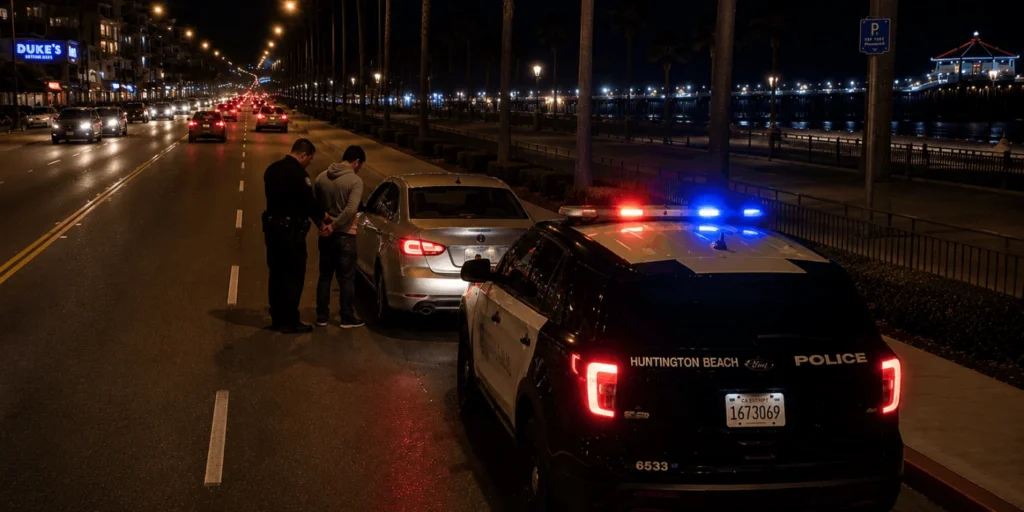
Alcohol can affect reaction time, coordination, judgment, and a driver’s ability to recognize hazards. An impaired driver may also be traveling at an unsafe speed for the traffic and roadway conditions.
These behaviors can be especially dangerous on busy Huntington Beach roads. A DUI accident on PCH near Downtown Huntington Beach can occur amid heavy traffic, pedestrians, cyclists, motorcycles, and vehicles entering or leaving restaurants, parking areas, and other nearby businesses.
Farther inland, major corridors such as Beach Boulevard and Warner Avenue bring different risks, including busy intersections, commercial traffic, and frequent turning and stopping.
Farther inland, major corridors such as Beach Boulevard, where unsafe speed is a recurring crash factor, and Warner Avenue bring different risks, including busy intersections, commercial traffic, and frequent turning and stopping.
Many DUI crashes can also occur in intersections, leading to devastating broadside (T-bone) accidents in Huntington Beach.
Huntington Beach Drunk Driving Accident Statistics & Trends
Local collision data provides a clearer picture of DUI accident trends in Huntington Beach and how often alcohol was involved in serious crashes in 2025:
Huntington Beach 2025 Alcohol-Involved Accident Data Snapshot
- Total Alcohol-Involved Crashes: 91 collisions
- Total Fatalities: 5 victims killed
- Total Injuries: 120 victims injured
- Highest-Risk Saturday Window: 22 crashes occurred between 3:00 p.m. and midnight, peaking at 8 crashes between 9:00 p.m. and midnight.
The risk changes as Saturday progresses. Huntington Beach’s 2025 collision data shows alcohol-involved crashes were most concentrated from Saturday afternoon through midnight, with the highest Saturday total occurring between 9 p.m. and midnight.
Alcohol also appeared in 11 of Huntington Beach’s 56 pedestrian crashes in 2025. For a closer look at where pedestrian collisions occurred throughout the city, see our analysis of Huntington Beach pedestrian accident hotspots.
Alcohol involvement is only one factor that can make collisions along the coast especially dangerous. Learn more about the factors that contribute to car accidents on PCH in Huntington Beach
Who Is Usually at Fault in a Drunk Driving Accident Under California Law?
When an impaired driver causes a crash, the drunk driver is typically responsible for the harm caused by their negligent driving. Because driving under the influence is prohibited under California Vehicle Code § 23152, evidence of intoxication can strongly support a finding of negligence and fault.
For most drivers age 21 or older, California prohibits driving with a blood alcohol concentration (BAC) of 0.08% or higher. A driver can also be arrested or convicted of DUI with a lower BAC if alcohol has impaired their ability to drive safely. Learn more about when buzzed driving can be considered DUI in California
However, even with strong evidence of DUI, the impaired driver is not automatically considered solely responsible for every collision. Under California’s comparative fault law, responsibility may be shared if another person’s actions also contributed to the crash.
Criminal DUI Case vs. Civil Injury Claim
A drunk driving crash can lead to both a criminal DUI case and a separate civil injury claim. The two may involve some of the same evidence, but they serve different purposes.
Criminal DUI Case
- Brought by the government: Prosecutors pursue the case against the accused driver; the victim does not pay to prosecute the driver.
- Focuses on criminal responsibility: The court determines whether the driver committed a crime.
- May result in criminal consequences: A conviction can lead to fines, probation, license restrictions, incarceration, and other penalties. The court may also order the driver to pay restitution to the victim for qualifying losses.
Civil Injury Claim
- Brought by the injured person: The victim pursues a claim against the responsible driver.
- Focuses on the victim’s losses: The claim may seek compensation for medical expenses, lost income, pain and suffering, and other damages.
- Often involves the driver’s liability insurance: The at-fault driver’s insurer generally pays covered damages up to the available policy limits. Other sources of recovery may also be available depending on the circumstances.
The Orange County District Attorney’s Office handles the criminal prosecution, but it does not represent the victim’s financial interests in a personal injury claim. The victim’s civil claim proceeds separately, even when a criminal DUI case is pending.
Victims’ Rights and Restitution Under Marsy’s Law
California crime victims have rights under Marsy’s Law, the state’s constitutional Victims’ Bill of Rights. These rights include receiving notice of criminal proceedings, being heard at certain stages of the case, and seeking restitution from the convicted person.
One of these rights—restitution—can help victims recover certain financial losses through the criminal case. Restitution is a court-ordered payment requiring the convicted drunk driver to reimburse the victim for losses caused by the crash, such as medical expenses and lost wages.
While restitution can address some of the victim’s economic losses, it is not the same as a personal injury claim. A civil claim can seek those economic losses as well as compensation for harm that restitution generally does not cover, such as pain and suffering.
How Does a DUI Conviction Affect the Civil Injury Claim?
A DUI conviction or guilty plea may strengthen the victim’s civil claim by providing important evidence of the driver’s unlawful conduct. However, a conviction does not automatically establish every part of the injury claim. The victim must still establish the injuries and losses caused by the crash.
Evidence That Can Strengthen a Huntington Beach DUI Accident Claim
Evidence can play an important role in establishing both responsibility for a DUI crash and the resulting harm. A strong claim may draw on evidence of the driver’s impairment, how the collision happened, and the injuries and losses the victim suffered.
Evidence of impairment:
- Police and arrest reports: Reports from HBPD or CHP can document officers’ observations, statements, and information related to the DUI investigation.
- Breath or blood test results: Chemical testing may provide evidence of the driver’s blood alcohol concentration or presence of drugs.
- Officer observations and body-camera footage: Video and observations may document the driver’s appearance, speech, coordination, or behavior.
- Receipts and other records: Bar tabs and similar records may help establish where the driver was before the collision and whether alcohol was purchased.
Evidence of fault and how the crash happened:
- Surveillance and traffic footage: Businesses and other properties along PCH and around Downtown Huntington Beach may have cameras that captured the collision or the driver’s behavior beforehand.
- Witness statements and dashcam footage: Other motorists, pedestrians, or nearby bystanders may have seen reckless driving or the collision itself.
- Crash scene and vehicle evidence: Vehicle damage, debris, skid marks, final vehicle positions, and other physical evidence can help reconstruct what happened.
Evidence of injuries and losses:
- Medical records and bills: These can document the injuries, treatment received, medical expenses, and connection between the injuries and the collision.
- Income and employment records: Pay stubs, tax records, and employer documentation may help establish lost income or reduced earning capacity.
- Future care documentation: Medical opinions and treatment plans may help establish the need for ongoing treatment, rehabilitation, or future medical care.
- Evidence of the accident’s impact: Photos, journals, and testimony from the victim or others may help document pain, limitations, and changes to daily life.
Can a Bar or Restaurant Be Liable for Serving the Drunk Driver?
Victims sometimes assume that a bar or restaurant can be held responsible for serving alcohol to a driver who later causes a DUI crash. In California, however, alcohol providers generally are not civilly liable simply because they served alcohol to someone who later caused an accident.
There are limited exceptions to this rule. Learn more about when a bar may be liable for car accident injuries and how California’s alcohol-provider liability rules work.
California’s Dram Shop Exception for an Obviously Intoxicated Minor
One important exception to California’s general dram shop liability rule involves obviously intoxicated minors. Under Business and Professions Code § 25602.1, a licensed alcohol provider that sells or furnishes alcohol to an obviously intoxicated minor may face civil liability if furnishing the alcohol was a proximate cause of the resulting injury or death.
What Compensation May Be Available After a DUI Accident?
A drunk driving accident in Huntington Beach can cause injuries ranging from whiplash and broken bones to traumatic brain injuries, spinal injuries, and other serious or lasting harm. The resulting medical needs, time away from work, and effects on daily life can create significant physical, emotional, and financial losses.
Through a civil personal injury claim, the victim may seek compensation for losses caused by the crash. In qualifying cases, the claim may also include punitive damages based on the drunk driver’s conduct.
- Economic damages may include emergency care, medical bills, future medical care, rehabilitation, lost wages, reduced earning capacity, and property damage.
- Non-economic damages may include physical pain, emotional distress, loss of enjoyment of life, and, in qualifying cases, loss of consortium.
Can You Recover Punitive Damages After a Drunk Driving Accident?
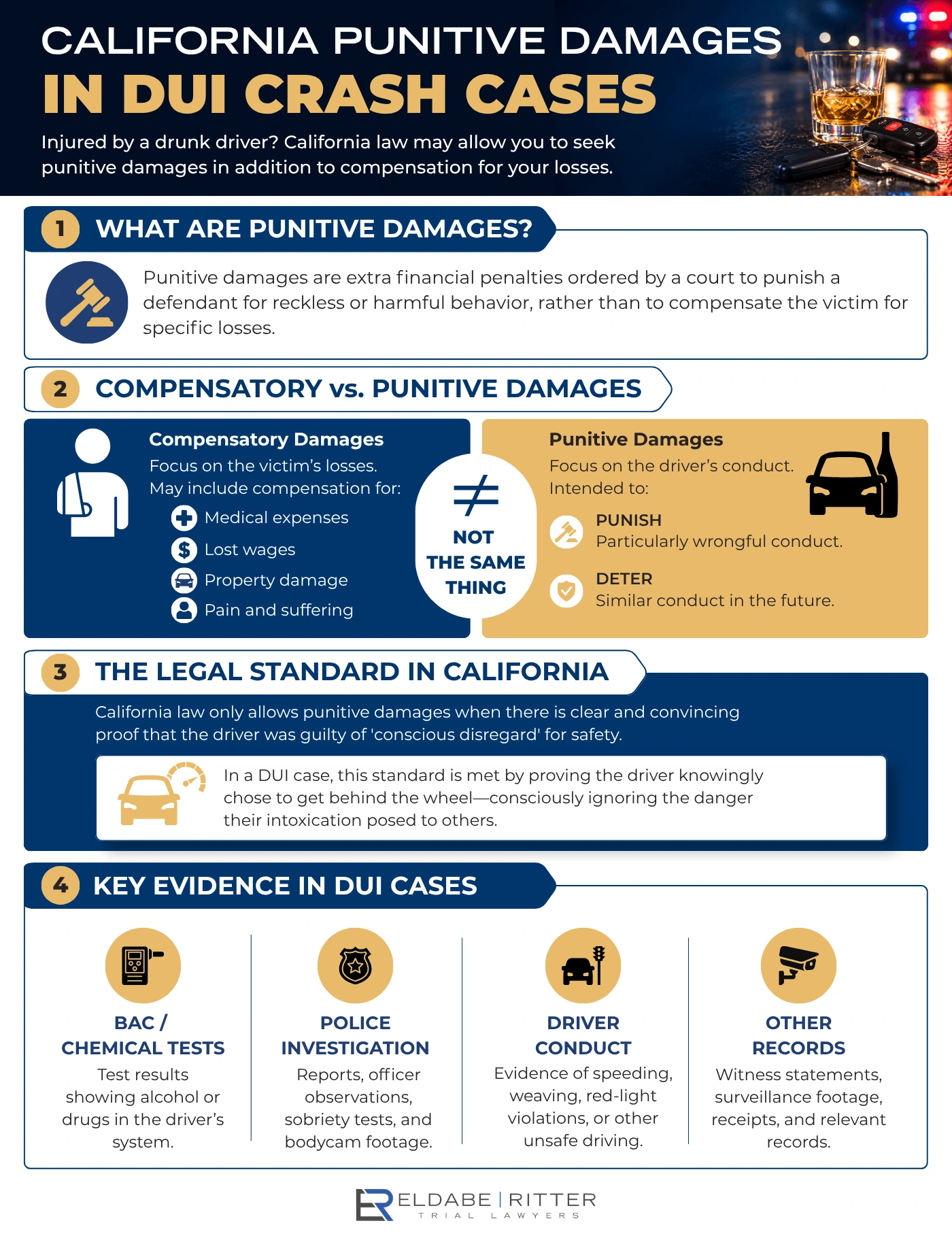
Punitive damages are different from economic and non-economic damages. While those damages compensate the injured victim for their losses, punitive damages are additional damages awarded to the victim based on the drunk driver’s conduct. Their purpose is to punish particularly wrongful behavior and deter similar conduct.
Under California Civil Code § 3294, punitive damages may be available when the evidence meets California’s required legal standard. In a DUI case, evidence that the driver knowingly chose to drive despite the danger their intoxication posed to others may support a punitive damages claim, but these damages are not automatic simply because alcohol was involved.
Insurance Coverage Issues After a Drunk Driving Accident
Even when a drunk driver is clearly responsible for a crash, recovering full compensation can present additional challenges. Insurance coverage may be limited, and the insurer may still dispute the extent of the victim’s injuries and losses.
What If the Drunk Driver Does Not Have Enough Insurance?
The drunk driver’s liability insurance is typically an important source of compensation after a DUI crash, but the policy may not provide enough coverage for all of the victim’s losses. When coverage is limited, the injured person’s own insurance may provide an additional source of recovery in some cases.
Which insurance applies—and how much coverage is available—can depend on several factors:
- Drunk driver’s policy limits: The at-fault driver’s liability insurance only pays up to the available policy limits. Those limits may not be enough when a crash causes serious injuries, extensive medical treatment, or other significant losses.
- Multiple injured victims: If several people are injured in the same crash, they may be seeking compensation from the same liability policy, making the available coverage especially important.
- Victim’s UM/UIM coverage: If the drunk driver has no insurance, does not have enough liability coverage, or cannot be identified after a hit-and-run, the injured person’s own uninsured/underinsured motorist (UM/UIM) coverage may provide another source of compensation, depending on the policy and circumstances.
Can Insurance Companies Still Dispute a DUI Accident Claim?
Even when a driver’s intoxication strongly supports fault, the insurance company may still dispute how much of the victim’s injuries and losses were caused by the crash and how much the claim is worth.
Common insurance company arguments may include:
- Shared fault: The injured person contributed to the collision.
- Pre-existing injuries: Some of the claimed injuries existed before the crash.
- Delayed treatment: Gaps or delays in medical care weaken the connection between the injuries and the collision.
- Unnecessary treatment: Certain medical care was excessive, unnecessary, or unrelated to the crash.
- Overstated losses: Future medical expenses, lost income, or other claimed losses are higher than the insurer believes the evidence supports.
Strong evidence of DUI can help establish fault, while thorough documentation of the victim’s injuries and losses can help counter insurance company disputes and establish the full value of the claim.
Frequently Asked Questions About Huntington Beach DUI Accidents
What should I do after being hit by a suspected drunk driver in Huntington Beach?
Knowing what to do after a DUI crash in Huntington Beach can help protect your safety and preserve important information about the collision.
- Get to safety: Move out of active traffic if you can do so safely.
- Call 911: Report the crash and any signs that the other driver may be impaired.
- Get medical attention: Have your injuries evaluated, even if they initially seem minor.
- Document the scene: If safe, photograph the vehicles, damage, roadway, and surrounding area.
- Identify witnesses: Get contact information from anyone who saw the crash or the driver’s behavior.
- Avoid confronting the driver: Keep your distance if the driver appears intoxicated or unpredictable.
- Preserve important records: Keep police, medical, insurance, and other crash-related documents.
Can I sue a drunk driver if they are convicted of DUI?
Yes. The criminal DUI case and your civil injury claim are separate. A conviction or guilty plea may provide important evidence, but you may still need to pursue a separate civil claim to recover compensation for your injuries and losses.
Do I have to wait for the criminal DUI case to end before filing my injury claim?
No. A civil injury claim can proceed separately from the criminal DUI case. Waiting for the criminal case to end can also create problems if surveillance footage disappears, witnesses become harder to locate, or a civil filing deadline approaches.
What if the drunk driver fled the scene?
Report the hit-and-run to law enforcement as soon as possible and provide any information you have about the vehicle, driver, license plate, witnesses, or direction of travel. Photos, witness statements, surveillance footage, and nearby cameras may help identify the driver.
If the driver cannot be identified or does not have adequate insurance, uninsured motorist coverage may also become important, depending on your policy and the circumstances of the crash.
How long do I have to file a DUI accident claim in California?
California generally gives an injured person two years from the date of an accident to file a personal injury lawsuit. However, different or shorter deadlines can apply in certain situations, including claims involving a government entity. Because exceptions can affect the deadline, it is important to determine which filing period applies to your case as early as possible.
Can I recover punitive damages from a drunk driver in California?
Punitive damages may be available in some DUI injury cases, but they are not automatic. The evidence must satisfy California’s legal standard for punitive damages, which focuses on the driver’s conduct rather than simply whether alcohol was involved.
A DUI Case Won’t Automatically Pay for Your Injuries
After a drunk driving accident in Huntington Beach, you may be dealing with medical treatment and insurance questions while a separate criminal investigation is already underway.
If you were injured by an impaired driver, our Huntington Beach car accident attorneys can investigate every available source of compensation while you focus on recovering. Our legal team can preserve important evidence, handle communication with the insurance companies, protect your rights throughout the claim, and evaluate whether the circumstances support punitive damages.
Contact El Dabe Ritter for a free consultation to discuss your DUI accident claim and the options available to you. There are no upfront attorney fees, and you pay no legal fee unless we recover compensation for you.
