
Broadside accidents—often called T-bone crashes—are among the most serious types of intersection collisions in Huntington Beach. Unlike many rear-end crashes, determining who caused a side-impact collision is not always straightforward. Drivers often have conflicting accounts of who had the legal right-of-way, making evidence a critical part of proving fault.
If you were injured in a broadside accident in Huntington Beach, this guide explains how California law determines fault, the evidence investigators rely on, and what you can do to protect your claim. If you have questions about your case, our Huntington Beach car accident lawyers are available to help.
How Broadside Accidents Happen at Huntington Beach Intersections
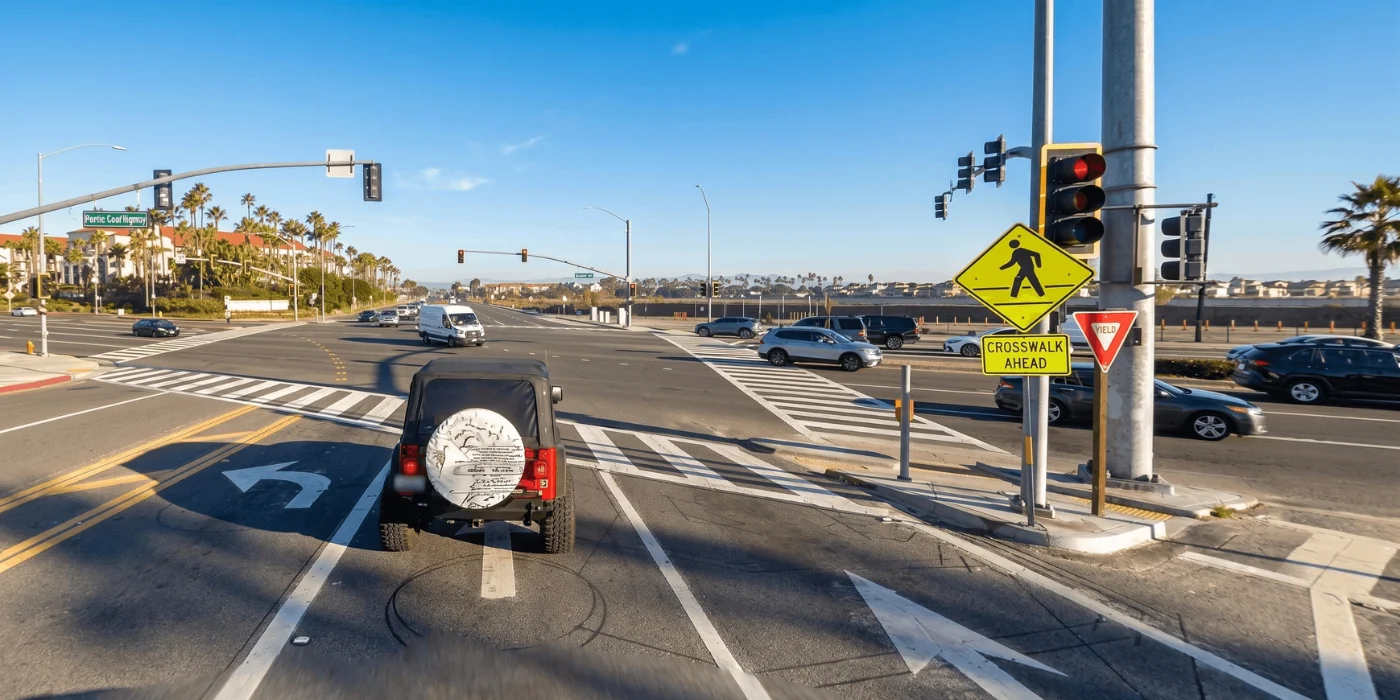
A broadside T-bone car accident in Huntington Beach occurs when the front of one vehicle strikes the side of another, usually inside or near an intersection. Most of these crashes happen in just a matter of seconds, often leaving little time for either driver to avoid the collision.
Some of the most common causes of T-bone accidents in Huntington Beach include:
- Running a Red Light: Entering an intersection after the light has turned red and striking cross-traffic with the right-of-way.
- Failing to Yield While Turning Left: Turning across oncoming traffic without enough time or space to complete the turn safely.
- Trying to Beat a Yellow Light: Accelerating through a yellow light instead of stopping before cross-traffic begins moving.
- Distracted Driving: Distracted driving accidents in Huntington Beach often happen when drivers look at a phone, navigation system, or other distraction instead of watching the road and traffic signals.
- Speeding Through Intersections: Reducing the time available to react while increasing the force of impact.
- Limited Visibility: Large vehicles, parked cars, or other obstructions blocking a driver’s view of approaching traffic.
Although these crashes can happen for many different reasons, they almost always come down to one issue: a driver failed to yield the right-of-way or violated a traffic law. Understanding where and why these collisions occur in Huntington Beach provides important context for determining fault.
Not every intersection crash is a T-bone. Learn how liability differs in a rear-end accident in Huntington Beach.
Why Broadside Accidents Are So Common in Huntington Beach
Broadside accidents are especially common at Huntington Beach’s busy, signalized intersections, where vehicles are constantly crossing paths, turning left, and reacting to changing traffic signals. Corridors such as Beach Boulevard, Warner Avenue, Main Street, and Yorktown Avenue connect to several of the most dangerous intersections in Huntington Beach, where heavy traffic and frequent turning movements increase the risk of broadside collisions.
Huntington Beach Intersection Trends & Crash Statistics
Those traffic conditions become even more challenging during peak commute hours, weekends, and the busy summer season. Popular destinations like Bella Terra, Downtown Huntington Beach, and routes connecting to Pacific Coast Highway (PCH) attract higher traffic volumes, contributing to the city’s high number of broadside collisions.
According to data from UC Berkeley’s Transportation Injury Mapping System (TIMS), 2025 collision records in Huntington Beach showed:
- Nearly half of all reported traffic collisions in Huntington Beach (49.74%) were broadside crashes, accounting for 195 of the city’s 392 reported collisions.
- Nearly 48% of those broadside crashes involved right-of-way violations.
- Another 30% involved traffic signal or sign violations.
- Those broadside crashes resulted in 3 fatalities and 624 reported injuries, highlighting the serious consequences of side-impact collisions.
These statistics show that right-of-way violations and traffic signal violations play a significant role in Huntington Beach broadside crashes. Determining which driver had the legal right-of-way is often the next step in establishing fault.
Who Is at Fault in a Huntington Beach Broadside (T-Bone) Accident?
Determining fault in a broadside accident usually comes down to one question: Which driver failed to yield the right-of-way or violated a traffic law?
Unlike many rear-end collisions, T-bone crashes often involve conflicting accounts of who entered the intersection lawfully. Investigators and insurance companies evaluate California traffic laws alongside the available evidence to determine responsibility.
Several California traffic laws commonly apply in broadside accident claims:
- Left-Turning Drivers Must Yield (CVC §21801): Drivers turning left must yield to oncoming traffic that is close enough to pose a hazard unless they have a protected green arrow.
- Drivers Must Obey Traffic Signals (CVC §21453): Entering an intersection against a steady red light is a traffic violation and may establish fault for the collision.
- Right-of-Way at Uncontrolled Intersections (CVC §21800): When an intersection is not controlled by working traffic signals, drivers must follow California’s right-of-way rules and yield when required.
- Drivers Must Stop at Stop Signs (CVC §22450): Drivers approaching a stop sign must come to a complete stop and yield to vehicles with the legal right-of-way before entering the intersection.
- Drivers Must Make Safe Turns (CVC §22107): Drivers may not turn or move right or left on a roadway until the movement can be made with reasonable safety.
What If Both Drivers Share Fault?
In some broadside accidents, both drivers may have contributed to the collision. For example, one driver may have failed to yield while the other was speeding or distracted.
California follows a pure comparative negligence system. This means you may still recover compensation even if you were partially at fault, but your recovery will be reduced by your percentage of responsibility. For example, if your damages total $50,000 and you are found 20% at fault, you could still recover $40,000.
Because every percentage point of fault can affect your compensation, gathering evidence such as traffic camera footage, witness statements, and vehicle data is often essential to building a strong claim.
Crucial Evidence to Prove Fault in a Huntington Beach Broadside Accident
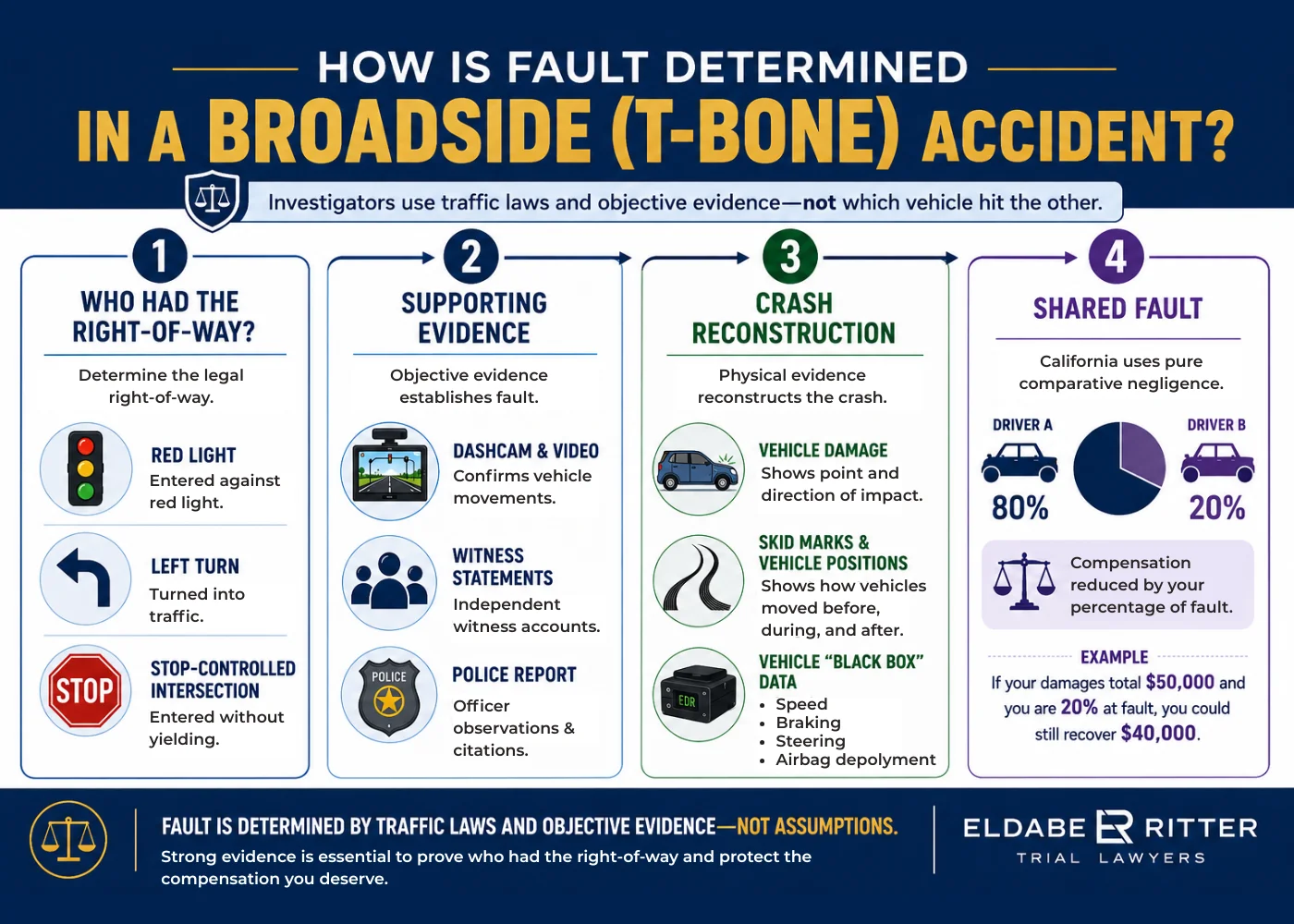
Investigators piece together multiple sources of evidence to determine how the collision occurred and which driver had the legal right-of-way. This evidence plays a critical role in determining side-impact collision fault in Huntington Beach, especially when both drivers give conflicting accounts of what happened. No single piece of evidence tells the whole story. Instead, liability is established by examining all of the available evidence together.
Traffic Signal Data & Video Footage
Traffic signal timing records and available intersection camera footage can show exactly which light was green or red at the time of the crash. Additionally, video from nearby business security cameras, dashcams, Tesla Sentry Mode, and available traffic cameras can provide valuable evidence.
Witness Statements & Police Reports
Statements from neutral bystanders—like pedestrians or other drivers who saw the light change—are extremely powerful. The official Huntington Beach Police Department report will also note physical evidence, officer observations, and any traffic tickets issued at the scene.
Vehicle Damage & Accident Reconstruction
The location of the damage, skid marks, debris, and the final resting positions of the vehicles can help investigators reconstruct how the collision occurred. Accident reconstruction experts analyze this physical evidence—along with roadway conditions and other available data—to determine how the crash likely happened, the direction each vehicle was traveling, and whether either driver attempted to brake or avoid the collision.
Vehicle “Black Box” Records
Most modern vehicles record data right before a collision occurs. This built-in computer memory shows:
- Exact speed in the 5 seconds before the crash
- Whether the driver pressed the brakes or accelerator
- Steering wheel position
- Seatbelt use and airbag deployment timing
The stronger the available evidence, the easier it becomes to establish who had the legal right-of-way and challenge inaccurate or conflicting versions of the crash. Preserving that evidence before it is lost can make a significant difference in a disputed broadside accident claim.
Common Insurance Company Defenses in Disputed T-Bone Claims
Broadside accidents often involve conflicting accounts of who had the legal right-of-way, so insurance companies frequently dispute liability before deciding how much they are willing to pay on a claim.
Rather than accepting one driver’s version of events, adjusters carefully examine the available evidence to determine side-impact collision fault in Huntington Beach and look for opportunities to argue that you were wholly or partially responsible for the crash.
Common arguments include:
- Questioning the Traffic Signal: Claiming you entered the intersection after the light changed or failed to stop for a yellow light.
- Shifting Partial Fault: Arguing you were speeding, distracted, or had enough time to brake or avoid the collision.
- Disputing the Available Evidence: Claiming there are no independent witnesses or that the evidence does not clearly establish who had the right-of-way.
- Minimizing the Police Report: Arguing that because the responding officer did not witness the crash, the report alone does not determine fault.
Because these arguments often rely on conflicting accounts, objective evidence—such as traffic camera footage, witness statements, signal timing records, and vehicle data—is frequently the strongest way to establish liability after a Huntington Beach broadside accident.
What Compensation Can You Recover After a T-Bone Crash?
Because there is less space between a vehicle’s side doors and its occupants than at the front or rear of the vehicle, broadside crashes frequently cause serious injuries, including concussions, neck and back injuries, broken ribs, and joint damage. If another driver’s negligence caused the collision, you may be entitled to compensation for losses such as:
- Medical Bills: Coverage for ambulance rides, emergency room care, surgeries, physical therapy, medications, and future medical visits.
- Lost Income: Payment for time missed from work during your recovery, as well as reduced future earning capacity if your injuries limit what you can do.
- Vehicle Repair or Replacement: The full cost to repair your car or its fair market value if it was totaled.
- Pain & Suffering: Financial recovery for physical pain, emotional stress, anxiety after the crash, and disruption to your daily life.
If you were injured in a T-bone car accident in Huntington Beach, the value of your claim will depend on the severity of your injuries, the available evidence, and the extent of your financial and personal losses.
Frequently Asked Questions About Huntington Beach Broadside Accidents
Is the driver who hit the side of the other car always at fault?
No. The driver who hit the side of the other car is not automatically to blame. If a driver turned left illegally in front of oncoming traffic or ran a red light, they are responsible for causing the crash—no matter which car’s bumper touched first.
Who is at fault if both drivers claim they had the green light?
When drivers disagree, the case comes down to neutral evidence. Traffic camera video, signal timing records, vehicle computer data, and witness accounts are used to establish who legally had the right-of-way.
Can I recover compensation after a T-bone car accident in Huntington Beach if I was partially at fault?
Yes. Under California law, you can still recover compensation even if you were partly to blame. Your payout will simply be reduced by your percentage of fault. For example, if you had $100,000 in damages but were 10% at fault, you would receive $90,000.
Does a traffic ticket prove fault after a broadside accident?
A traffic citation issued to the other driver may help support your claim, but it does not automatically establish liability. Insurance companies and courts consider many factors, including witness statements, surveillance footage, police reports, and other evidence when determining fault after a broadside accident.
Can I still prove fault if there were no witnesses?
You can still pursue a claim after a broadside accident even if no one witnessed the crash. Investigators may rely on traffic signal records, surveillance footage, dashcam video, vehicle damage, skid marks, and event data recorder (black box) information to determine how the collision occurred and who had the right-of-way.
Can I file a claim if the other driver says I ran the red light?
Yes. It is common for drivers involved in broadside accidents to give conflicting accounts of what happened. Liability is determined by the available evidence—not simply by one driver’s statement. Traffic signal records, surveillance footage, witness testimony, and accident reconstruction may all help establish who had the legal right-of-way.
How long do I have to file a broadside accident lawsuit in California?
In most cases, California gives you two years from the date of the accident to file a personal injury lawsuit. However, shorter deadlines may apply if a government entity is involved, such as a crash caused by a dangerous roadway condition or a government vehicle. Because important evidence can disappear quickly, it is best to speak with a Huntington Beach car accident lawyer as soon as possible to protect your rights.
How is fault determined after a broadside accident in Huntington Beach?
Fault is determined by examining the available evidence alongside California’s right-of-way laws. Investigators may review traffic signal records, surveillance footage, witness statements, police reports, vehicle damage, accident reconstruction, and electronic vehicle data to determine which driver caused the collision.
Injured in a Huntington Beach T-Bone Crash? Fight Back Against Disputed Fault.
Because liability in a side-impact collision is often disputed, speaking with an experienced Huntington Beach car accident attorney as early as possible can help preserve critical evidence before it disappears.
At El Dabe Ritter Trial Lawyers, we move quickly to protect your claim by:
- Conducting a thorough investigation before evidence is lost.
- Obtaining traffic camera footage, surveillance video, and black box data whenever available.
- Interviewing witnesses and working with accident reconstruction experts when liability is disputed.
- Handling all communication with the insurance company so you don’t have to.
- Aggressively negotiating for the full compensation you deserve and taking your case to trial if a fair settlement cannot be reached.
With more than 60 years of combined experience, over $500 million recovered for injured clients, and no fee unless we win, our trial lawyers have the experience and resources to stand up to insurance companies on your behalf. Contact us today for a free consultation and let us help you protect your rights while you focus on your recovery.
Injured in a car accident in Huntington Beach?
Our Huntington Beach car accident attorneys offer a free consultation — no fees unless we win.
Talk to a Huntington Beach car accident lawyer → OR CALL 714-536-9366