
Rear-end collisions are one of the most common crashes on Huntington Beach roads, but determining who is at fault isn’t always as straightforward as it may seem. Although many rear-end collisions may point to negligence by the following driver, fault ultimately depends on the facts and evidence.
If you were recently involved in a rear-end accident Huntington Beach roads frequently see, understanding how fault is determined can help you protect your rights and make informed decisions about your claim. An experienced Huntington Beach car accident lawyer can also explain how these legal principles apply to your specific situation.
How Rear-End Crashes Happen in Huntington Beach
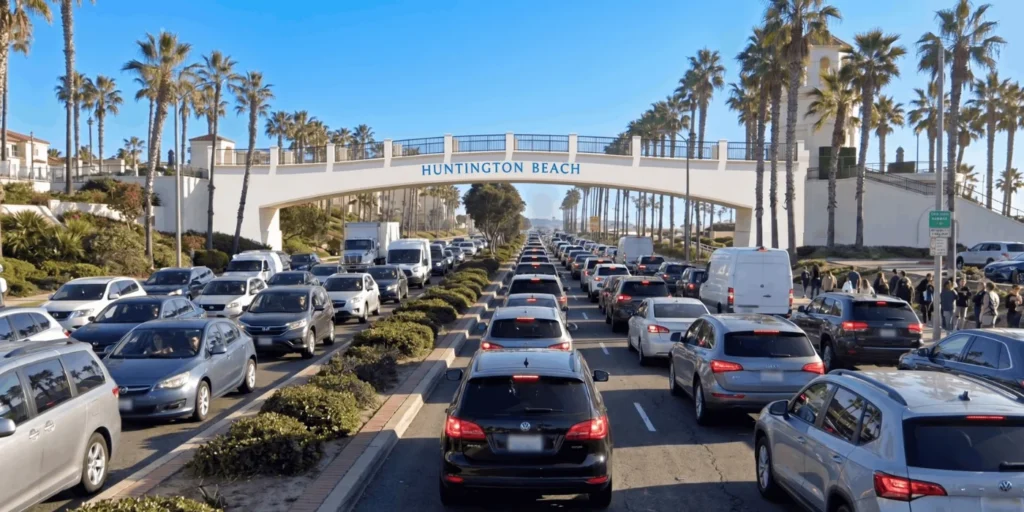
This type of accident is common on Huntington Beach roads, where changing traffic patterns, busy intersections, and seasonal congestion can cause vehicles to slow or stop with little warning. While following too closely is often a primary factor, many crashes result from a combination of driver behavior, traffic conditions, and roadway design.
Crash Statistics & Trends in Huntington Beach
According to SWITRS collision data, rear-end impacts made up 35.46% of all reported traffic collisions in Huntington Beach in 2025. Out of 392 total car accidents across the city, 139 involved a rear-end collision, causing over 200 injuries.
The data also shows which factors contributed most often to rear-end crashes in Huntington Beach:
- Unsafe Speed: Contributed to 86 rear-end crashes (61.87%).
- Driving Under the Influence (DUI): Contributed to 16 rear-end crashes (11.51%).
- Following Too Closely: Contributed to 15 rear-end crashes (10.79%).
Excessive speed can increase the force and severity of a rear-end collision. Learn more about unsafe speed accidents in Huntington Beach.
Traffic Conditions That Contribute to Rear-End Collisions
Rear-end crashes are especially common when traffic speeds change unexpectedly. Weekends, holidays, and the busy summer season can bring heavier traffic to Huntington Beach, increasing the likelihood of sudden slowdowns and frequent braking.
Several characteristics of Huntington Beach traffic can increase that risk, including:
- Stop-and-go traffic: Weekend and summer beach traffic can create frequent slowdowns and sudden changes in traffic speed. A rear-end crash on PCH in Huntington Beach may occur when drivers fail to adjust their speed or following distance in time.
- Heavy congestion: Beach Boulevard has frequent traffic signals, shopping centers, and turning vehicles that can create repeated stopping and changes in traffic flow.
- Commuter traffic: Warner Avenue and Goldenwest Street can see vehicles traveling closely together during morning and evening rush hours, increasing the importance of maintaining a safe following distance.
- Downtown traffic: Main Street can involve frequent pedestrian crosswalks, parking activity, and vehicles entering or leaving curbside spaces, creating additional stopping and turning conflicts.
- Reduced visibility and road conditions: Marine layer fog, sun glare, and wet roads can make it harder to see slowing traffic or increase the distance needed to stop safely.
Why the Rear Driver Isn’t Always at Fault Under California Law
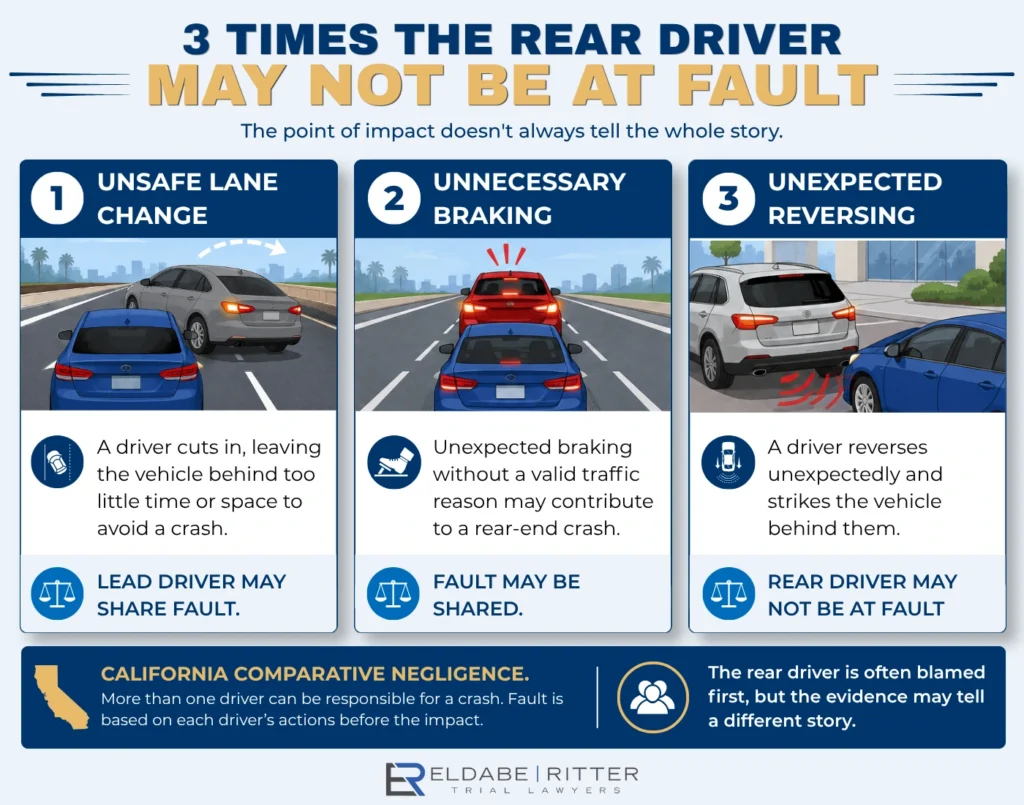
Rear-end crashes are often associated with fault on the part of the trailing driver, but the point of impact alone does not determine liability. California law considers the conduct of each driver and the circumstances leading up to the collision.
When the Rear Driver is Typically at Fault
Drivers are expected to leave enough space to react safely when traffic slows or stops. Under California Vehicle Code § 21703, drivers must maintain a safe following distance based on factors such as speed, traffic, and roadway conditions.
Following too closely is one of the most common reasons a rear driver may be at fault, but it is not the only factor. Other driving behaviors can also contribute to a rear-end crash, including:
- Following too closely: Leaving too little space to stop safely when the vehicle ahead slows or stops.
- Driving too fast for conditions: Traveling at a speed that makes it difficult to stop for congestion, changing weather, or other roadway conditions.
- Distracted driving: Looking at a phone, navigation system, or another distraction while driving instead of noticing slowing or stopped traffic.
- Impaired driving: Alcohol or drugs can reduce reaction time, judgment, and the ability to brake safely.
- Failing to react to normal traffic: A driver does not stop in time when the vehicle ahead brakes for a red light, pedestrian crossing, congestion, or another legitimate reason.
When the Rear Driver May Not Be Fully at Fault
Not every rear-end crash begins with a mistake by the trailing driver. Fault in a rear-end collision in Huntington Beach may change when the lead driver—or another vehicle—creates a hazard that gives the driver behind little opportunity to avoid a crash.
Examples include:
- Unsafe lane changes: Under California Vehicle Code § 22107, an unsafe lane change that leaves the following driver little time to react may contribute to a rear-end crash.
- Sudden or unnecessary braking: Under California Vehicle Code § 22109, suddenly stopping or slowing without appropriate warning may contribute to a rear-end crash.
- Brake checking: Intentionally braking hard to intimidate or provoke the driver behind.
- Reversing: Unexpectedly backing into the vehicle behind.
- Malfunctioning brake lights: Failing brake lights may leave the following driver without adequate warning.
- Chain-reaction collisions: A vehicle may be pushed into the car ahead after being struck from behind.
These situations show why determining fault requires looking at what each driver did before the collision, not simply which vehicle was struck from behind.
The circumstances that determine fault in a rear-end crash can also matter in other types of collisions. For more on how right-of-way and driver actions can affect broadside and T-bone accidents, see our related guide.
California Comparative Negligence
Sometimes, the evidence shows that both drivers contributed to the crash. California’s pure comparative negligence system allows responsibility to be divided based on each person’s actions.
For example, a rear driver may share fault for following too closely while the lead driver also bears responsibility for making an unsafe maneuver. Any compensation you recover is reduced according to your percentage of fault.
Understanding who may be responsible is only one part of building a claim. The steps you take after the crash can help preserve the evidence needed to establish what happened.
What to Do Immediately After a Rear-End Accident in Huntington Beach
The moments after a rear-end collision can be stressful, but the steps you take may affect both your health and your injury claim. Your priority should always be safety, followed by preserving evidence that can help establish what happened.
- Check for injuries and call 911. If anyone is injured, request emergency medical assistance and report the accident to the Huntington Beach Police Department.
- Move to a safe location if possible. If the vehicles are drivable, move them out of traffic to reduce the risk of another collision and keep the scene as safe as possible.
- Exchange information with the other driver. Collect names, contact information, driver’s license numbers, insurance information, and vehicle details before leaving the scene.
- Photograph the scene. Take clear photos of vehicle damage, the position of the vehicles, skid marks, traffic signals, road conditions, and any visible injuries.
- Speak with witnesses. If anyone saw the collision, ask for their name and contact information before they leave, as their account may help clarify how the crash occurred.
- Seek prompt medical treatment. Even if you feel fine, injuries such as whiplash or concussions may not appear immediately. Early medical records also help document the connection between the crash and your injuries.
- Be careful when speaking with insurance companies. Report the accident promptly, but avoid guessing about fault or providing a recorded statement until you understand your legal rights.
Why Immediate Medical Care Matters for Your Claim
Rear-end impacts often cause soft-tissue damage, whiplash, or concussions that basic X-rays miss. Insurance companies use delays in treatment to argue your injuries are minor or pre-existing. Getting an immediate specialist evaluation—like an MRI or CT scan—creates concrete medical proof linking your injuries directly to the crash.
Essential Evidence That Can Strengthen Your Claim
When fault is disputed after a rear-end accident in Huntington Beach, what can be proven may matter more than what either driver says happened. Preserving evidence early can help establish the events leading up to the collision and challenge attempts to shift blame.
The following types of evidence can help strengthen your claim:
- Photos and video: Show vehicle damage, road conditions, and the crash scene, helping establish how the collision occurred.
- Witness statements: Independent accounts can help clarify what happened and resolve disputes over fault.
- Police report: May provide useful information about the crash and surrounding circumstances.
- Vehicle damage: Shows the location and severity of impact, helping explain how the vehicles collided.
- EDR data: May record speed, braking, and steering before impact, providing objective information about the crash.
- Medical records: Document your injuries and treatment, helping connect them to the collision and support your damages.
- Cell phone records: May show phone activity around the time of the crash, helping establish possible distracted driving.
Even strong evidence doesn’t always prevent disputes. Insurance companies often examine the same evidence to look for reasons to reduce or deny a claim.
Common Insurance Company Defenses
Even when liability seems straightforward, insurance companies often look for ways to reduce or deny a claim. In a rear-end collision, they may question how the crash happened, whether your injuries were caused by the accident, or whether you share some responsibility for what occurred. Understanding these common defenses can help you prepare for the claims process and recognize why evidence is so important.
Assuming the Rear Driver Is Automatically at Fault
An insurer may initially place responsibility on the trailing driver simply because of where the vehicles made contact. But the point of impact alone does not establish fault. Evidence showing what each driver did before the crash may challenge that assumption.
Arguing the Lead Driver Had a Legitimate Reason to Stop
Adjusters may argue that the lead driver had a legitimate reason to brake and that the rear driver failed to maintain a safe following distance. In disputed cases, witness statements, dashcam footage, and vehicle data can help determine whether the stop was reasonable.
Arguing the Impact Was Too Minor to Cause Injury
Low-speed collisions can still result in injuries such as whiplash, soft-tissue damage, or concussions. Because modern vehicles are designed to absorb impact, limited vehicle damage does not necessarily reflect the severity of a person’s injuries.
Blaming Pre-Existing Medical Conditions
It’s common for insurers to review a person’s medical history and argue that neck pain, back pain, or other symptoms existed before the collision. Prompt medical treatment and thorough medical records can help distinguish new injuries from pre-existing conditions.
Questioning Delayed Symptoms or Treatment
Not every injury causes immediate pain. Symptoms from whiplash, concussions, and other soft-tissue injuries may take hours or even days to appear. Delaying medical treatment may allow the insurance company to argue that your injuries were unrelated to the crash or were less serious than claimed.
What Compensation May Be Available?
Compensation after a rear-end crash may account for both the financial losses caused by the collision and its impact on your daily life. Depending on the severity of your injuries, those losses can extend beyond immediate medical bills to include missed work, ongoing treatment, and long-term limitations.
Compensation may include:
- Medical expenses, including future medical treatment
- Lost wages and reduced earning capacity
- Property damage to your vehicle
- Pain and suffering
- Emotional distress
- Permanent disability or disfigurement, when applicable
Some losses may not be fully known right away, particularly when an injury requires ongoing treatment or affects your ability to work. Considering both current and future losses can help ensure that a settlement reflects the full impact of the accident.
How Much Is a Rear-End Collision Claim Worth in Huntington Beach?
Every rear-end accident is different, so there is no standard settlement amount for a Huntington Beach claim. The value depends on factors such as the severity of your injuries, the treatment required, how the injuries affect your daily life and ability to work, and the strength of the evidence supporting your claim.
Future medical needs can also play an important role. If your doctors anticipate physical therapy, pain management, injections, surgery, rehabilitation, or other ongoing care, those expected costs should be considered when evaluating a settlement. Once a claim is resolved and a release is signed, you generally cannot seek additional compensation from the same party for expenses that arise later from the same claim.
Understanding both your current losses and expected future needs can help you evaluate the full value of your rear-end accident claim.
Managing a Rear-End Accident Claim While You Recover
Insurance companies have their own process for investigating and evaluating rear-end accident claims. A Huntington Beach car accident lawyer can protect your rights throughout that process, help you make informed decisions, and pursue the full value of your claim.
Our legal team can help by:
- Handling the insurance claim: Managing communication, paperwork, deadlines, and negotiations with the insurance company.
- Evaluating settlement offers: Helping you understand whether an insurer’s offer fairly accounts for the losses caused by your injuries.
- Taking legal action when necessary: If a fair resolution cannot be reached, an attorney can determine whether filing a lawsuit is appropriate and represent you through the litigation process.
Having legal representation also means you do not have to navigate each stage of the claims process on your own.
Frequently Asked Questions About Rear-End Accidents in Huntington Beach
Is the rear driver always at fault in a Huntington Beach rear-end accident?
No, although the rear driver is often responsible, California law does not determine fault based on the point of impact alone. An unsafe lane change, unnecessary braking, reversing, or another driver’s actions may affect how responsibility is assigned.
Can I recover compensation if I was partially at fault for a rear-end accident?
Yes. California’s pure comparative negligence system allows injured drivers in Huntington Beach to recover compensation even when they are partially at fault for a rear-end accident. The amount you can recover is reduced by your percentage of responsibility.
How is fault determined in a multi-vehicle rear-end crash?
Fault in a multi-vehicle rear-end crash can depend on how the sequence of impacts occurred. Evidence may be needed to determine which driver caused the initial collision, whether a vehicle was pushed into another, and whether multiple drivers contributed to the crash.
What if the other driver stopped suddenly in Huntington Beach traffic?
A sudden stop does not automatically make the rear driver responsible. If the lead driver stopped without a legitimate traffic reason, changed lanes abruptly, or otherwise created an unsafe situation, their actions may affect how fault is divided.
Should I see a doctor after a rear-end accident if I feel okay?
Yes. Some injuries, including whiplash and concussions, may not cause symptoms immediately. Prompt medical evaluation can protect your health and create documentation connecting your injuries to the accident.
How long do I have to file a rear-end accident claim in Huntington Beach?
For most personal injury claims in California, you have two years from the date of the crash to file a lawsuit. However, if your accident involved a public vehicle (such as a City of Huntington Beach maintenance truck, an OCTA bus, or a police car) or a dangerous municipal road condition, California Government Code § 911.2 strictly requires you to file a formal administrative claim within 6 months of the crash date. Missing this 6-month window usually forfeits your right to recover compensation entirely.
Injured in a Huntington Beach Rear-End Crash? Get the Compensation You Deserve.
Every collision deserves a careful investigation. Our Huntington Beach car accident lawyers evaluate the evidence to determine exactly what happened, protect you from unfair blame, and help you seek the full compensation you deserve.
Contact El Dabe Ritter Trial Lawyers today to schedule your free, no-obligation consultation. We work on a contingency fee basis, so you pay nothing unless we win compensation for you.
Injured in a car accident in Huntington Beach?
Our Huntington Beach car accident attorneys offer a free consultation — no fees unless we win.
Talk to a Huntington Beach car accident lawyer → OR CALL 714-536-9366