
After an accident, it might be clear who was at fault. Still, the insurance company may not accept that the crash actually caused your injuries.
Sometimes, the main question becomes what effect the accident had on your body. The defense might say the impact was too small to cause your injuries or claim that your condition existed before the accident or was caused by something else.
When these issues matter, attorneys often bring in a biomechanical expert.
A biomechanical expert examines how forces impact the human body. In an injury case, their analysis helps attorneys see how a collision moved someone’s body, what forces were involved, and if the mechanics match the injuries being claimed.
However, biomechanics is just one piece of proving what caused an injury. Medical records, accident reconstruction, witness statements, and other evidence are also important.
In this article, we explain what biomechanical experts do, when attorneys might use them, and how their opinions can impact a personal injury case.
What Is a Biomechanical Expert?
Biomechanics is the study of how forces and movement affect the human body. It combines principles from fields such as engineering, physics, anatomy, and human movement.
In a personal injury case, a biomechanical expert looks at how a person’s body moved during the accident and how forces affected different parts of the body.
For example, in a rear-end collision, an accident reconstruction expert might examine how fast the vehicles were going, the direction of the impact, and how the cars moved after the crash.
On the other hand, a biomechanical expert asks a related but different question: What did those forces do to the person inside the vehicle?
Medical experts play a different role. A doctor can diagnose injuries, review medical images, discuss treatment, and give opinions on what caused a patient’s condition.
These fields can overlap, but they are not the same.
Why Are Biomechanical Experts Used in Personal Injury Cases?
Biomechanical experts are especially helpful when there is a disagreement about what caused an injury.
An insurance company or defense lawyer might admit there was a crash but argue that the impact could not have caused the injuries being claimed.
For example, the defense may argue that:
- The collision was too minor to cause the injury.
- The person’s body could not have moved as claimed.
- The forces involved were inconsistent with the alleged injury.
- A preexisting condition better explains the person’s symptoms.
A biomechanical expert can review the evidence to assess these arguments.
This is important because proving negligence is not enough to get compensation. The injured person must also show a link between the defendant’s actions and the harm suffered.
What Does a Biomechanical Expert Analyze?
A biomechanical analysis depends on the facts of the case. There is no one-size-fits-all test that applies to every accident.
Instead, an expert may review several sources of evidence to understand the collision and the forces at play.
These can include:
- Vehicle photographs
- Vehicle damage and repair records
- Crash direction and severity
- Accident reconstruction data
- Seat belt use
- Airbag deployment
- The person’s position inside the vehicle
- Photos or video of the collision
- Medical records and imaging
- Deposition testimony
- Witness statements
The expert then uses physics and biomechanics to determine how the person likely moved during the crash and how forces moved through their body.
In other words, the analysis looks at more than just how damaged the car was.
A more helpful question is often, “What happened to the person inside?”
Low-Speed Collisions and the “Minor Impact” Defense
Vehicle damage often becomes a major point of dispute in rear-end and other lower-speed collisions.
The defense may point to photographs showing limited exterior damage and argue the collision was not serious enough to cause the claimed injuries.
However, vehicle damage and what caused the injury are two different things.
A biomechanical analysis examines how the crash happened, how the person moved, and what forces were involved, rather than relying only on photos of the car.
Still, biomechanical evidence does not replace medical evidence. The type of injury, the person’s medical history, diagnostic imaging, treatment records, and medical opinions all matter when determining what caused a particular condition.
Biomechanical Experts vs. Accident Reconstruction Experts
Accident reconstruction and biomechanics often go hand in hand, but they answer different questions.
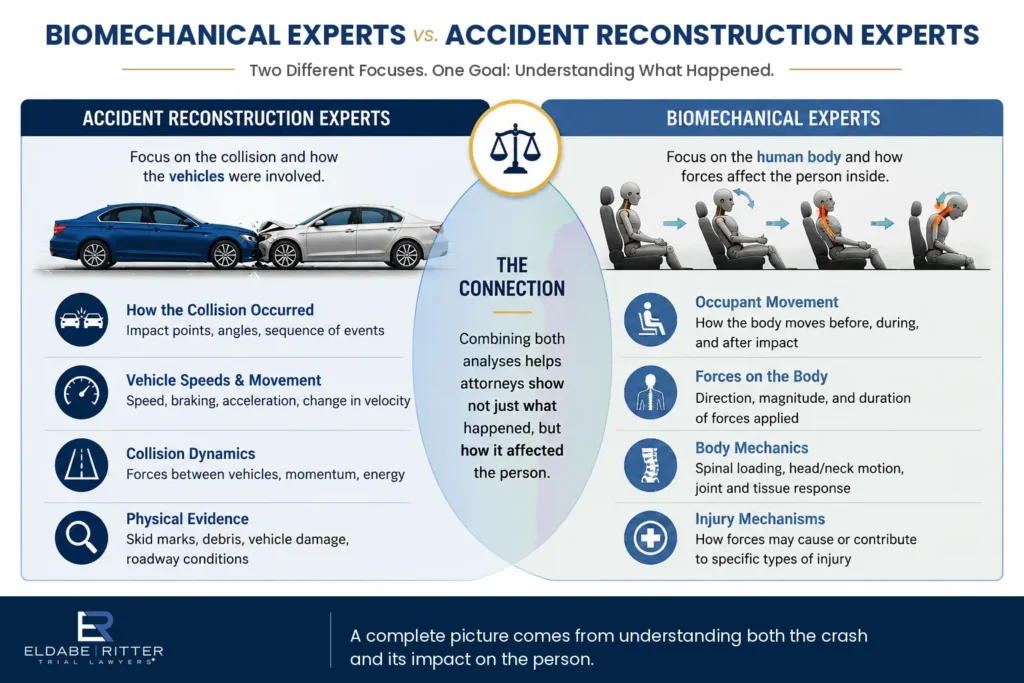
An accident reconstruction expert generally focuses on the collision itself. The expert may analyze vehicle speeds, braking, impact angles, points of impact, vehicle movement, and physical evidence from the scene.
A biomechanical expert focuses more closely on what those forces did to the person involved.
For example, accident reconstruction might show how quickly a car slowed down during a crash. A biomechanical expert then uses that information to figure out how the person moved and what forces they felt.
In a complex case, attorneys may use both kinds of experts. They can compare their findings with medical evidence to develop a more complete picture of what happened.
Can a Biomechanical Expert Determine What Caused an Injury?
It’s important to make a distinction here.
A biomechanical expert can explain collision forces, body movement, and whether the way an injury happened matches the claimed injuries. But that doesn’t mean they can diagnose medical conditions or give all types of medical opinions.
California courts examine an expert’s qualifications as well as the basis for the opinions the expert intends to give. An expert opinion must concern a subject that requires specialized knowledge and must rest on information experts can reasonably rely on.
Courts also look at how the expert connects the facts to their conclusions. If an opinion is based on guesses or unsupported ideas, it can be challenged.
This difference is important in injury cases. A biomechanical expert knows a lot about physics and movement, while a doctor is trained to diagnose injuries and assess a patient’s condition.
So, attorneys need to consider not just what an expert says, but also whether the expert is qualified to give that opinion.
How Attorneys Challenge Biomechanical Expert Testimony
Just because someone is an expert does not mean their conclusion is always right.
Attorneys can examine the information, assumptions, and methods the expert used to reach that conclusion.
For example, a biomechanical opinion might rely on guesses about how fast the car was going, where the person was sitting, the direction of the crash, or the forces involved. If any of these guesses are wrong, it can affect the expert’s opinion.
Attorneys may therefore examine:
- The expert’s education, training, and experience
- The evidence the expert reviewed
- Assumptions about vehicle speed or impact severity
- Assumptions about the occupant’s position
- The scientific studies or data relied upon
- Whether important evidence was overlooked
- Whether the methodology fits the facts of the accident
- Whether the expert is offering opinions outside their field
Attorneys can explore these issues during an expert’s deposition and, if the case goes to trial, through cross-examination.
California courts also act as gatekeepers when expert testimony is challenged. The judge does not decide which expert is more convincing, but checks whether the opinion is well supported and based on solid reasoning.
When Might a Personal Injury Case Need a Biomechanical Expert?
Not all personal injury cases need a biomechanical expert.
In many cases, medical records, doctors, witness statements, photos, and other evidence are enough to show what happened and link the accident to the injuries.
However, biomechanical analysis may become useful when:
- The defense strongly disputes injury causation.
- The vehicle has limited visible damage.
- The injury mechanics are unusual or complex.
- There were multiple impacts.
- The person’s movement during the accident is disputed.
- Accident reconstruction evidence raises questions about injury mechanics.
- The opposing side has retained its own biomechanical expert.
Attorneys need to consider whether expert testimony will really help with the issues being argued in the case.
Bringing in more experts does not always improve a case. What matters is whether an expert can help explain something important in the case.
How Biomechanical Evidence Fits Into the Larger Case
Biomechanics alone rarely explains the whole story of an injury.
Instead, attorneys often need to put together different types of evidence.
Accident reconstruction helps show how a crash happened. Biomechanics explains the forces and body movements. Medical experts and doctors address diagnosis, treatment, recovery, and the cause of the injury.
Other evidence can add detail, such as medical scans, photos, videos, car data, witness statements, and the injured person’s own story.
Together, these pieces create a clearer picture of the accident and its effects.
If the evidence does not match up, attorneys need to figure out why.
This is why choosing the right expert matters. The goal is not just to hire someone with great credentials, but to find someone whose analysis fits the facts and evidence of the case.
Building a Strong Injury Case When Causation Is Disputed
Some personal injury cases are mostly about who was at fault. Others are about what actually caused the injuries.
Even if the defendant admits causing the accident, the defense might still argue that the accident did not cause all the injuries being claimed.
These cases need a close look at all the evidence.
Depending on the issue, this might mean working with doctors, accident reconstruction experts, biomechanical experts, or other specialists. It also means knowing what each expert can and cannot do, and checking the assumptions behind different opinions.
At El Dabe Ritter Trial Lawyers, we prepare personal injury cases with these kinds of disputes in mind. When expert testimony is needed, our attorneys look at how it fits with the medical evidence, physical evidence, and the overall strategy for your case.
If you were seriously injured in an accident and the insurance company is questioning whether the crash caused your injuries, contact El Dabe Ritter Trial Lawyers for a free consultation. We can review the facts of your case, explain your options, and determine what evidence may be needed to protect your claim.
