
Traffic in Huntington Beach can slow to a crawl, and for motorcyclists, lane splitting can be a practical way to move through stopped or slow-moving traffic. Some drivers leave room for an approaching motorcycle, while others may move into the rider’s path without seeing them. If you are injured from a lane-splitting motorcycle accident in Huntington Beach, you may wonder: does lane splitting affect your claim?
Lane splitting is legal in California, and the fact that a motorcyclist was lane splitting does not, by itself, establish fault. What matters is the conduct that contributed to the crash, including whether the driver checked for the motorcycle, signaled, and made a safe lane movement. A Huntington Beach motorcycle accident lawyer can investigate those circumstances and determine who may be responsible.
How Lane-Splitting Motorcycle Accidents Happen in Huntington Beach
With coastal views and year-round riding weather, Huntington Beach offers plenty of reasons to get out on a motorcycle. The challenge comes when those scenic roads fill with beachgoers, commuters, and stop-and-go traffic.
As traffic builds, motorcyclists may split lanes to move between slower vehicles. A collision can happen when a driver changes lanes or moves into an open gap without seeing the motorcycle approaching. On PCH, beach access, parking activity, and frequent turning vehicles can make these movements more common, while the multiple lanes and commercial driveways along Beach Boulevard create additional points where vehicles may unexpectedly cross a rider’s path.
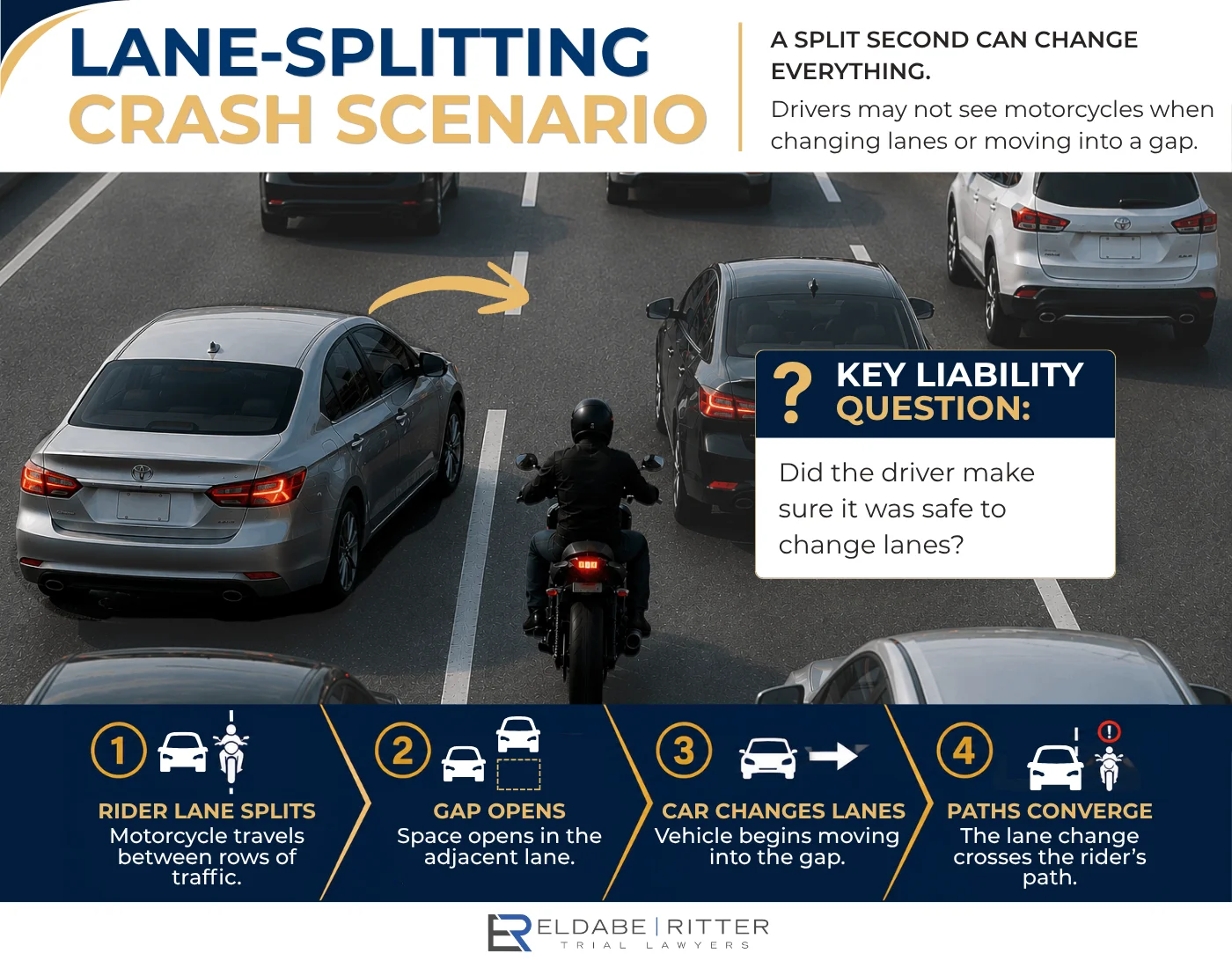
Limited visibility can make these situations even more dangerous, particularly when SUVs or trucks prevent a driver from seeing an approaching motorcycle. As HBPD Sergeant Gerrit DeJong cautioned:
“Motorcycles may be difficult to spot, so be extra careful before changing lanes; a simple double-take can make a life-saving difference. Motorcycle riders do not have the same protection as drivers and passengers do. Let’s do our part to keep each other safe out there.”
What Huntington Beach Motorcycle Crash Data Shows
Huntington Beach recorded 124 motorcycle crashes in 2024 and 2025. Several major roads appeared frequently in the crash data:
- Pacific Coast Highway — 33 crashes
- Beach Boulevard — 27 crashes
- Warner Avenue — 15 crashes
These numbers show that motorcycle crashes were concentrated along some of Huntington Beach’s major corridors. Although the data does not identify which crashes involved lane splitting, it provides useful local context about where motorcycle collisions are occurring.
Lane splitting can become especially relevant on busy freeways such as I-405, where motorcycles may encounter slow-moving traffic, merging vehicles, and frequent lane changes. For a closer look at these crashes, see our guide to motorcycle accidents on the 405 Freeway near Huntington Beach.
Is Motorcycle Lane-Splitting Legal in Huntington Beach?
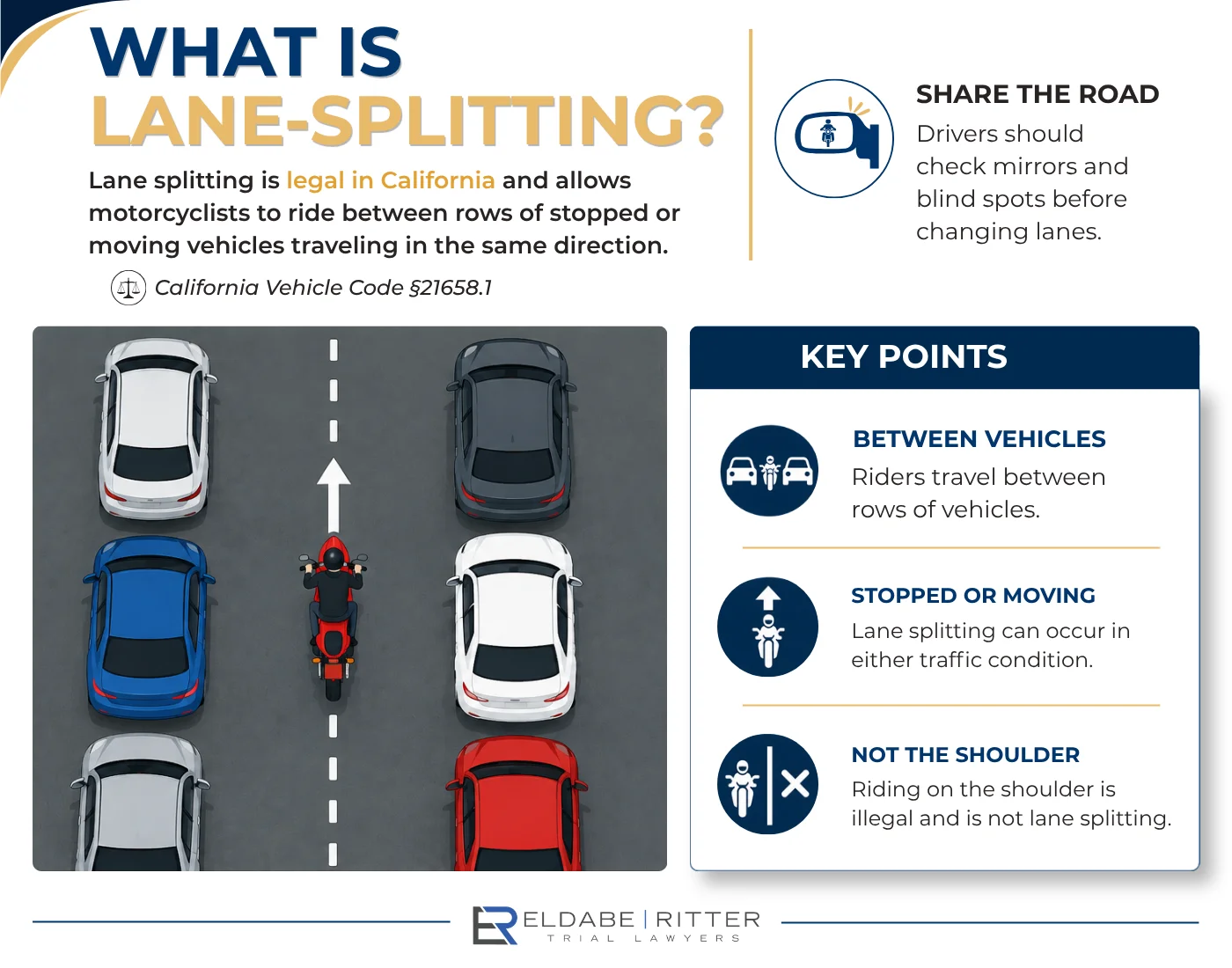
Lane splitting is legal on Huntington Beach roads, but riders must still follow California traffic laws and ride with reasonable care. California Vehicle Code §21658.1 defines lane splitting as riding a two-wheeled motorcycle between rows of stopped or moving vehicles on divided or undivided streets, roads, and highways.
The law does not restrict lane splitting to freeways, stopped traffic, or a particular pair of lanes. Riding on the shoulder, however, is illegal and is not considered lane splitting.
California does not set a separate speed limit specifically for lane splitting. Riders must still obey posted speed limits and California’s Basic Speed Law, which requires traveling at a safe speed for current conditions.
Who Is at Fault in a Lane-Splitting Motorcycle Accident?
The fact that a motorcyclist was lane splitting does not by itself determine fault. Responsibility depends on the actions of the driver, rider, or both in the moments leading up to the collision.
Several California traffic laws may be relevant when determining fault:
- CVC §22107 – Unsafe Lane Movements: A driver must make sure a turning or lane movement can be completed with reasonable safety and signal when another vehicle may be affected. In a lane-splitting accident, this can be important when a driver changes lanes or moves into a gap without signaling or checking for an approaching motorcycle.
- CVC §22517 – Opening Vehicle Doors: A vehicle door cannot be opened on the side available to moving traffic unless it is reasonably safe. This may apply when a driver or passenger opens a door into the path of a lane-splitting rider.
- CVC §22350 – Basic Speed Law: Both drivers and motorcyclists must travel at a reasonable and prudent speed for current conditions. In a lane-splitting crash, the speed of both vehicles, surrounding traffic, visibility, and roadway conditions may be considered when determining whether speed contributed to the collision.
CHP advises drivers that intentionally blocking or impeding a motorcyclist in a way that could cause harm to the rider is illegal. Separately, CVC §22400 prohibits unnecessarily driving slowly or stopping in a way that impedes the normal and reasonable movement of traffic.
Fault for a lane-splitting accident does not always fall entirely on one party; it can be divided based on each party’s contribution to the crash. For example, a driver may make an unsafe lane change while the motorcyclist is traveling too fast for the conditions. If both actions contributed to the collision, the rider’s recovery may be reduced based on their percentage of fault.
How Can Lane Splitting Affect Your Motorcycle Insurance Claim?
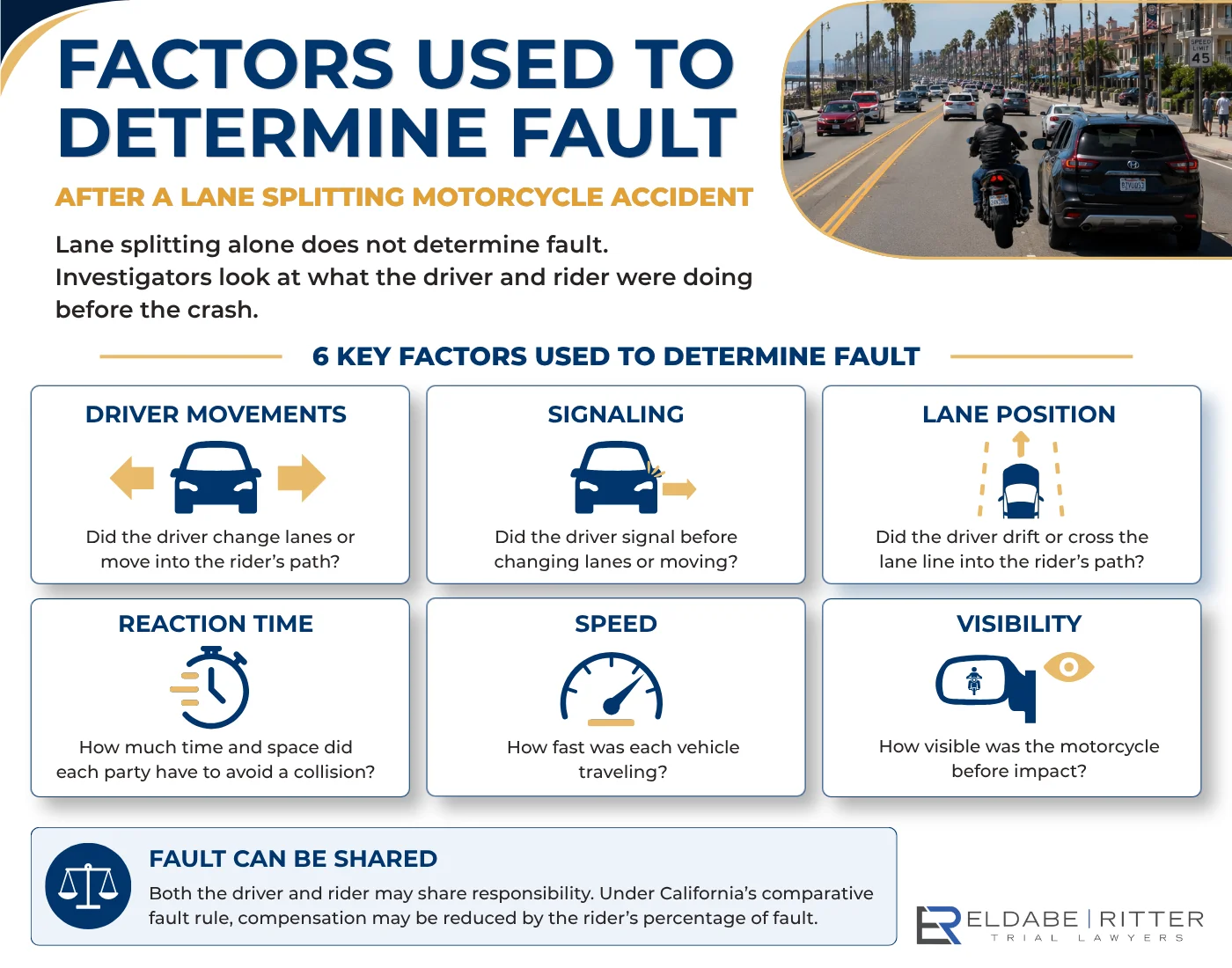
After a lane-splitting motorcycle accident in Huntington Beach, an insurance company may closely examine what both the rider and driver were doing in the moments before impact. In a motorcycle lane-splitting insurance claim, that investigation often focuses on questions such as:
- Speed: How fast were the motorcycle and driver traveling compared with surrounding traffic?
- Lane position: Was the rider actually lane splitting, or does the insurer claim the motorcycle was riding on the shoulder or making another maneuver?
- Visibility: How long was the motorcycle visible before the collision, and could the driver reasonably have seen it?
- Driver movement: Did the driver signal and check for approaching traffic before moving into the rider’s path?
- Reaction time: How much time and space did each party have to avoid the collision?
These details can shape the outcome of the liability investigation. An insurer may use them to accept fault, dispute it, or argue that the motorcyclist shares responsibility for the crash.
What Evidence Can Help Prove Fault in a Lane-Splitting Accident?
When fault is disputed in a lane-splitting accident, evidence can be critical. It can help establish the motorcycle’s position, traffic movement, and the driver’s actions before impact. Important evidence may include:
- Helmet-cam and dashcam footage: Can show lane position, traffic speed, signals, vehicle movements, and how much time the rider had to react.
- Surveillance and traffic-camera footage: Nearby cameras may have captured the motorcycle or vehicle before, during, or after the collision.
- Witness statements: Other drivers, passengers, pedestrians, or cyclists may have seen the lane change or how traffic was moving.
- Vehicle damage: The location and angle of impact can help reconstruct how the motorcycle and vehicle came together.
- Police or CHP reports: May preserve early statements, witness information, scene observations, and potential traffic violations.
- Accident reconstruction: In disputed cases, an expert may analyze physical and video evidence to evaluate speed, vehicle movements, visibility, and reaction time.
Preserve original helmet-cam or dashcam footage without editing or clipping it. The seconds before impact may help establish what each party could see and how much time they had to react.
Case Spotlight: Strong Evidence Can Challenge an Initial Fault Determination
In one of our cases, a motorcyclist was initially blamed for a collision with an 18-wheeler while lane splitting. The police report and witness testimony supported placing fault on the rider. Our attorneys at El Dabe Ritter Trial Lawyers dug deeper and uncovered evidence that told a different story.
A motorcyclist should not be blamed simply because they were lane splitting. Lane splitting alone does not establish fault, and a deeper investigation may uncover evidence showing what actually caused or contributed to the collision.
Tips for Safer Lane-Splitting
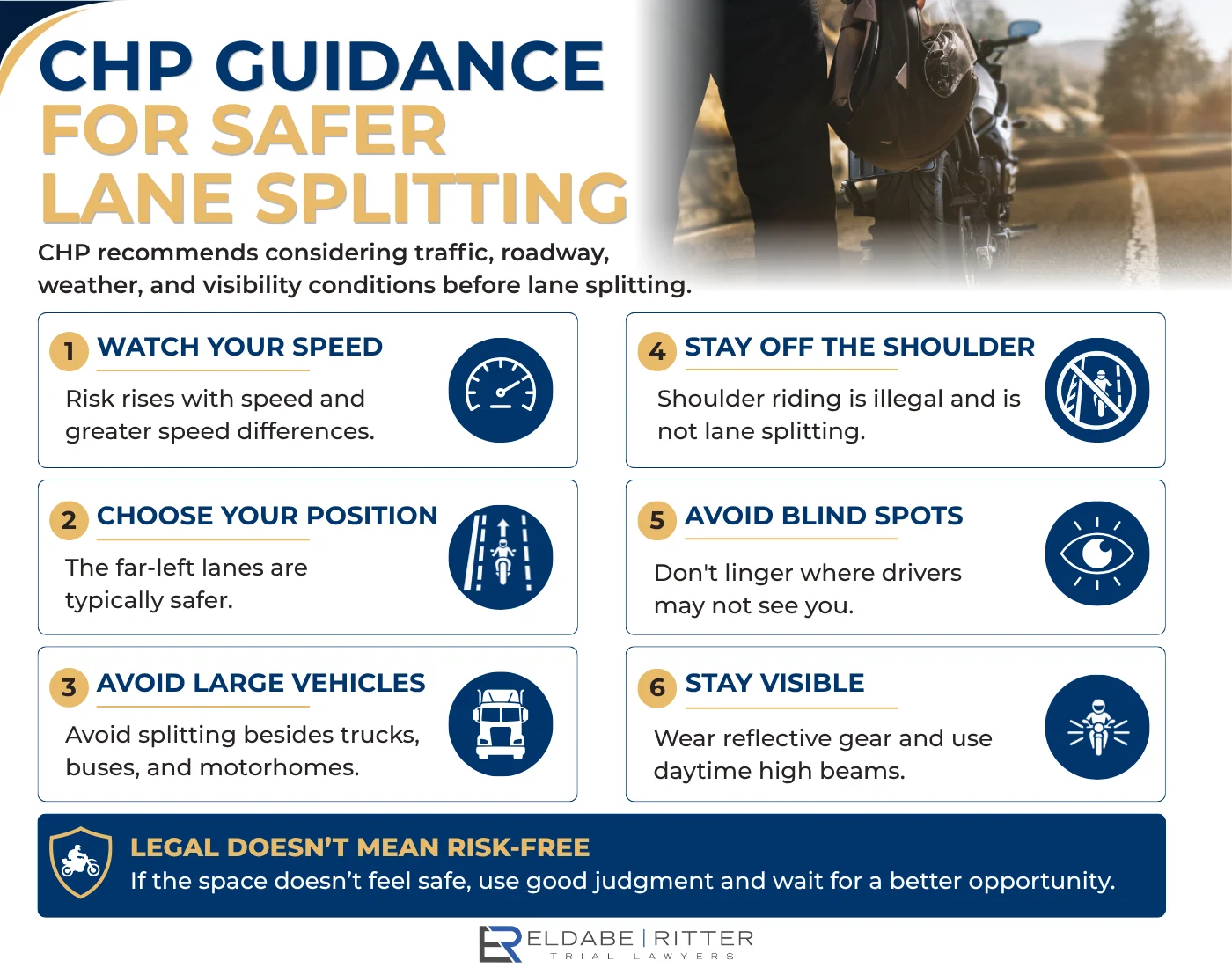
Lane splitting requires caution and may not be appropriate for inexperienced riders. CHP emphasizes that these recommendations are general safety guidance, not a guarantee against a crash or injury. Riders must ultimately use their own judgment when deciding whether to split lanes.
Key recommendations include:
- Watch your speed: Risk increases as overall speed and the speed difference between the motorcycle and surrounding traffic increase.
- Choose your position carefully: Splitting between the far-left lanes is generally considered safer than splitting between other lanes.
- Stay clear of large vehicles: Avoid splitting next to big rigs, buses, motorhomes, and other vehicles that can limit visibility and space.
- Make yourself visible: Avoid lingering in blind spots and consider bright or reflective protective gear.
- Stay off the shoulder: Shoulder riding is illegal and is not considered lane splitting.
CHP’s recommendations are intended to help reduce risk, but no set of guidelines can make lane splitting completely safe. Riders should use their judgment and recognize when it may be safer to wait for another opportunity.
What Should You Do After a Lane-Splitting Motorcycle Accident?
After a lane-splitting crash, important evidence may not be available for long. Taking the right steps early can protect your health while preserving the information needed to establish what happened.
- Get to safety and call 911: Move out of traffic if you can do so safely and report the crash to the Huntington Beach Police Department (HBPD).
- Get medical attention: Motorcycle injuries are not always immediately apparent. Seek appropriate medical care, whether at Huntington Beach Hospital or another facility equipped to evaluate your injuries.
- Document the scene: If you are able, photograph the vehicles, motorcycle damage, lanes, road conditions, your injuries, and surrounding area.
- Preserve original video: Save any helmet-cam, dashcam, or other recordings without editing the original files.
- Keep damaged gear: Preserve your helmet, riding gear, and damaged motorcycle parts rather than immediately repairing or discarding them.
- Identify witnesses and cameras: Get contact information from anyone who saw the crash and note nearby businesses or properties with cameras that may have captured it.
- Be careful about estimates: Avoid guessing about your speed, distance, or fault when speaking with an insurance adjuster.
Because video and other evidence can disappear quickly, identifying potential sources early can make a significant difference in a disputed claim.
What Compensation May Be Available After a Lane-Splitting Accident?
If another driver caused or contributed to a lane-splitting crash, an injured motorcyclist may be able to recover compensation for both the financial and personal impact of their injuries. Depending on the circumstances, damages may include:
- Medical expenses: Emergency care, hospitalization, rehabilitation, and reasonably necessary future treatment.
- Lost income: Wages lost while recovering and reduced earning capacity when injuries affect the ability to work.
- Pain and suffering: Physical pain, emotional distress, and loss of enjoyment of life.
- Property damage: Repair or replacement of the motorcycle and other damaged property.
The compensation available will depend on the rider’s injuries, financial losses, and the long-term impact of the crash.
Frequently Asked Questions About Lane-Splitting Accident Claims
Is riding on the shoulder considered lane splitting?
No. Riding on the shoulder is illegal and is not considered lane splitting. California defines lane splitting as operating a two-wheeled motorcycle between rows of stopped or moving vehicles traveling in the same direction.
What if I was lane splitting next to stopped traffic when a driver changed lanes?
Lane splitting next to stopped traffic does not automatically make you responsible for the crash. Whether the driver made a safe lane movement, whether they signaled, the rider’s speed, visibility, and the time each person had to react may all be relevant to determining fault.
Does a driver’s claim that “I didn’t see the motorcycle” mean I was at fault?
No. A driver’s statement that they did not see the motorcycle does not automatically determine liability. Evidence may show how visible the motorcycle was and whether the driver checked for approaching traffic before changing lanes or moving into the rider’s path.
What if there is no helmet-cam footage of the accident?
You can still have evidence to establish how the crash happened. Dashcam or surveillance footage, witnesses, vehicle damage, photographs, police reports, and accident reconstruction may help establish the motorcycle’s position and the movements leading up to impact.
Can Not Wearing a Helmet Affect My Lane-Splitting Accident Claim?
California law requires motorcycle riders and passengers to wear a compliant safety helmet under CVC §27803. Not wearing a helmet does not by itself mean the rider caused the crash, although it may become relevant if there is a dispute over whether helmet use affected the rider’s injuries. Learn more about claiming damages after a motorcycle crash without a helmet.
Does the police report determine who was at fault after a lane-splitting accident?
No. A police or CHP report can be important evidence, but it does not necessarily determine civil liability. Video, witness testimony, vehicle damage, physical evidence, and other information may provide a different picture of how the crash occurred.
Injured in a Lane-Splitting Motorcycle Accident in Huntington Beach?
After a lane-splitting motorcycle accident in Huntington Beach, you should not have to figure out fault, track down evidence, and deal with the insurance company on your own. A Huntington Beach motorcycle accident lawyer at El Dabe Ritter Trial Lawyers can step in quickly to uncover and preserve evidence before it disappears, investigate who was responsible, and handle the insurance company on your behalf.
Let us handle the claim while you focus on your recovery. Contact us 24/7 for a free consultation. There are no upfront fees, and you pay no attorney fees unless we win.
