
A California personal injury case can resolve in three ways. If you settle before filing a lawsuit, expect three to nine months. If you settle after filing but before trial, expect twelve to eighteen months. However, if your case goes to a jury verdict, expect eighteen months to three years.
The wide range you see online reflects these three different exit points, not three competing guesses about the same process.
Statutory deadlines shape every part of this timeline, including a strict two-year filing window and a much shorter six-month deadline for claims against government entities. Never leave these deadlines to chance.
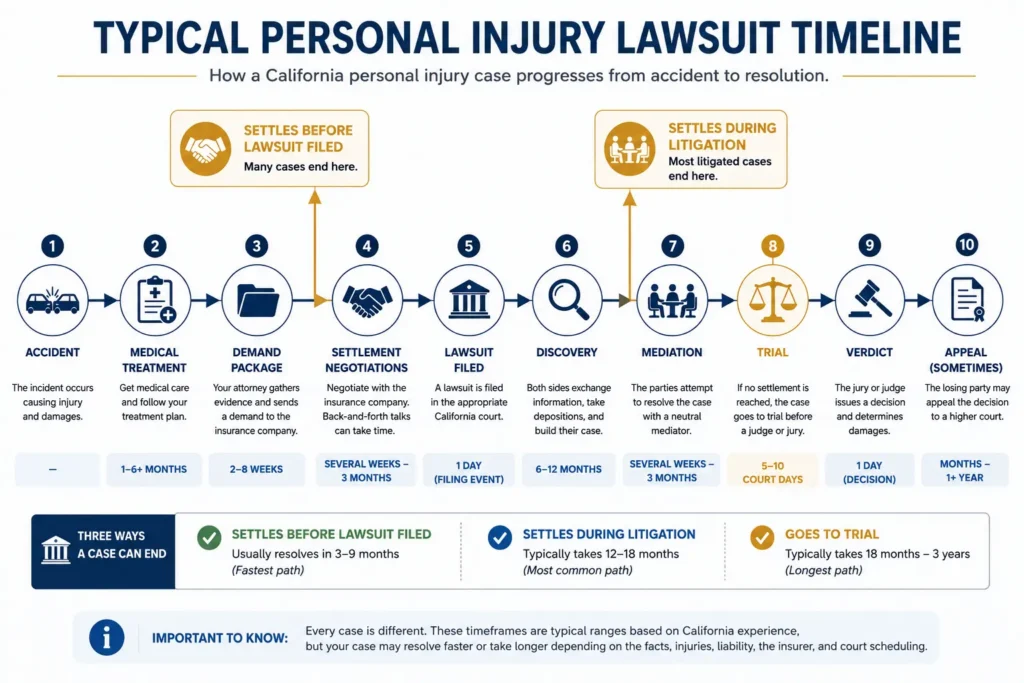
If you’ve searched this question before, you’ve probably noticed that every law firm gives a different answer. One site says three months. Another says three years. Both can be true, because they describe different outcomes, not different opinions about the same process.
This guide breaks down how long each phase of a California personal injury case typically takes. It also covers what determines whether your case resolves in months or years, and the legal deadlines that apply no matter which path you take.
| Phase | Typical Duration |
|---|---|
| Pre-Litigation Investigation | 1–6+ months |
| Settlement Negotiations | Weeks–Months |
| Lawsuit is Filed | |
| Discovery | 6–12 months |
| Mediation | Weeks–Months |
| Trial | Days–Weeks |
Important: Filing the lawsuit marks the transition from pre-litigation to litigation—it is a procedural event rather than a lengthy stage.
Why the Timeline You’ve Read Online Varies So Much
Most of the conflicting numbers you’ll find come down to one fact. A personal injury case can end at several different points, and each one has its own typical timeframe.
Some cases settle before anyone files a lawsuit. This usually happens when liability is clear, and the insurance company makes a fair offer. These cases can resolve in as little as three to nine months.
Other cases require filing a lawsuit but still settle before trial. This often happens once discovery and mediation clarify the strength of the evidence. These cases typically take twelve to eighteen months from the date of filing.
A smaller number of cases proceed all the way to trial. This happens when the insurer refuses to offer fair value even after litigation begins. These cases usually take eighteen months to three years from filing to verdict, and sometimes longer when liability is disputed, or injuries are catastrophic.
None of these numbers is wrong. They describe three different roads, and most cases never reach the third one. Understanding which road your case is on matters more than memorizing a single average.
Phase 1: Before You File — Investigation and the Demand Letter
Every personal injury case starts with investigation and treatment, not litigation. Your attorney gathers medical records, bills, and wage-loss documentation.
Your attorney also collects evidence establishing liability. Then your attorney compiles all of it into a demand package for the at-fault party’s insurance company.
Building a strong demand package typically takes a few weeks to a couple of months. It often takes longer if you’re still receiving medical treatment.
Attorneys generally wait until you reach maximum medical improvement, or at least have a clear prognosis, before sending the demand. Settling too early can undervalue a claim whose full cost isn’t yet known.
Once an insurance company receives your demand package, it must investigate your claim and handle settlement negotiations in good faith. California law doesn’t impose a one-size-fits-all deadline for responding to a demand letter, but many insurers provide an initial response within 30 to 60 days.
More complex cases may take longer, especially if the insurer needs additional information before evaluating the claim.
Recommended Reading: Factors to Consider Before Accepting a Personal Injury Settlement
Phase 2: Negotiation with the Insurance Company
Insurance adjusters rarely accept an opening demand. During personal injury settlement negotiations, it’s common for an insurance company to respond to a demand package with a lower counteroffer before meaningful negotiations begin.
A back-and-forth negotiation follows, and it can last anywhere from a few weeks to several months.
Cases with clear liability, well-documented injuries, and cooperative insurers tend to resolve quickly at this stage. Cases take longer when the insurer disputes fault or questions the severity of the injury. They also take longer when the insurer simply lowballs the claim. In these situations, your attorney often needs to apply additional pressure through further evidence or the credible threat of litigation.
This is where trial readiness starts to matter, even for cases that never see a courtroom.
Insurance adjusters evaluate the overall risk of a claim, including the available evidence, the damages being claimed, and whether the plaintiff’s attorney appears prepared to litigate the case if necessary. At El Dabe Ritter Trial Lawyers, we build every case as though it may need to go the distance. That preparation often strengthens our position during settlement negotiations, even when a case ultimately resolves before trial.
Consider this hypothetical example:
Maria is injured when another driver runs a red light in Los Angeles. After months of medical treatment, the at-fault driver’s insurance company acknowledges liability but offers $45,000 to settle the claim, arguing that her injuries are not as serious as claimed and that some of her symptoms were pre-existing.
Rather than accepting the offer, Maria’s attorneys file a personal injury lawsuit. During litigation, the parties exchange evidence, including expert reports. Maria’s treating physicians and a retained medical expert explain how the collision caused her ongoing limitations, while an accident reconstruction expert supports her version of how the crash occurred.
After reviewing the expert reports and preparing for the possibility of trial, the insurance company reassesses its risk and returns with a substantially higher settlement offer of $325,000, which Maria ultimately accepts.
As the evidence became more fully developed, the insurer faced greater uncertainty about how a jury might value Maria’s claim.
Every case is different, and filing a lawsuit does not guarantee a higher settlement or any particular outcome. However, this hypothetical example illustrates why some insurers may reevaluate a claim once they see that the injured person is prepared to fully litigate the case and support it with credible evidence and expert testimony.
Phase 3: Filing the Lawsuit and Discovery
If negotiation stalls or the insurer refuses a reasonable offer, the next step is filing a lawsuit in California Superior Court.
Filing doesn’t mean the case will go to trial. Many cases that reach this stage still settle before ever seeing a jury.
Once you file, your attorney must generally serve the defendant within 30 to 60 days. The defendant then owes a written response 30 to 45 days later.
Discovery begins next: the formal exchange of evidence between both sides. It typically runs from shortly after filing through about 30 days before trial.
Discovery is also when medical experts often become more involved. Their opinions can clarify the extent of the plaintiff’s injuries, future treatment needs, and long-term prognosis, helping both sides better evaluate the case before settlement discussions continue.
Depending on how the incident occurred, discovery may also include accident reconstruction reports.
Written interrogatories, governed by California Code of Civil Procedure §§ 2030.010 et seq., require each side to answer questions under oath within 30 days.
Discovery as a whole, including document production and depositions, often takes six to twelve months or longer. The exact length depends on how complex the case is.
Phase 4: Mediation and Settlement Discussions
Once discovery develops the evidence, most litigated cases move toward mediation.
Mediation is a confidential negotiation process with a neutral third party. As negotiations continue, attorneys evaluate whether mediation, arbitration, or trial offers the best path toward resolution.
Many cases resolve here, since both sides now have a realistic picture of the evidence and the risk of proceeding further.
Mediation typically adds a few weeks to a few months to the timeline. The exact length depends on scheduling and how far apart the parties remain on value.
If mediation fails to produce an agreement, the case moves toward trial preparation.
Phase 5: Trial (When Necessary)
Only a small share of filed lawsuits, commonly estimated at three to five percent, actually reach a jury verdict.
When a case does reach this stage, trial typically occurs twelve to thirty months after filing. The exact timing depends on how congested the court is in your county.
The trial itself can last anywhere from a few days to several weeks, depending on its complexity.
Los Angeles County Superior Court adopted a “One Year to Trial” case management rule in 2025. This rule aims to compress the timeline for newly filed unlimited civil cases. Its practical effect still depends on each courtroom’s individual caseload.
After a verdict, either party may appeal, which can add additional months or longer to the overall timeline.
Learn more about the trial process, stage-by-stage.
The Legal Deadlines That Control Your Timeline
Every phase above happens inside a hard legal boundary. Missing it can end your case regardless of its merits.
The general statute of limitations. California Code of Civil Procedure § 335.1 generally gives you two years from the date of injury to file a personal injury lawsuit. This deadline governs the vast majority of accident and injury claims in California.
Claims against a government entity. The deadline shrinks dramatically if the at-fault party is a public entity. This includes a city, county, school district, or state agency such as Caltrans. Under Government Code § 911.2(a), you generally must present a formal administrative claim within six months of the injury, not two years. Missing this deadline doesn’t just delay your case. It can permanently bar it. Government Code § 911.4 does allow a late-claim application in limited circumstances, but you must file it within a reasonable time.
Minors and mental incapacity. California Code of Civil Procedure § 352 generally tolls, or pauses, the two-year clock while the injured person is under 18 or legally incapacitated. For a minor, the two-year window typically doesn’t start running until their 18th birthday. That gives them until age 20 to file. This tolling doesn’t extend to government claims, however. A parent or guardian must still present a government claim within six months on a minor’s behalf.
Knowing which deadline applies to your situation protects your right to compensation. This matters regardless of how long the rest of your case ultimately takes.
Injured in an accident?
Our California personal injury attorneys offer a free, no-obligation consultation — no fees unless we win.
Shedule Your Free Evaluation → 213-985-1120Why Some Personal Injury Lawsuits Take Longer Than Expected
Several factors consistently separate a fast resolution from a long one. A police report, witness statements, or physical evidence that clearly establishes liability removes one of the biggest sources of delay. Genuinely disputed fault almost always extends a case, regardless of how serious the injuries are.
Ironically, many of the same issues that extend a lawsuit also create cases insurers treat as high risk, for instance:
- Permanent injuries
- Significant future damages
- Disputed liability
- Strong expert support
These issues increase the insurer’s financial exposure, often leading to more intensive investigation and negotiation before resolution.
The severity and stability of your injuries matter just as much. Your case can’t settle for full value until your medical picture is clear. That means surgery, extended treatment, or long-term prognosis questions naturally add time. Injuries that resolve within a few months move faster.
The number of parties involved also affects speed. Multiple defendants, multiple insurers, or overlapping coverage disputes all require more coordination, and that typically extends the timeline.
Finally, the insurance company’s approach matters enormously. An insurer that negotiates in good faith based on solid documentation can resolve a case quickly. An insurer that delays, disputes, or lowballs a well-documented claim is usually signaling something else. That signal often means litigation, and the longer timeline it brings will be necessary to secure fair value.
In Short, What Delays a Personal Injury Lawsuit?
The most common reasons include:
- disputed liability
- severe injuries
- ongoing medical treatment
- multiple defendants
- expert witnesses
- court scheduling
- insurance company delays
In many situations, what appears to be delay is actually how plaintiff attorneys build leverage before trial. Gathering stronger evidence, completing discovery, retaining qualified experts, and preparing the case as though it will be presented to a jury often places additional pressure on insurers to negotiate more seriously.
Which Timeline Fits Your Case?
Every personal injury case follows its own path. As previously mentioned, factors like disputed liability, the severity of your injuries, ongoing medical treatment, and the insurance company’s willingness to negotiate can all influence how long your case takes to resolve.
Use the decision tree below to see which timeline most closely matches your situation.
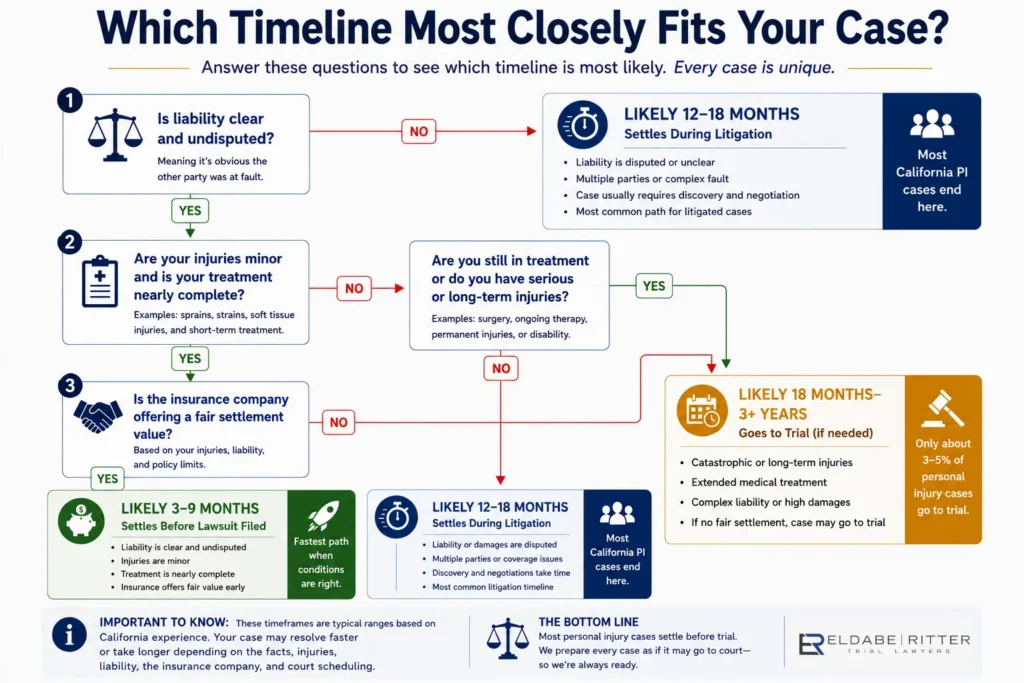
3–9 months if:
- Clear liability
- Minor injuries
- Cooperative insurer
12–18 months if:
- Serious injuries
- Disputed fault
- Lawsuit filed
18 months–3 years if:
- Catastrophic injuries
- Multiple experts
- Trial likely
Frequently Asked Questions
How long does it take to settle a personal injury claim?
Cases that settle before you file a lawsuit often resolve in three to nine months. Cases that require a lawsuit but still settle before trial typically take twelve to eighteen months from filing.
Does filing a lawsuit mean my case will go to trial?
No. Filing a lawsuit starts the formal litigation process. The large majority of filed cases still settle during discovery or at mediation before ever reaching a jury.
How long do I have to file a personal injury lawsuit in California?
Generally, two years from the date of injury, under California Code of Civil Procedure § 335.1. Your specific circumstances can shorten or toll this deadline, though.
What if the at-fault party is a government entity?
You generally must present a formal administrative claim within six months of the injury, under Government Code § 911.2(a). That’s a much shorter deadline than the standard two-year statute of limitations.
Why do some cases take longer than others?
Disputed liability, serious or unresolved injuries, and multiple parties all add time. So does an insurer that refuses to negotiate in good faith.
Can I speed up my case?
Working with an attorney who documents your claim thoroughly often shortens the timeline. Well-prepared cases give insurers less room to delay, especially when your attorney is ready to litigate if necessary.
What happens if I miss the statute of limitations?
In most cases, missing the filing deadline permanently bars your right to sue for compensation. This holds true regardless of how strong your case might otherwise have been.
How long does it take to get paid after a settlement or verdict?
Payment typically arrives one to three months after you sign a settlement or the court enters a verdict. The timing can vary based on your insurer and any liens you need to resolve first.
The Right Question Isn’t “How Long Will My Case Take?”
It’s “How long should it take to obtain a fair outcome?”
A fast settlement isn’t always the best settlement.
Some cases resolve quickly because liability is clear and the insurer pays fair value. Others require litigation because the insurance company refuses to fully compensate the injured person. Understanding the timeline helps you make informed decisions throughout the process rather than feeling frustrated by every delay.
At El Dabe Ritter Trial Lawyers, we walk every client through exactly where their case stands. We also explain what realistically comes next, whether that’s a quick resolution or a longer path toward trial. Our overall litigation strategy focuses on building the strongest possible claim from the outset.
If you’re wondering how long your case might take, Sherif El Dabe and Jonathan Ritter can give you a straightforward answer based on your specific situation. Contact our office for a free case evaluation by calling (213) 985-1120, filling out the form below, or using our chat.
- California Code of Civil Procedure § 335.1 (two-year statute of limitations for personal injury)
- California Code of Civil Procedure § 352 (tolling for minors and mental incapacity)
- California Code of Civil Procedure §§ 2030.010 et seq. (written interrogatories)
- California Government Code § 911.2(a) (six-month deadline to present a claim against a public entity)
- California Government Code § 911.4 (late-claim application process)
- Los Angeles Superior Court, “One Year to Trial” case management rule (2025)
