
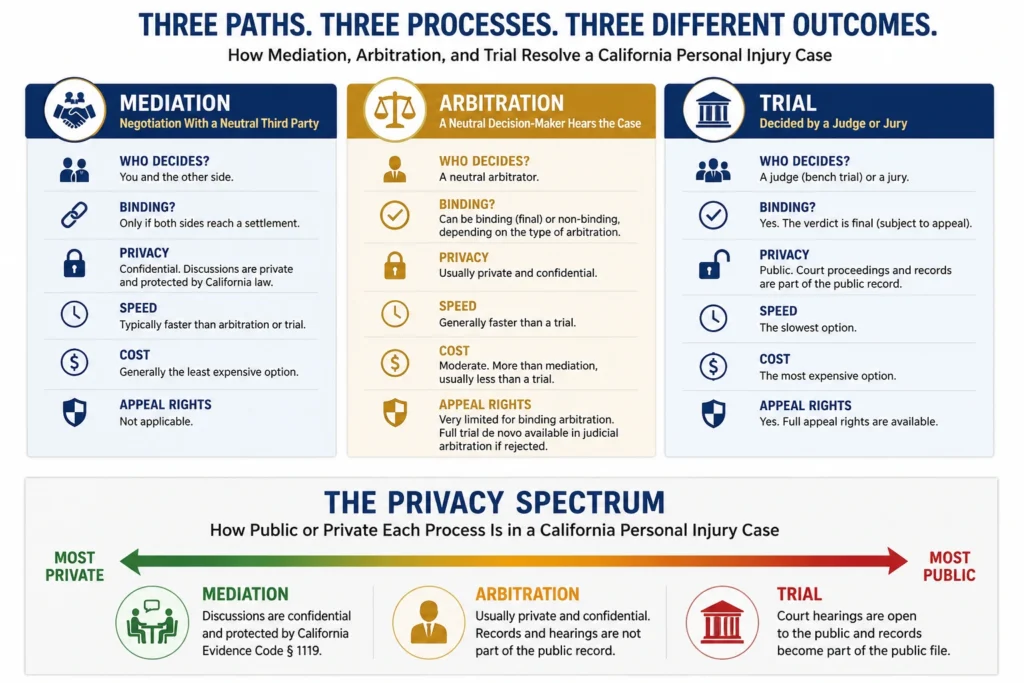
Mediation, arbitration, and trial resolve a California personal injury case in three very different ways. Mediation is a voluntary, confidential negotiation, and you keep full control over whether to accept any agreement. Arbitration puts a neutral arbitrator in charge of the decision, and it can be binding or non-binding depending on the circumstances. Trial puts the decision in the hands of a judge or jury, and it produces the most final, most public, and most time-consuming outcome of the three. Which path your case takes depends on the type of claim, your insurance policy, and how far apart you and the other side remain on value.
Quick Answer
* Mediation is voluntary negotiation.
* Arbitration is a private decision made by an arbitrator.
* Trial is a courtroom proceeding decided by a judge or jury.Each differs in control, cost, privacy, and finality.
If you’ve been told your case might go to “mediation” or “arbitration,” you may not know exactly what that means or how it differs from a trial. All three are legitimate ways to resolve a personal injury claim, but they work very differently.
Each one changes who makes the final decision, how much control you keep, and how quickly your case actually wraps up. This guide walks through all three, explains when each one typically applies in California, and covers two situations: judicial arbitration and UM/UIM claims.
| Feature | Mediation | Arbitration | Trial |
|---|---|---|---|
| Decision Maker | Parties | Arbitrator | Judge/Jury |
| Binding | Only if settled | Sometimes | Yes |
| Public | No | Usually no | Yes |
| Appeals | N/A | Limited | Yes |
Mediation: Negotiation With a Neutral Third Party
Mediation is a voluntary, non-binding negotiation process. A neutral mediator, often a retired judge or an experienced attorney, helps both sides work toward a mutually acceptable settlement.
The mediator doesn’t decide anything. They guide the conversation, test each side’s position, and look for common ground.
Nothing becomes final in mediation unless both sides agree and sign a settlement. You keep complete control over the outcome. If the numbers don’t work for you, you can simply decline and continue toward litigation instead.
Confidentiality is central to why mediation works well.
Under California Evidence Code § 1119, communications made during mediation, and even communications made in preparation for it, generally cannot be used later in court.
This protection is unusually broad under California law. Courts have held that it applies even outside the mediation session itself, which lets both sides speak candidly without fear that a concession will resurface later at trial.
California courts frequently encourage mediation because it allows injured people and insurance companies to explore settlement before the time and expense of a jury trial.
In many Los Angeles personal injury cases, mediation occurs after the parties have completed discovery and have a clearer picture of the strengths and weaknesses of the evidence.
Most personal injury cases that resolve through litigation do so at mediation, once discovery has clarified the strength of the evidence on both sides.
Arbitration: A Neutral Decision-Maker Hears the Case
Arbitration works differently. Instead of facilitating a negotiation, a neutral arbitrator hears evidence and arguments from both sides, then issues a decision. It resembles a simplified, private trial, though it usually moves faster and involves fewer formal procedures than a courtroom case.
Arbitration in California personal injury cases generally falls into two categories:
1. Private, contractual arbitration happens when the parties have agreed in advance, often through a policy or contract, that arbitration will resolve certain disputes. This can be binding, meaning the arbitrator’s decision is final and enforceable, with very limited grounds for appeal. Or,
2. Judicial arbitration is different, and it’s a piece rarely explained in simple terms. California courts can order certain civil cases into a court-run arbitration program under Code of Civil Procedure §§ 1141.10 et seq., typically for cases valued under a set dollar threshold.
Unlike private arbitration, this arbitration is non-binding. Either side can reject the arbitrator’s award and request a full trial instead, called a trial de novo, generally within 30 days of the award under Code of Civil Procedure § 1141.20.
That right isn’t free, though. Under Code of Civil Procedure § 1141.21, if you reject the award and go to trial but don’t achieve a more favorable result, the court can order you to pay specific costs and fees tied to that decision.
This rule discourages parties from rejecting a reasonable arbitration award simply to delay the case, and it’s a genuinely important detail for anyone deciding whether to accept an award or push forward.
Think of judicial arbitration as a court-required practice round that either side can reject.
Arbitration in Uninsured and Underinsured Motorist Claims
One of the most common real-world examples of binding arbitration in a personal injury case has nothing to do with a lawsuit against the at-fault driver at all. It involves your own insurance company.
Under California Insurance Code § 11580.2, every California auto policy must offer uninsured and underinsured motorist, or UM/UIM, coverage.
When the at-fault driver has no insurance, or not enough insurance to cover your damages, you pursue the difference through a claim against your own carrier.
Disputes over the value of a UM/UIM claim are commonly resolved through binding arbitration under this statute, rather than through a traditional lawsuit.
This matters because many people are surprised to learn that a claim against their own insurer, not the driver who caused the crash, can end up in binding arbitration governed by a specific statutory framework.
Consider a hypothetical: a client injured by an uninsured driver whose own UM policy carried a $50,000 limit, resolved not through a courtroom trial but through arbitration against the client’s own insurance carrier.
This scenario plays out regularly in California auto accident cases, and it’s a clear example of how arbitration shows up in personal injury practice even when no lawsuit against the other driver is ever filed.
Trial: A Judge or Jury Decides
Trial is the most formal, most public, and generally the most time-consuming path. After months of trial preparation, a judge or jury hears the evidence, evaluates witness credibility, and issues a verdict.
Unlike mediation or arbitration, the outcome doesn’t depend on agreement between the parties, and it isn’t shaped by a single neutral decision-maker chosen for that dispute alone.
A civil jury trial follows a structured sequence:
- Jury selection
- Opening statements
- Evidence presentation (including expert witness testimony)
- Cross-examination
- Closing arguments
- Deliberations
- Verdict
The plaintiff must show that the claim is more likely true than not true. This is a standard lower than the “beyond a reasonable doubt” threshold used in criminal cases.
Trial produces the most durable result of the three options. A jury verdict, once entered as a judgment, carries far more weight and finality than an arbitration award, and it’s far harder to challenge or unwind than either a settlement or a non-binding arbitration outcome.
Recommended Reading: The Personal Injury Trial Process in California: Every Stage Explained, From Lawsuit to Verdict
Which Path Is Most Likely in Your Case?
There’s no one-size-fits-all answer. The path your case follows depends on the facts of the accident, the type of insurance involved, the strength of the evidence, how willing each side is to negotiate, and when to file a lawsuit vs settle based on the unique circumstances of your claim.
For example, if liability is clear and your injuries are well documented, mediation often provides the quickest path to a fair resolution because both sides have a realistic understanding of the case’s value. Many California personal injury lawsuits settle this way after discovery has been completed.
If your claim involves uninsured or underinsured motorist (UM/UIM) coverage, the dispute may never go before a judge or jury at all. Instead, disagreements over the value of the claim are commonly resolved through binding arbitration under California law.
Some lower-value civil cases may also be directed into California’s judicial arbitration program before trial. While either party can reject the arbitrator’s decision and request a trial de novo, doing so carries potential cost consequences if the trial result is not more favorable than the arbitration award.
Cases involving disputed liability, catastrophic injuries, multiple defendants, or insurance companies that refuse to make a reasonable settlement offer are the ones most likely to proceed toward trial.
Even then, settlement discussions often continue throughout the litigation process, and many cases still resolve before a jury reaches a verdict.
At El Dabe Ritter Trial Lawyers, we prepare every case as though it will ultimately be decided by a jury. Our trial-ready approach is central to your case’s overall litigation strategy, strengthening your position at every stage because insurance adjusters, mediators, and arbitrators all evaluate risk differently when they know your legal team is prepared to present a compelling case in court.
Recommended Reading: How Long Does a Personal Injury Lawsuit Take? Understanding the Timeline
Can a Case Go Through Mediation, Arbitration, and Trial?
Yes. These three paths aren’t always mutually exclusive, and many California personal injury cases move through more than one of them before reaching a final resolution.
The clearest example is judicial arbitration itself. If a case goes through court-ordered arbitration and either side rejects the award, the case proceeds to a trial de novo under Code of Civil Procedure § 1141.20.
The arbitration doesn’t replace the trial in that scenario. It becomes a step that happens before it, and it can meaningfully shape how both sides approach the trial that follows.
Mediation and arbitration can also happen within the same case, at different points and for different purposes.
A case might attempt mediation early, fail to reach an agreement, proceed through litigation and discovery, then return to mediation later once the evidence is stronger.
This progression also illustrates how plaintiff attorneys build leverage before trial. As discovery uncovers additional evidence, expert opinions are developed, and the defense gains a clearer picture of the risks it faces before a jury, settlement negotiations often become more productive.
Some cases also involve two separate tracks entirely. A claim against the at-fault driver might proceed through litigation and settle at mediation, while a related UM/UIM claim against your own insurer moves through binding arbitration under Insurance Code § 11580.2 on its own timeline.
This layering is one of the reasons personal injury cases can feel confusing from the outside. Your case isn’t necessarily following a single, linear path toward one outcome.
It may be moving through more than one process at once, or moving from one to the next as earlier attempts fail to resolve it. Understanding which combination applies to your situation is something your attorney should be able to explain clearly at any point in the case.
Frequently Asked Questions
What’s the main difference between mediation and arbitration?
Mediation is a voluntary negotiation where you and the other side control the outcome. Arbitration puts the decision in the hands of a neutral arbitrator, and it can be binding or non-binding depending on the type of arbitration involved.
Is mediation legally binding in California?
The mediation process itself isn’t binding. However, once you sign a written settlement agreement at the end of mediation, that agreement generally is enforceable.
Is arbitration legally binding in California?
It depends on the type. Private, contractual arbitration is often binding. Judicial arbitration, ordered by the court for smaller civil cases, is non-binding, and either side can request a trial instead.
What is judicial arbitration and how is it different from private arbitration?
Judicial arbitration is a court-run, non-binding process for certain civil cases under California Code of Civil Procedure §§ 1141.10 et seq. Private arbitration arises from a contract or policy and is often binding with limited appeal rights.
Can I reject an arbitration award and still go to trial?
In judicial arbitration, yes. You generally have 30 days to request a trial de novo under Code of Civil Procedure § 1141.20. If you don’t do better at trial than the award, though, you may owe certain costs and fees.
How does UM/UIM arbitration work in a car accident case?
When the at-fault driver has no insurance or not enough coverage, you pursue the difference through your own insurer under Insurance Code § 11580.2. These disputes are commonly resolved through binding arbitration rather than a traditional lawsuit.
Which method is faster: mediation, arbitration, or trial?
Mediation is generally the fastest, often resolving in a single session or a few weeks of follow-up. Arbitration usually moves faster than trial but takes longer than mediation. Trial is the slowest of the three.
Speed isn’t always the most important consideration. Understanding what insurance companies don’t want you to know about litigation can help explain why some cases benefit from moving beyond settlement negotiations and into the litigation process before reaching their highest value.
Which method is used most often in personal injury cases?
Mediation resolves the largest share of litigated personal injury cases in California. Trial remains uncommon, reserved mainly for cases where liability is disputed, or a fair settlement can’t be reached.
Understanding Your Options Puts You in Control
Knowing the difference between mediation, arbitration, and trial helps you understand what’s actually happening in your case, and why. Each path changes who decides the outcome, how much control you keep, and how final that outcome will be.
At El Dabe Ritter Trial Lawyers, we evaluate every case with all three paths in mind from the start, not just the one it seems headed toward today.
Not sure whether your case is heading toward mediation, arbitration, or trial? We can explain where your case stands during a free consultation. Sherif El Dabe and our team can walk you through your options in plain terms. Contact our office for a case evaluation by calling (213) 985-1120, chatting us, or filling out the form below.
