
Pacific Coast Highway (PCH) is one of Huntington Beach’s most iconic roadways, attracting motorcyclists year-round with its oceanfront views, beach access, and proximity to Surf City’s restaurants, shops, and attractions.
Those same features also contribute to many motorcycle accidents on PCH in Huntington Beach. In fact, local collision data shows that more than one-quarter of Huntington Beach’s reported motorcycle crashes occur along the PCH corridor.
If you were injured in a motorcycle accident on PCH in Huntington Beach, understanding why these crashes happen and who may be responsible is the first step toward protecting your rights. An experienced Huntington Beach motorcycle accident lawyer can help you navigate the claims process and pursue the compensation you deserve.
Why PCH Creates Unique Risks for Motorcyclists
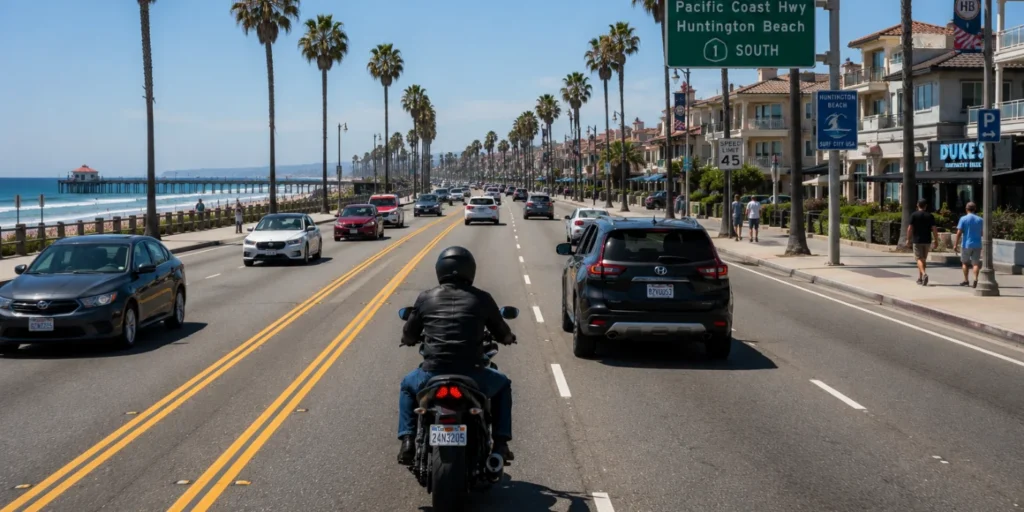
Unlike most roads in Huntington Beach, Pacific Coast Highway functions as both a major transportation corridor and a popular coastal destination. The constant mix of local commuters, tourists, beachgoers, cyclists, and pedestrians creates traffic conditions that can increase the risk of motorcycle collisions.
Some of the unique roadway characteristics that make PCH more challenging for riders include:
- Heavy Tourist Activity: Visitors unfamiliar with the area may slow suddenly, make last-minute turns, or search for beach parking.
- Numerous Beach Access Points: Parking lot entrances, hotels, restaurants, and side streets create frequent vehicle turning movements.
- Higher Traffic Speeds: Vehicles often travel faster than on surrounding city streets, leaving less time to react.
- Coastal Conditions: Sun glare, marine layer fog, sand, and debris can reduce visibility and traction.
- Construction and Roadway Changes: Temporary lane shifts, uneven pavement, and narrowed lanes can create additional hazards for motorcyclists.
Why Motorcycle Accidents on PCH Often Cause Severe Injuries
Motorcycle crashes on Pacific Coast Highway often result in severe injuries because motorcycle riders have little protection during an impact. Unlike occupants inside passenger vehicles, motorcyclists are exposed to direct contact with other vehicles and the roadway. Combined with the higher speeds commonly seen on PCH, these collisions frequently cause life-changing injuries.
Common injuries include:
- Road Rash: Sliding across pavement can cause deep abrasions that may require skin grafts or other specialized treatment.
- Traumatic Brain Injuries (TBIs): Even when wearing a helmet, riders may suffer concussions or more serious brain injuries during a violent collision.
- Spinal Cord Injuries: Damage to the spine can lead to chronic pain, reduced mobility, or permanent paralysis.
- Broken Bones and Nerve Damage: Fractures to the wrists, collarbones, ribs, legs, and shoulders are common and may require surgery and lengthy rehabilitation.
Many victims also face ongoing medical treatment, lost income, diminished earning capacity, and lasting physical or emotional effects long after the initial crash.
Common Causes of Motorcycle Accidents on PCH in Huntington Beach
Every motorcycle accident is unique, but local collision data shows that certain driver behaviors repeatedly contribute to crashes on Pacific Coast Highway and nearby Huntington Beach roads. Understanding these trends not only helps explain why these collisions happen, but also highlights the types of negligence that are often used to establish fault after an accident.
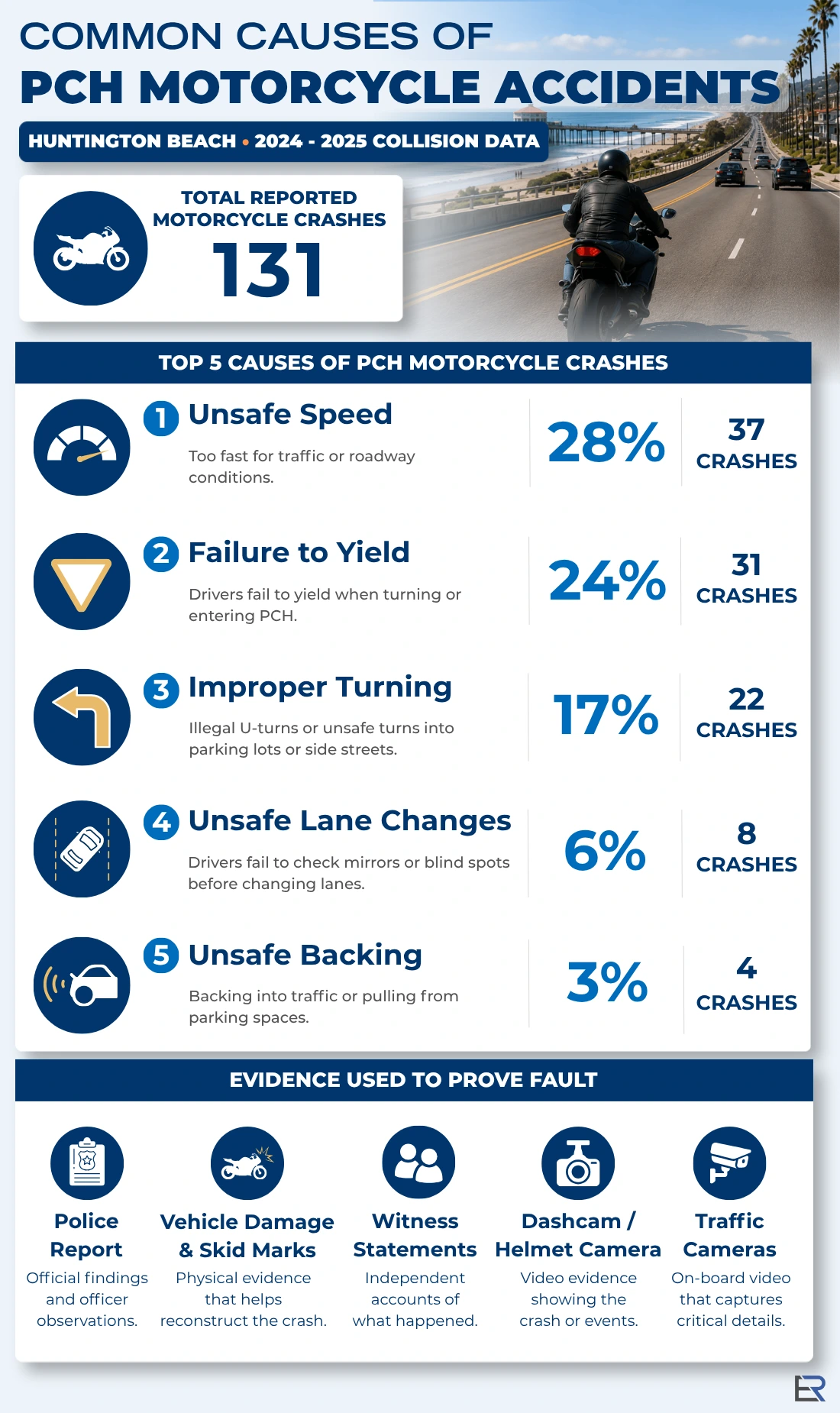
According to 2024–2025 Huntington Beach motorcycle collision data, the most common contributing factors include:
- Unsafe Speed (37 crashes – 28.24%): Drivers traveling too fast for traffic or roadway conditions have less time to react to slowing vehicles or motorcyclists ahead.
- Failure to Yield the Right-of-Way (31 crashes – 23.66%): Many collisions occur when drivers turn across traffic or pull onto PCH without noticing an approaching motorcycle.
- Improper Turning (22 crashes – 16.79%): Illegal U-turns, sudden turns into parking lots, and other unsafe turning maneuvers frequently contribute to crashes.
- Unsafe Lane Changes (8 crashes – 6.11%): Drivers who fail to check mirrors or blind spots may sideswipe motorcycles traveling beside them.
- Unsafe Starting or Backing (4 crashes – 3.00%): Vehicles backing out of parking spaces or entering traffic unexpectedly can create dangerous situations for riders.
These reported collision factors do not capture every form of driver negligence. Distracted driving, following too closely, and impaired driving frequently contribute to motorcycle accidents on PCH by reducing a driver’s ability to recognize and react to motorcyclists in time to avoid a crash. These behaviors often become important evidence when determining fault and negotiating with insurance companies.
Motorcycle Accident Hotspots Along PCH in Huntington Beach
Although motorcycle accidents on PCH in Huntington Beach can happen anywhere along Pacific Coast Highway, local collision data shows that several intersections and roadway segments experience more crashes than others. Of Huntington Beach’s 131 reported motorcycle collisions, 34 occurred along the PCH corridor, accounting for approximately 27% of the city’s motorcycle crashes.
The data points to five primary high-risk hotspots along the route:
Downtown Huntington Beach (Main Street, 5th Street, 6th Street & 8th Street)
Downtown Huntington Beach is one of the busiest areas along PCH, attracting heavy pedestrian traffic, tourists, cyclists, and rideshare vehicles throughout the day. Drivers are frequently searching for parking, stopping for pedestrians, or turning into nearby businesses, creating constant vehicle turning movements and stop-and-go traffic. Many motorcycle crashes occur when drivers fail to yield, make sudden turns, or pull into a rider’s path without enough time to react.
PCH and Warner Avenue (The High-Velocity Transition)
This intersection marks the transition from the open stretches of Pacific Coast Highway near Bolsa Chica to the busier beach access area. As vehicles slow for the state beach entrance, drivers often merge, change lanes, or make last-minute turns. The combination of merging traffic, sudden braking, and higher approach speeds increases the risk of rear-end collisions, unsafe lane changes, and left-turn crashes involving motorcycles.
PCH and Seapoint Street (The Coastal Curve)
Near Huntington Dog Beach, this section of PCH features a broad curve, beach access points, and roadside turnouts. The roadway design can reduce sight distance, while drivers may slow unexpectedly or turn into nearby parking areas. Motorcyclists are particularly vulnerable when drivers fail to anticipate vehicles entering, exiting, or slowing along this stretch, increasing the likelihood of turning and lane-change collisions.
PCH and Twin Dolphin Drive (The Resort & Hotel Strip)
Located near the Hyatt Regency Huntington Beach Resort and the Hilton Waterfront Beach Resort, this stretch of PCH experiences frequent hotel traffic, valet operations, rideshare pickups, and guest drop-offs. Vehicles regularly enter and exit resort driveways, make last-minute turns, or stop unexpectedly near hotel entrances, creating numerous conflict points for motorcyclists. Crashes commonly occur when drivers turn across traffic, merge without checking for motorcycles, or stop suddenly to pick up or drop off passengers.
PCH and Newland Street / Magnolia Street (The State Beach Gates)
These intersections provide access to Huntington State Beach and experience heavy traffic, particularly on weekends and during the summer. Drivers entering and exiting the beach parking lots frequently make left turns across oncoming traffic or rush through changing traffic signals to reach the entrance or exit. Motorcyclists traveling straight through the intersections are especially vulnerable when drivers fail to yield before turning.
Getting to and from PCH can also involve I-405, where riders face different traffic conditions, including merging vehicles, lane changes, and heavy freeway traffic. For a closer look at motorcycle crashes on this major freeway, see our guide to motorcycle accidents on the 405 Freeway near Huntington Beach.
Recommended Reading: Most Dangerous Collision Intersections in Huntington Beach
Ongoing PCH Construction Can Increase Motorcycle Crash Risks
Caltrans is installing new Class II bike lanes and making other safety improvements along PCH between the Santa Ana River Bridge and Anderson Street. During construction, temporary lane shifts, pavement changes, and work zone activity may create additional hazards for motorcyclists.
If you are riding through an active work zone, watch for:
- Temporary lane closures and lane shifts that may reduce space for motorcycles.
- Fresh striping, pavement transitions, or grooved asphalt that can affect traction.
- Construction debris, including loose gravel, sand, or other materials on the roadway.
- Modified intersections and turn lanes as crews widen right-turn pockets and install new bike lane features.
- Construction vehicles entering and exiting the work zone, temporary traffic controls, and shifting lane configurations.
If unsafe construction conditions—such as inadequate warning signs, poorly maintained work zones, or roadway hazards—contributed to your motorcycle accident, the construction contractor, Caltrans, or another responsible party may be liable depending on the circumstances. Claims against government entities are subject to strict deadlines, so it is important to act quickly.
Who Is Responsible for Motorcycle Accidents on PCH in Huntington Beach?
Determining who is responsible for a motorcycle accident on PCH depends on how the crash occurred. Although another driver’s negligence is responsible for many motorcycle accidents on PCH, multiple parties may share liability depending on how the collision occurred.
Potentially responsible parties may include:
- Negligent Drivers: Drivers who speed, fail to yield, make unsafe turns, change lanes carelessly, or drive distracted.
- Commercial Vehicle Owners or Employers: May share liability when an employee or commercial vehicle causes the crash.
- Construction Companies: May be liable for unsafe work zones, debris, or inadequate warnings.
- Government Entities: May be liable when dangerous road conditions or poor maintenance contribute to a crash.
What If You Were Partially at Fault?
Insurance companies may unfairly blame motorcyclists for speeding, lane splitting, or riding aggressively in an effort to reduce what they pay. By increasing your percentage of fault, they may be able to reduce the amount they have to pay on your claim.
Even if you do share some responsibility, California’s pure comparative negligence rule allows you to recover compensation, reduced by your percentage of fault. For example, if you are 20% at fault, you may still recover 80% of your damages.
Evidence such as police reports, witness statements, video footage, and photos can help establish what happened and challenge unfair blame.
How to Prove Fault After a Motorcycle Accident on PCH
Motorcyclists are sometimes unfairly blamed after a crash, with insurance companies arguing they were speeding, lane splitting, or riding aggressively. Building a strong claim requires evidence that clearly shows how the collision occurred and who was responsible.
The following types of evidence can play a critical role in establishing liability and strengthening your motorcycle accident claim:
- Official Police Reports: Documentation from the Huntington Beach Police Department (HBPD) may provide useful information about the crash.
- Traffic and Sensor Cameras: Caltrans highway monitoring footage that may have captured the exact mechanics of the impact.
- Nearby Business Surveillance: Security video from PCH hotels, restaurants, and gas stations before the data is automatically overwritten.
- Dashcam or Helmet Cam Video: Dashcam or surveillance footage capturing the driver’s actions before the crash.
- Accident Reconstruction Data: Expert analysis of skid marks, vehicle damage profiles, and scene physics to mathematically prove how the crash happened.
What to Do After a Motorcycle Accident on PCH
If you are involved in a collision along the highway, the actions you take in the first few hours are absolutely critical to your health and your eventual legal claim:
- Move to Safety & Call 911: If physically capable, move your bike out of the active highway lanes to avoid a secondary impact. Ensure emergency dispatch sends the HBPD to file an official traffic collision report.
- Seek Immediate Medical Care: Visit Huntington Beach Hospital, Hoag Health Urgent Care, or another nearby medical facility as soon as possible. Prompt treatment can identify hidden injuries and create important medical documentation for your claim.
- Gather Evidence at the Scene: Take photos of vehicle damage, the positioning of the cars, the sun’s location, any construction barriers, and road surface conditions. Secure the names and phone numbers of any eyewitnesses (including beachgoers or cyclists).
- Don’t Admit Fault: State the objective facts to the responding officer, but never say “I’m sorry” or apologize to the other driver. Insurance companies will misinterpret standard politeness as an admission of fault.
- Consult with an Attorney: Do not sign any insurance settlement offers or give recorded statements to the at-fault driver’s insurance adjuster until you have spoken with a Huntington Beach motorcycle accident attorney.
What Compensation Can You Recover After a Motorcycle Accident on PCH?
If someone else’s negligence caused your motorcycle accident, you may be entitled to compensation. The value of your claim depends on factors such as the severity of your injuries, available insurance coverage, and how the crash has affected your ability to work and daily life.
Compensation may include:
- Medical expenses: Current bills, future treatment, and rehabilitation.
- Lost income: Lost wages and reduced future earning capacity.
- Property damage: Motorcycle repairs or replacement and damaged riding gear.
- Personal losses: Pain and suffering, emotional distress, disability, scarring or disfigurement, and loss of enjoyment of life.
In rare cases involving particularly dangerous conduct—such as a crash caused by an impaired driver or other exceptionally reckless behavior—the court may also award punitive damages to punish the wrongdoer and discourage similar conduct.
Why Choose a Huntington Beach Motorcycle Accident Lawyer?
Motorcycle accidents on PCH often involve complex liability issues, disputed fault, and evidence that can disappear quickly. A Huntington Beach motorcycle accident lawyer understands the unique traffic patterns, intersections, and roadway conditions along Pacific Coast Highway.
At El Dabe Ritter Trial Lawyers, our Huntington Beach office is located at 1120 Pacific Coast Highway, Unit A, just steps from where many of these crashes occur. We can help:
- Investigate the accident and identify all liable parties.
- Preserve important evidence before it is lost.
- Handle negotiations with the insurance company.
- Fight for the maximum compensation available through settlement or trial.
If you were injured in a motorcycle accident on PCH, we’re here to protect your rights and help you move forward.
Frequently Asked Questions About Motorcycle Accidents on PCH in Huntington Beach
Does lane splitting affect my PCH motorcycle crash claim?
No. Lane splitting is completely legal in California under Assembly Bill 51, provided it is done in a safe and prudent manner. If an ocean-distracted driver swerved into you while you were filtering or splitting lanes through downtown traffic, the driver may still be liable if their negligence caused the collision.
Can I sue Caltrans if a construction zone caused my accident?
Yes. If hazardous conditions within the ongoing PCH bike lane construction project contributed to your crash, you may file a public entity liability claim against the state or the contracted construction company. Note that government claims have much stricter, shorter filing deadlines than standard claims.
What if the other driver claims I was speeding on PCH?
This is a standard insurance tactic. We counter this by deploying accident reconstruction experts who analyze the vehicle damage, skid marks, and electronic data logs to prove your actual speed and demonstrate that the driver’s failure to yield was the true cause of the collision.
How long do I have to file a motorcycle accident claim in California?
Generally, the statute of limitations for a personal injury claim in California is two years from the date of the accident. However, if a government entity like Caltrans or the City of Huntington Beach is a named defendant due to road conditions, you must file a formal administrative claim within six months of the incident.
What if there were no witnesses to my PCH crash?
Many sections of PCH are isolated or wrapped in fast-moving traffic where bystanders don’t stop. We can build a strong case even without eyewitnesses by pulling Caltrans highway sensor data, checking surrounding resort security footage, analyzing physical vehicle damage, and utilizing forensic accident reconstruction.
Injured on PCH? Put an Experienced Huntington Beach Motorcycle Lawyer in Your Corner.
A serious motorcycle accident can leave you facing mounting medical bills, missed time from work, and an uncertain road to recovery. You should be focused on healing—not dealing with insurance adjusters or trying to prove fault on your own.
A knowledgeable Huntington Beach motorcycle accident lawyer can investigate the crash, preserve critical evidence, identify all liable parties, and fight for the full compensation you deserve. At El Dabe Ritter Trial Lawyers, our Huntington Beach office is conveniently located on Pacific Coast Highway, just minutes from many of the motorcycle accident hotspots discussed in this guide.
Call our Huntington Beach office today at (714) 536-9366 or complete our online contact form to schedule your free consultation and learn how we can help protect your rights after a motorcycle accident on PCH.
