
Insurance defense lawyers look at your case the same way every time. They check if they can blame part of the accident on you. They look for gaps in your medical care and check if an old injury could explain your pain. Also, they look at what you’ve said, your social media, and your daily activities to see if anything doesn’t match your claim. Then they compare every piece of evidence against every other piece. California law limits some of these tactics. But knowing what the defense looks for helps you protect your case before they can use it against you.
The Defense Playbook Starts Before You Know It Exists
Most injury victims think the insurance company is just deciding whether to pay them. That’s not the whole story. Once a claim reaches a certain value, a defense lawyer may already be building a file to reduce or deny it. This can start weeks before you get a formal denial letter or a low offer.
We cover how insurance companies decide a claim’s risk level in a separate article. Here, we focus on the exact checklist defense lawyers use once they’re assigned to your case, category by category, using the same legal rules California courts apply at trial.
When Does an Insurance Defense Lawyer Get Involved?
Not every claim gets a defense lawyer right away. Most claims start with a claims adjuster. This person handles routine letters and settlement talks. A defense lawyer usually steps in once a lawsuit is filed, once your damages reach a high amount, or once the adjuster decides the case will be hard to settle.
Panel Counsel, Reserve-Setting, and the Litigation Trigger
Insurance companies keep a list of outside law firms, known as panel counsel, they trust to defend claims. Which firm gets assigned depends on the type of case and how much money is at risk. A minor soft-tissue injury with a low value may never need a lawyer at all. But a serious injury, a case where fault is unclear, or a case that could cost more than the insurance policy covers usually gets a defense lawyer involved early — sometimes before you’ve even hired your own attorney.
Why Earlier Involvement Usually Means Higher Perceived Exposure
If a defense lawyer gets involved early, that tells you something. It usually means the insurance company expects your case to be worth more and will require formal evidence gathering, expert witnesses, or a trial rather than a quick payout.
The First Question: Can They Shift Blame to You?
Before a defense lawyer even looks at how much your case is worth, they look at who caused the accident. California follows a rule called pure comparative negligence. This comes from a 1975 court case, Li v. Yellow Cab Co. Under this rule, a jury decides what percent of the blame belongs to each person involved, including you, and your final payment gets reduced by that percentage.
For example, if a jury finds you 30 percent at fault in a $200,000 case, you would still receive $140,000.
Even if a jury finds you 90 percent at fault, you can still recover the remaining 10 percent.
This is exactly why the defense works so hard to blame you. Every percent of fault they move onto you saves the insurance company money.
Under a rule called CACI No. 405, the defense must prove two things: that you acted carelessly and that this carelessness caused your own injury. However, they can’t just claim this; they need real evidence. That’s why defense lawyers spend so much time and money investigating your case.
Common arguments include claims about your speed, who had the right of way, how fast you reacted, or whether you made your own injuries worse. This is the same dynamic explored in our breakdown of how litigation leverage gets built before trial: the side that controls the story about who was at fault usually has the advantage when it’s time to negotiate or go to trial.
They’re Looking for Gaps in Your Medical Treatment
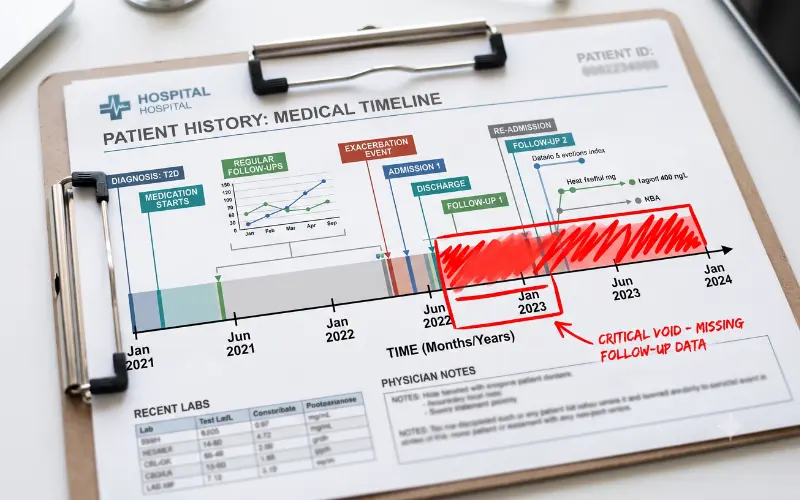
A gap in your medical treatment is one of the easiest things for the defense to use against you. Say you saw a doctor right after the accident, then didn’t go back for six weeks. The defense will say this gap proves your injury wasn’t serious, or that something else happened during that time to cause or worsen your pain.
Not every gap hurts your case. There can be good reasons: you didn’t have a ride, you couldn’t get an appointment, you couldn’t afford care yet, or your doctor told you to rest before more treatment. But the defense doesn’t care if your reason is good. Their job is to find the gap and let the jury guess why it happened, unless your lawyer explains it first.
The best way to protect yourself is to go to every appointment, follow your doctor’s advice, and keep a clear paper trail from day one.
A treatment record with no unexplained gaps gives the defense much less to work with and allows treating physicians or medical experts to explain the progression of the injury without having to account for missing periods of care.
Follow the link to learn more about why similar injuries can result in very different case values.
They’re Looking for Pre-Existing Injuries
If you had a past back injury, an earlier car accident, or a condition that was already getting worse over time, expect the defense to ask for every medical record they can find — sometimes going back years. Their goal is to say your current pain comes from something old, not from this accident.
California law limits how far they can take this argument. It’s called the eggshell plaintiff doctrine (CACI No. 3928). This rule says a person who causes an accident is responsible for all the harm they cause, even if you were more likely to get hurt than the average person.
Courts have put it simply: the person who caused the accident has to take you as they found you. In plain terms, the other driver doesn’t get to pay less just because a healthier person would have healed faster.
A related rule, CACI No. 3927, says you can’t get paid for the condition you already had before the accident, but you can get paid in full for how much worse the accident made it. This is why detailed medical records matter so much, both from before and after the accident.
Records that show your condition beforehand, compared to records that show it got worse afterward, turn a pre-existing injury from a weakness into a non-issue.
They’re Looking for Other Causes of Your Injuries
Besides pre-existing conditions, the defense also looks for any other explanation for your pain, for example, a later fall, a work injury, a different car accident, or just normal aging.
This is called a causation argument, and it’s different from a fault argument. This is usually where independent medical exams (IMEs) come in.
If your case goes to court, the defense has the right to send you to a doctor of their choosing for an exam. This doctor does not work for you. It’s not unusual for their report to try to blame your symptoms on something other than the accident, or make your recovery sound better than your own doctors say it is.
The best way to fight this is with your own treating doctors and, in larger cases, an independent medical expert who can speak directly to what caused your injury. When the defense also disputes how the collision occurred or whether the forces involved could have caused the claimed harm, accident reconstruction experts may help connect the physical evidence from the crash to the injury mechanism.
They Investigate Your Social Media

Checking your social media has become one of the most common tactics in personal injury defense. Under California law (Code of Civil Procedure § 2017.010), the other side can request almost anything related to your case, even things that couldn’t be used directly in court, as long as it might lead to real evidence.
Courts have allowed this to include social media when there’s reason to believe relevant information is there.
In real life, posting seemingly innocent photos on social media can jeopardize your case. This means a smiling photo at a family party, a comment about your weekend, or a location check-in can all end up in your case file, often without the context that would explain them.
Someone recovering from a back injury who goes to a one-hour birthday dinner and smiles for one photo is not the same as someone who has fully healed, but by the time a jury sees just that photo, that difference is often lost.
The safest choice during your claim is to stop posting completely, set your accounts to private, and ask friends and family not to tag you or talk about your case online.
These steps don’t guarantee protection, since a court can still order you to turn things over. But they remove easy chances for the defense to build a misleading story.
Surveillance Isn’t Just in Movies
Video and photo surveillance are still common in personal injury cases, especially once a claim is worth enough to justify hiring an investigator.
Insurers use this footage to show activities that don’t match your claimed limits, such as yard work, grocery shopping, going to the gym, or any activity your doctor told you to avoid.
Investigators usually stay within the law by watching and recording you in public, where you don’t have privacy rights. But surveillance inside your home, in a fenced backyard, or in other private areas crosses a legal line.
Investigators may also talk to your neighbors, coworkers, or friends — sometimes in a casual conversation — to learn more about your daily life.
The best response isn’t paranoia. It’s consistency. Follow your doctor’s restrictions in real life, not just on paper, and remember that anything you do in public could end up in your case file, whether or not it tells the full story.
They Compare Everything You Say
Recorded statements, depositions, medical intake forms, and even casual comments to your own doctor are all treated as evidence the defense will eventually compare against each other.
An early recorded statement to an adjuster is one of their favorite tools — it locks in your story before your lawyer has had a chance to prepare you, and before all the facts are known.
The differences don’t have to be big to matter. If you tell an adjuster the accident happened at one intersection, then later say a slightly different location in your deposition, or if how you describe your pain changes between your first doctor visit and your deposition, the defense will use that difference to attack your credibility, even if your injury and its cause are not seriously in question.
This is also where your history comes in. The defense may look into whether you’ve filed injury claims before with the aim of framing you as a “vexatious litigant”. Sometimes they’ll try to argue that a pattern of past claims makes you less believable.
The best protection is simple:
- Stay consistent,
- Be honest when you’re not sure about something instead of guessing, and
- Tell your own lawyer about anything unflattering before the defense finds it first.
Every Piece of Evidence Gets Compared
Beyond comparing what you’ve said at different times, the defense also compares every piece of evidence against every other piece.
Your recorded statement gets compared to the police report. Your medical records get compared to your deposition. Surveillance footage gets compared to what you say you can and can’t do. Photos of your damaged car get compared to how you describe the crash.
This isn’t one big “gotcha” moment. It’s a slow, careful process. If the defense finds even small differences among several sources, they’ll present all of them together at trial or during negotiations to suggest you’re unreliable, even if each difference means very little on its own.
The best way to fight back is to build your own case file with the same care the defense uses against you: consistent records, witness statements that support your story, and a clear evidence trail that your own attorney controls.
In that sense, trial preparation begins long before a trial date is set, with the evidence, medical records, and witness information preserved immediately after the accident.
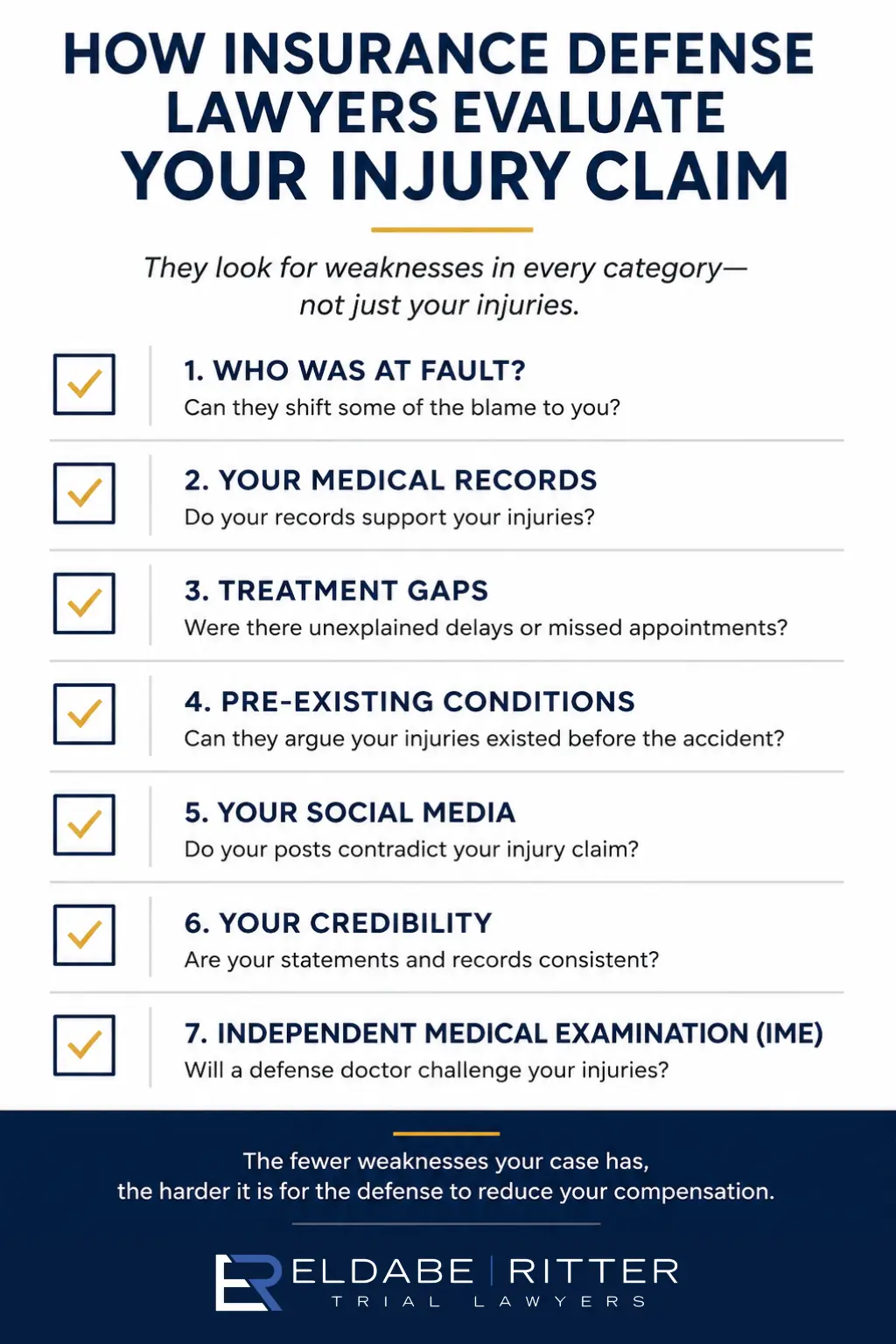
Common Defense Arguments in California Injury Cases
A few specific defense strategies come up often enough in California cases to explain on their own.
Low-Impact and MIST Defenses
MIST stands for “Minimal Impact Soft Tissue.” This defense argues that if there’s little to no damage to your car, the crash couldn’t have caused a real injury, even if your medical records say otherwise.
Splitting Fault Between Multiple People
When there’s more than one defendant, a rule called CACI No. 406 allows a jury to split the blame among you, the defendant, and even people who aren’t part of the lawsuit. This can sometimes reduce how much one defendant has to pay by pointing to someone who isn’t even in the courtroom.
Disputes Over What Your Medical Bills Are Really Worth
A 2011 case, Howell v. Hamilton Meats & Provisions, Inc., says you can recover only the lower of two amounts for your past medical bills: what was actually paid or what the service was actually worth — not the higher amount originally billed. That sounds simple. It isn’t.
Who Decides What a Service is “Really Worth”?
Deciding what a service was “really worth” is up to the jury. Courts have said a medical bill by itself doesn’t prove what the service was actually worth. This usually requires expert testimony, often from a medical billing expert or your own doctor, someone who can explain what your treatment is really worth in your local area, separate from the number on the bill.
When You Don’t Have Insurance or Treating on a Lien
This gets more complicated if you don’t have insurance, or if you’re being treated on a lien, meaning a doctor treats you now and gets paid later out of your settlement.
Without an insurance company’s negotiated rate to fall back on, there’s no easy discount.
In that case, California courts have said you can still recover the full billed amount, but only if a qualified expert testifies that the billed rate is fair and matches what your local market actually charges (Bermudez v. Ciolek, 2015). The defense will often challenge this directly, arguing the expert’s methods aren’t reliable.
Factoring In Future Medical Costs
Future medical costs make this even harder. Under a 2013 case, Corenbaum v. Lampkin, the full billed amount for past care generally can’t be used to prove what your future treatment will cost.
This means both sides have to build their future-costs case almost entirely on expert testimony — usually from a life care planner working with your treating doctor — rather than just guessing based on past bills.
For you, this means the medical damages part of your case is rarely a simple addition. It’s a battle between experts, and the side with the more believable, better-prepared expert on what your treatment is really worth usually wins this argument in front of a jury.
Time Limits and Other Procedural Defenses
Under California law (Code of Civil Procedure § 335.1), you generally have two years from the date of your injury to file a lawsuit. There are some exceptions, and they depend heavily on the details of your case.
“Sudden Emergency” and “Assumption of Risk” Arguments
These arguments try to excuse the defendant’s actions by claiming the situation was unforeseeable, or that you willingly accepted the risk involved. Knowing about these defenses ahead of time lets your attorney prepare a response before the defense even brings them up.
| Defense Argument | Your Response |
|---|---|
| “You weren’t hurt.” | Medical records prove it. |
| “You caused the crash.” | Evidence and witnesses say otherwise. |
| “You didn’t need treatment.” | Your doctor’s opinion says you did. |
| “You waited too long to get help.” | There’s a real reason for the delay. |
| “You had this injury before.” | The accident made it worse. |
| “Your social media doesn’t match your claim.” | The full story explains the photo. |
How This Differs From Why Insurers Flag a Case as “High Risk”
This checklist differs from how an insurance company internally decides that your case is “high risk.” We explain that process — like when they raise their reserves or bring in outside lawyers earlier — in a separate article, What Makes a Case “High Risk” for Insurance Companies. That’s an internal, financial decision.
What we’ve covered here is the actual game plan defense lawyers use once they’re assigned to your case:
- The specific weaknesses they hunt for and
- The arguments they build.
A case can be marked high risk internally and still be defended on just one weak point (such as an unexplained treatment gap) if that’s what they find in your file.
Los Angeles and Orange County: What Local Cases Look Like
Where your case is filed matters. In Orange County, any civil case asking for more than $35,000 is filed as an “unlimited civil action” in Superior Court. This affects the rules, the extent of evidence gathering allowed, and how complex the pretrial process becomes.
Los Angeles County Superior Court is the largest trial court system in the country. Its heavy caseload affects how fast cases move toward resolution, even with the county’s 2025 “One Year to Trial” program, which is meant to reduce delays.
Local defense firms know that court delays can work both ways. A slow court can give a defendant time to wait out a plaintiff. But it also means an insurance company that waits too long risks facing a well-prepared plaintiff’s team once the case finally reaches a courtroom.
The cost of living in Los Angeles and Orange County also affects your case. Medical costs and lost wages here tend to run higher than the national average, which affects both how insurance companies approach settlement and how much they expect to pay for pain and suffering if the case goes to trial.
How to Protect Your Case From the Start
The first 72 hours after an accident set the tone for everything that follows.
What to Do in the First 72 Hours
- Get medical care right away, even if you think your injury is minor. Some injuries, especially soft tissue injuries and concussions, don’t show all their symptoms right away.
- Take photos of the accident scene, the vehicles, and any visible injuries before anything gets fixed or cleaned up.
- Get contact information from any witnesses before they forget what happened.
What Not to Post, Say, or Sign
- Don’t give a recorded statement to any insurance adjuster — even your own — before talking to a lawyer.
- Don’t post about the accident, your injuries, or your recovery on any social media.
- Follow every instruction from your doctor exactly. If you can’t follow through for any reason, tell your attorney right away instead of letting the record show an unexplained gap.
El Dabe Ritter Trial Lawyers has represented clients in cases where nearly every one of these tactics showed up in some form. The lesson is always the same: cases built on early, careful documentation are much harder for the defense to take apart than cases put together after a denial letter has already arrived.
What You Can Do to Strengthen Your Case
- Follow treatment
- Be consistent
- Save evidence
- Avoid discussing your case online
- Don’t exaggerate
- Hire a lawyer early
Frequently Asked Questions
What do insurance defense lawyers look for in a personal injury case?
Insurance defense lawyers look at whether they can blame part of the accident on you; your medical records for gaps or inconsistencies; and any past injuries or other things that could explain your pain. They watch your social media and public activities. And they compare everything you’ve said at different times to find any inconsistencies.
Can insurance companies check my social media during a lawsuit?
Yes. Under California’s discovery rules, a court can order you to turn over social media content if it could lead to relevant evidence, especially once a lawsuit has started. That broader discovery exposure is one of the practical considerations an attorney may evaluate when deciding whether it is better to settle vs. file a lawsuit. However, the strength and value of the claim remain the more important factors.
Does a gap in medical treatment hurt my personal injury case?
It can. The defense often argues that an unexplained gap in treatment means your injury wasn’t serious. A clear, reasonable explanation for any gap can greatly reduce this risk.
How does comparative negligence affect my settlement in California?
Under California’s pure comparative negligence rule, your final payment is reduced by whatever percentage of fault a jury gives you. But you can still recover money even if you’re found up to 99 percent at fault.
Can a pre-existing condition be used against my injury claim?
The defense will try. But California’s eggshell plaintiff doctrine requires them to pay you in full for any way the accident worsened your prior condition, even though you can’t be paid for the condition as it existed before the accident.
What is an independent medical examination, and do I have to attend?
It’s an exam done by a doctor chosen by the defense, once your lawsuit has started. In most cases, you’re required to go if the defense properly requests it. But you should review the resulting report carefully with your own doctors.
What happens during a recorded statement with an adjuster?
An adjuster will ask you to describe the accident, your injuries, and how they’ve affected your life, then record your answers. This recording can be used later in your claim or in court, and inconsistencies may influence negotiations or how the case is presented during mediation, arbitration, or trial. Talking to a lawyer before giving any recorded statement can help you avoid saying something that gets taken out of context later.
Recommended Reading: What Insurance Companies Don’t Want You to Know
El Dabe Ritter’s Approach to Neutralizing These Tactics
Sherif El Dabe and Jonathan Ritter built El Dabe Ritter Trial Lawyers’ litigation practice around one simple idea: knowing exactly what the defense is trained to look for is the fastest way to remove it as a problem.
That means documenting treatment gaps before they happen, gathering before-and-after medical evidence for any pre-existing condition, and preparing clients for recorded statements and depositions with the same care the defense uses to attack them.
If you’re dealing with a California personal injury claim and want to know exactly what the insurance company’s lawyers will be looking for in your file, contact El Dabe Ritter Trial Lawyers for a free case evaluation. Call now or fill out the form below to get started.
