
According to the Insurance Information Institute, 17% of drivers in California were uninsured in 2022, and many more carry only the minimum required coverage.
That means the chances of being hit by someone with little or no insurance are higher than you might expect. Even when a driver does have insurance, it may not be enough to cover your medical bills, lost income, or other damages.
Understanding your rights under California law is the first step to a fair recovery. This article explains the strict deadlines and hidden rules you must navigate, and how an experienced car accident lawyer uses them to protect the value of your case.
Understanding California’s Liability Insurance Minimums
As of January 1, 2025, California law requires all drivers to carry a minimum of $30,000 per person and $60,000 per accident in bodily injury liability coverage (pursuant to SB 1107). This insurance pays for damages to others when the insured driver is at fault.
However, these minimums are often woefully inadequate after a serious crash. A single surgery, hospitalization, or extended rehabilitation can easily exceed these amounts. Once an at-fault driver’s policy limits are exhausted, their insurer has no further obligation to pay. Any remaining damages become the personal responsibility of the at-fault driver — leaving you to pursue other avenues for recovery.
Recommended Reading: What Happens If the Driver Isn’t Listed on the Insurance Policy?
Critical California-Specific Rules You Must Know
Before exploring your recovery options, there are several California-specific laws that can significantly affect your rights. Missing even one of these could bar your claim entirely.
1. The Two-Year Statute of Limitations
You generally have two years from the date of the accident to file a personal injury lawsuit in California. If you miss this deadline, your claim is permanently barred — no matter how serious your injuries or how clear the other driver’s fault.
Critical Deadline: Do not wait. Consult an attorney as soon as possible after your accident. Evidence disappears, witnesses become unavailable, and deadlines can approach faster than expected — especially while you are focused on recovering.
2. Government Entity Claims — Only 6 Months to File
If a government entity shares responsibility for your accident, you must file a government tort claim within just six months of the incident. For example, if the accident was due to a dangerous road condition, missing signage, or a defective traffic signal. This deadline is far shorter than the standard two-year personal injury statute of limitations.
Do Not Miss This: Failing to file a timely government tort claim permanently forfeits your right to sue any city, county, or state agency. This applies even if the government’s negligence contributed only partially to your accident.
3. Proposition 213 — Uninsured Drivers Cannot Recover Pain and Suffering
Under California Civil Code § 3333.4 (commonly known as Proposition 213), if you were driving without valid auto insurance at the time of the accident, you are barred from recovering non-economic damages: pain and suffering, emotional distress, and loss of enjoyment of life — even if the other driver was entirely at fault.
You may still recover economic damages such as medical bills and lost wages, but the prohibition on non-economic damages can dramatically reduce the value of your claim.
Your Options When the At-Fault Driver’s Insurance Isn’t Enough

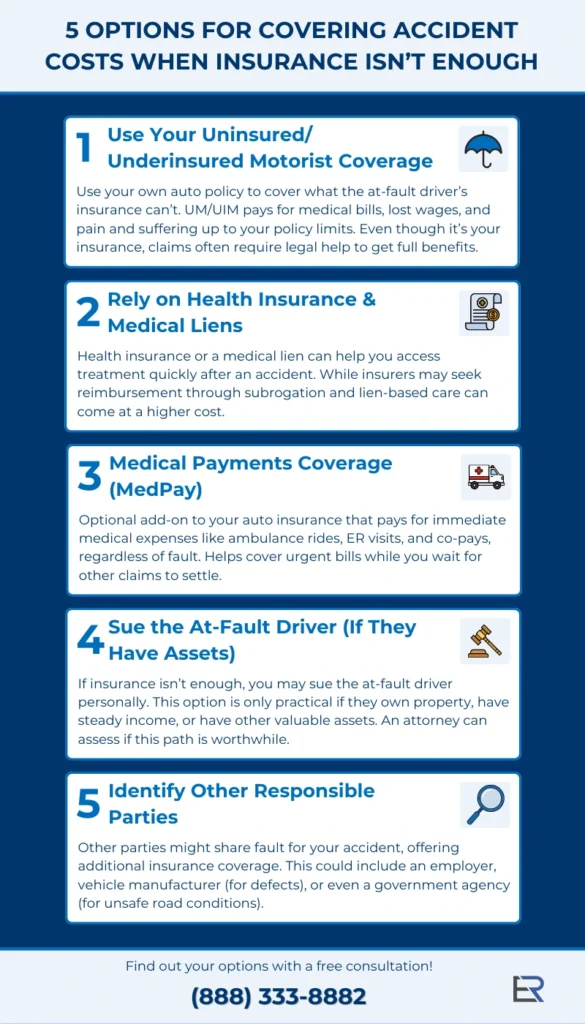
Realizing the other driver’s insurance won’t cover your injuries is frustrating, but it doesn’t mean you’re out of options. Alternative paths are available to help you secure fair compensation. Here are the primary avenues for recovering additional compensation under California law.
Option 1: Your Uninsured/Underinsured Motorist (UM/UIM) Coverage
Uninsured/underinsured motorist (UM/UIM) coverage is often your most important source of recovery when the at-fault driver has no insurance or insufficient coverage. It is part of your own auto insurance policy.
Under California Insurance Code § 11580.2, insurers are required to offer UM/UIM coverage to every California policyholder. However, you may have waived this coverage in writing when you purchased your policy. Check your declarations page to confirm whether you have this coverage and at what limits.
How UIM Coverage Actually Works in California: California follows a “limits trigger” approach. Your UIM carrier pays the difference between your UIM policy limit and the amount actually paid by the at-fault driver’s liability insurer — not the difference between your total damages and the at-fault driver’s limits.
Example: You have $100,000 in UIM coverage. The at-fault driver has $30,000 in liability coverage, and their insurer pays $30,000. Your UIM carrier’s maximum obligation is $70,000 ($100,000 minus $30,000) — regardless of whether your total damages exceed $100,000.
Watch Out: Insurance companies frequently attempt to minimize UIM payouts even on valid claims. An experienced attorney can help you document your damages fully and push back against lowball offers.
UM/UIM coverage typically covers medical expenses, lost wages, and pain and suffering up to your policy limits. In hit-and-run accidents where the at-fault driver is never identified, UM coverage also applies.
Recommended Reading:
- Do I Have An Uninsured/Underinsured Motorist Claim?
- How to Handle a Denied Uninsured or Underinsured Motorist Claim
- Consequences of Getting in a Car Accident with No Insurance
Option 2: Medical Payments Coverage (MedPay)
Medical Payments Coverage, commonly known as MedPay, is an optional benefit you can add to your auto insurance policy.
It helps cover immediate medical expenses after a car accident, regardless of who was at fault. While some states require drivers to carry MedPay, California does not mandate it. However, having MedPay can provide critical financial relief while larger insurance claims are being resolved.
Common Medical Costs Covered by MedPay:
- Ambulance rides
- Emergency room visits
- Initial medical treatments
- Out-of-pocket medical costs (like co-pays or deductibles)
Policy limits vary from as little as $1,000 up to $100,000 or more, depending on your carrier and selected coverage. Unlike UIM benefits, MedPay is typically paid quickly without the need to establish fault.
Option 3: Your Health Insurance and Medical Liens

If the at-fault driver’s insurance doesn’t cover all your medical expenses, health insurance or a medical lien may help you get the care you need without delay. Both can be valuable tools, but each comes with important conditions.
Covering Car Accident Injuries with Health Insurance
Health insurance can help cover treatments related to your injuries, such as hospital stays, surgeries, doctor visits, prescription medications, and physical therapy. One of its biggest advantages is that it provides immediate access to medical care, allowing you to begin your recovery without waiting for your personal injury claim to resolve.
However, most policies include a subrogation clause, which allows your insurer to seek reimbursement from your settlement. In California, the made-whole doctrine may limit this right, protecting you from having to repay the insurer until you’ve been fully compensated for your losses. It’s important to review your health plan carefully. If you’re unsure about your policy’s terms, a personal injury attorney can explain your rights and help protect your financial recovery.
Paying for Medical Care with a Lien After an Accident
If you do not have health insurance, some healthcare providers will treat you under a medical lien arrangement — meaning they agree to defer payment until your case resolves, with reimbursement coming directly from your settlement.
This can be a useful way to access quality care promptly. Note that lien rates are sometimes higher than standard insurance rates, and lien amounts may be negotiable at the time of settlement.
Recommended Reading:
- Treatment with Health Insurance Versus On A Doctor’s Lien
- How to Pay Medical Bills after a Car Accident Injury
Option 4: Suing the At-Fault Driver Personally
If the at-fault driver’s insurance is exhausted and your own coverage is insufficient, you may pursue a personal judgment against the driver for the remaining amount. This option is only worth pursuing if the driver has assets or income that could realistically satisfy a judgment.
Before deciding to sue personally, consider the following California-specific realities:
- California’s homestead exemption (AB 1885) protects between $300,000 and $600,000 of a debtor’s home equity, depending on the county median home price. This means the at-fault driver’s home is often protected from collection.
- Wage garnishment in California is subject to significant exemptions and is limited to a percentage of disposable earnings. Collecting on a judgment can be a slow, expensive process.
- Judgments in California are valid for 10 years and renewable, but enforcement requires ongoing legal effort and court proceedings.
- If the driver has no significant assets or income, a judgment may be uncollectible regardless of its size.
It’s worth highlighting that in some cases, suing a judgment-proof defendant costs time and money with little prospect of recovery.
Injured in a car accident in California?
Our California car accident attorneys offer a free, no-obligation consultation — no fees unless we win.
Talk to a California car accident lawyer → 213-985-1120Option 5: Third-Party Liability Claims
The at-fault driver may not be the only party legally responsible for your accident. A thorough investigation may identify other defendants who share liability. This can open the door to larger insurance policies and deeper financial resources.
Potential third-party claims may include:
- Employer Liability: If the driver was working (delivery driver, rideshare, etc.), their employer’s commercial insurance may cover the damages.
- Vehicle Manufacturer: Defects like brake failure or airbag malfunctions could lead to a product liability claim.
- Government Entities: Poor road conditions, missing signs, or faulty traffic signals could make a city, county, or state agency partially responsible.
These additional claims can make a significant difference in cases where the at-fault driver’s liability coverage is insufficient.
Protecting Your Claim When Policy Limits Aren’t Enough
Navigating multiple insurance claims, medical liens, and potential lawsuits can be overwhelming. Insurance companies, whether it’s the at-fault driver’s insurer or your own, may try to minimize what they pay.
Having an experienced California car accident attorney on your side ensures that you explore every option for compensation. Our attorneys are here to guide you through what to do when the other driver’s insurance isn’t enough, so you’re not left navigating complex claims on your own.
At El Dabe Ritter Trial Lawyers, we will:
- Review your insurance policies and identify available coverages.
- Handle negotiations with all insurance companies.
- Manage medical liens to protect your settlement.
- Investigate additional third-party responsibility.
- File lawsuits when needed to recover full compensation.
Schedule Your Free Consultation and Explore Every Option!
If you’ve been injured in a car accident and just learned that the other driver’s insurance isn’t enough to cover your medical bills, lost wages, and other expenses, don’t panic. You have more options than you might think.
You’re not alone! Our car accident attorneys assist clients every day who are dealing with limited insurance coverage after an accident. Your consultation is completely free, and you don’t pay us unless we win your case. Reach out today to protect your future!
