
The paved multi-use path running parallel to Pacific Coast Highway is one of Surf City’s finest amenities, but as motorized cycling has expanded, e-bike accidents on the Huntington Beach Strand have become a major public safety concern. Navigating a 10-to-14-foot-wide path creates unique liability challenges when 28-mph electric bicycles mix with dense pedestrian traffic near the pier and coastal parking ramps. Determining who is legally responsible for medical bills and lost wages in these shared-space collisions requires a clear understanding of both state laws and local city codes.
Below, our experienced Huntington Beach e-bike accident attorneys break down how liability works on the beach path, what local rules apply, and how injured victims can seek full compensation.
Why the Huntington Beach Strand Is a Hotspot for E-Bike Accidents
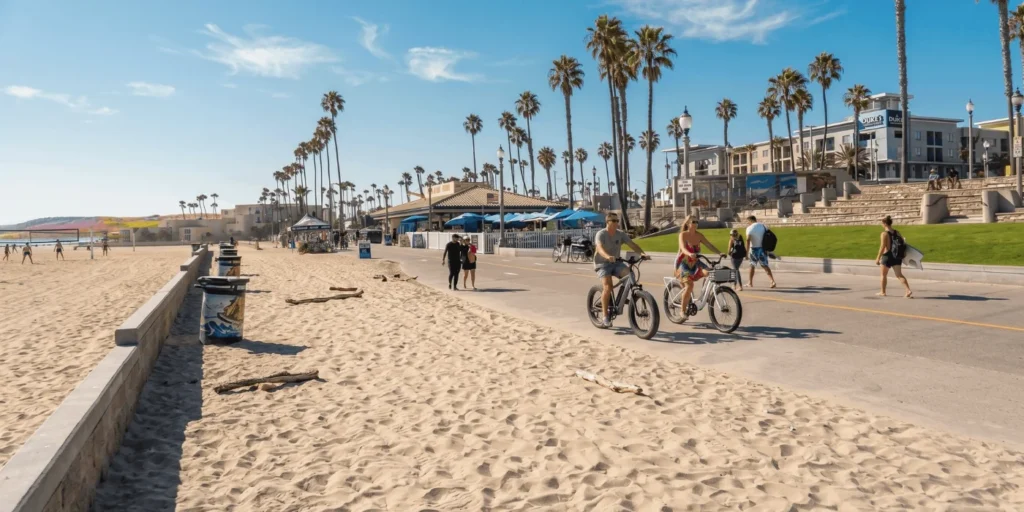
Over the last decade, electric bicycles have become a popular way to travel along Huntington Beach’s coastline. As ridership has grown, so have serious injuries. According to recent medical research, e-bike injuries increased by 90.9% between 2019 and 2022, reflecting the rapid rise in e-bike use across the country.
The Huntington Beach Strand presents a unique combination of conditions that make collisions more likely than on a typical bike path:
- Heavy Pedestrian and Tourist Traffic: Thousands of pedestrians, families with strollers, runners, and dog walkers share a paved path that is often only 10 to 14 feet wide.
- Speed Differences: Pedestrians typically travel at 3 to 5 mph, while traditional cyclists often ride at 10 to 15 mph. Depending on their class, e-bikes can reach assisted speeds of 20 to 28 mph, creating a significant speed difference on crowded sections of the Strand.
- Busy Crossings and Parking Lot Entrances: Areas around the Huntington Beach Pier, Pacific City, Bolsa Chica State Beach, and beach parking lot entrances experience constant crossing traffic from pedestrians, cyclists, and vehicles.
- Rental E-Bikes: Visitors renting e-bikes near Main Street and Pacific Coast Highway may be unfamiliar with the weight, acceleration, and braking characteristics of electric bicycles.
Together, these conditions create an environment where even a brief lapse in attention can lead to a serious collision.
Who Is Liable for an E-Bike Accident on the Huntington Beach Strand?
Liability for an e-bike accident on the Huntington Beach Strand depends on who acted negligently. In many cases, more than one person or business may share responsibility. To recover compensation, you must show that another party’s negligence caused your injuries.
Depending on the circumstances, liable parties may include:
- Another E-Bike Rider or Cyclist: Riders who speed, fail to yield, ride recklessly, or operate an unauthorized e-bike on the Strand.
- Negligent Pedestrians: Pedestrians who step into the bike path without looking, walk in designated bike lanes, or allow an unleashed dog to create a hazard.
- Motorists: Drivers entering or exiting beach parking lots or access roads who fail to yield to riders crossing the Strand.
- E-Bike Rental Companies: Businesses that rent unsafe e-bikes due to poor maintenance or mechanical defects.
- Manufacturers & Parts Suppliers: Companies responsible for defective brakes, batteries, throttles, or other components that contribute to a crash.
- Parents of Minors: Under California Civil Code § 1714.1, parents may be financially liable for injuries caused by their minor children’s willful misconduct.
- Government Entities: The City of Huntington Beach or California State Parks may be liable if dangerous public property, such as damaged pavement or hazardous path conditions, contributed to the accident.
Understanding California’s Pure Comparative Negligence Rule
California follows a pure comparative negligence system. This means you may still recover compensation even if you were partly responsible for the accident. For example, if you are found 20% at fault because you were riding slightly over the speed limit, your compensation would simply be reduced by 20%. You are not automatically prevented from recovering damages simply because you shared some responsibility for the crash.
Who Pays for an E-Bike Accident on the Huntington Beach Strand?
Many people assume the person who caused the accident will pay for the damages out of pocket. In reality, compensation usually comes from one or more insurance policies. Depending on the circumstances, coverage may be available through a homeowner’s or renter’s insurance policy, an auto insurance policy (if a vehicle was involved), a commercial policy for a rental company or business, or an umbrella policy for catastrophic injuries.
Identifying every available insurance policy is an important part of maximizing compensation after an e-bike accident. An experienced Huntington Beach E-bike accident attorney can investigate the accident and determine which insurance policies may apply.
What Compensation Can You Recover After a Huntington Beach Strand E-Bike Accident?
If someone else’s negligence caused your injuries, California law allows you to pursue compensation for both the financial losses and the personal impact the accident has had on your life. Depending on your injuries, you may be able to recover compensation for:
- Medical Expenses: Emergency treatment, hospital stays, surgeries, diagnostic testing, physical therapy, medications, and future medical care.
- Lost Income & Future Earning Capacity: Reimbursement for wages lost while taking time off to recover, as well as compensation if your injuries permanently affect your ability to work or earn a living in the future.
- Pain and Suffering: Physical pain, emotional distress, anxiety, loss of enjoyment of life, and other non-economic damages caused by the accident.
- Rehabilitation and Long-Term Care: Ongoing rehabilitation, occupational therapy, assistive devices, or future surgeries that may be necessary because of your injuries.
- Permanent Disability or Disfigurement: Compensation for lasting physical impairments, scarring, or reduced quality of life.
- Property Damage: The cost to repair or replace your e-bike, helmet, phone, riding gear, or other personal property damaged in the collision.
If more than one party contributed to the accident, California law may reduce your recovery based on your percentage of fault, but they do not automatically prevent you from recovering compensation.
Common Causes of E-Bike Accidents on the Beach Path
Establishing negligence after a beach path crash requires showing how a rider, pedestrian, or driver breached their duty of care. On the Huntington Beach Strand, liability typically traces back to these common factors:
- Excessive Speed in Crowded Zones: Riding at speeds exceeding 15 to 20 mph through crowded pedestrian zones near the pier.
- Failure to Yield Right-of-Way: Failing to yield to pedestrians in designated crosswalks or passing other cyclists without leaving a safe margin.
- Distracted Riding: Looking at cell phones, taking photos of the ocean, or wearing dual-ear headphones while navigating high-density areas.
- Blind Corners and Access Ramp Congestion: Weaving through pedestrian foot traffic near public restrooms, concessions, and stairways leading down from PCH.
- Sand Accumulation: Sudden loss of traction caused by loose ocean sand blown across the paved path.
- Unsafe Passing: Attempting to pass pedestrians or slower cyclists without leaving enough room on the narrow shared-use path.
- Wrong-Way Riding: Traveling against the flow of bicycle traffic, making head-on collisions more likely.
- Vehicles Entering Beach Parking Lots: Drivers crossing the Strand without yielding to approaching cyclists or e-bike riders.
Proving which of these factors caused your crash is the foundation of building a successful personal injury claim and holding the responsible party accountable.
21-Year-Old E-Biker Dies Following Recent Fatal Huntington Beach Crash
Serious e-bike crashes can happen in seconds. A recent Huntington Beach collision that claimed the life of a 21-year-old rider underscores how quickly riders can lose control, particularly when speed, roadway conditions, or unexpected hazards are involved.
– KTLA
Huntington Beach Strand E-Bike Laws Every Rider Should Know
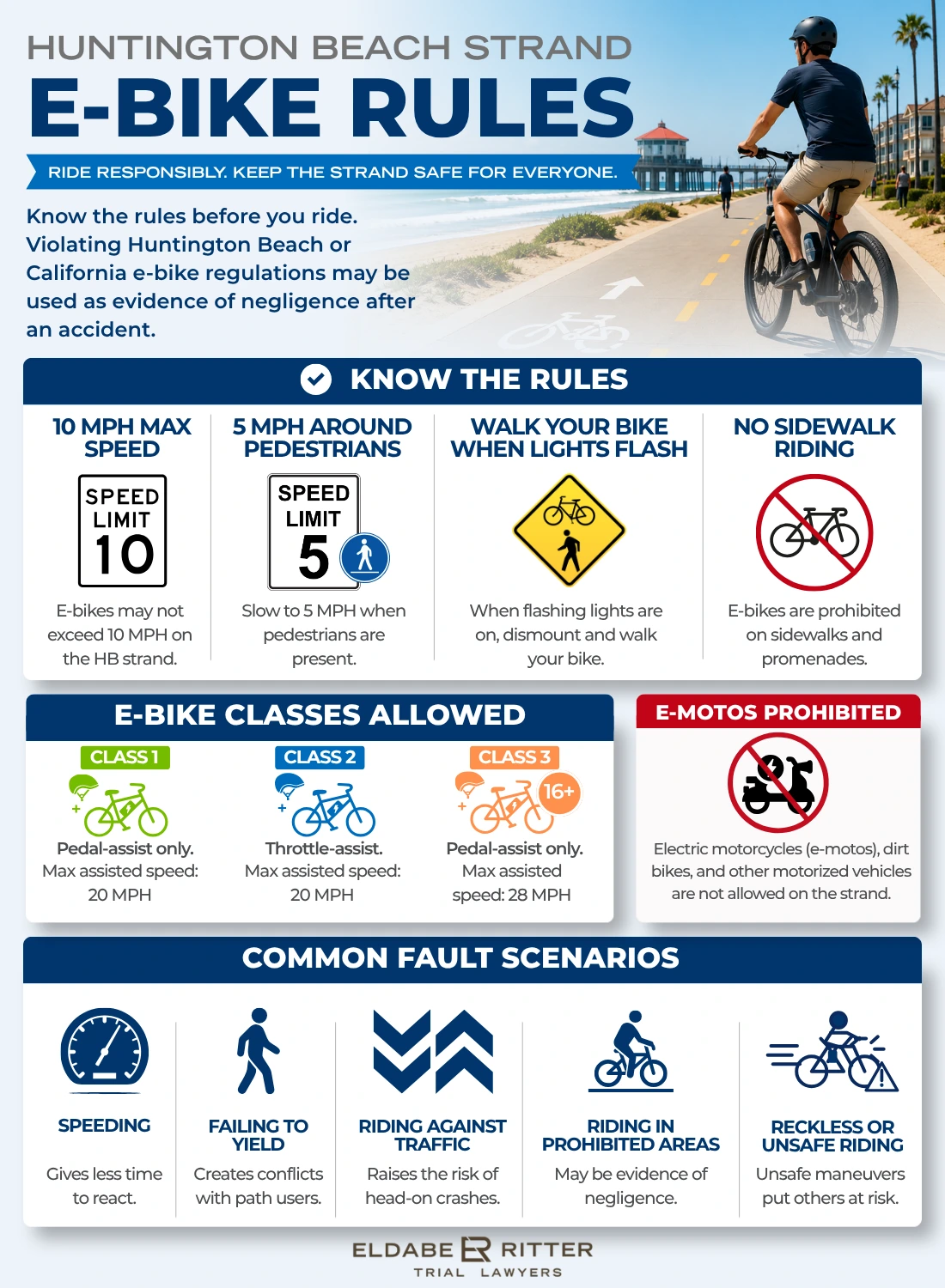
Both California law and the Huntington Beach Municipal Code regulate how e-bikes may be operated on the Strand. Violating these rules may be used as evidence of negligence after a crash.
The Strand Speed Limits & Flashing Lights
Under Huntington Beach Municipal Code § 13.08.280(c)(1), the absolute maximum speed limit on the beach bicycle path is 10 MPH. Furthermore, riders are legally required to reduce their speed to 5 MPH when pedestrians are present. Under HBMC § 13.08.280(c)(2), riders must dismount and WALK their bicycles when yellow warning lights are flashing on designated sections of the Strand.
Strict Ban on Sidewalks and “Off-Limit” Zones
E-bikes are strictly banned on the beach sand, beach service roads, and the Huntington Beach Pier itself. Additionally, under HBMC § 10.84.160, operating an e-bike on sidewalks within Downtown Huntington Beach (Districts 1, 2, and 3) or on sidewalks adjacent to public schools, churches, recreational centers, and parks is illegal. Riding in these off-limit areas heavily shifts legal fault onto the rider if a pedestrian is struck.
The “Unsafe Manner” Catch-All Rule
HBMC § 10.84.140 prohibits riding an e-bike or similar conveyance in an “unsafe manner” anywhere in the city. Unsafe riding explicitly includes:
- Riding against the flow of traffic on bike paths or lanes.
- Carrying passengers on an e-bike not specifically designed with passenger seating.
- Doing wheelies or intentionally lifting wheels off the ground.
- Swerving recklessly around stopped foot traffic.
Police officers have full authority to issue citations and impound the e-bike if an operator rides dangerously.
E-Bike Age Limit & Class Restrictions
California categorizes e-bikes into three classes:
- Class 1 & 2: Pedal-assist or throttle up to 20 mph. Allowed on the Strand subject to path speed limits.
- Class 3: Pedal-assist up to 28 mph. Operators must be at least 16 years old (CVC § 21213).
- Helmet Rules: Riders under 18 years old must wear an approved helmet on all e-bike classes (CVC § 21212). All Class 3 riders, regardless of age, must wear a helmet.
For a broader breakdown of state-level restrictions, check out our guide on California E-Bike Laws Every Rider Should Know.
E-Bikes vs. E-Motos: Why the Difference Matters After an Accident
A growing safety concern on the Huntington Beach Strand is the illegal use of e-motos—high-powered electric vehicles such as Sur-Ron, Talaria, and Segway dirt bikes. Although they may resemble e-bikes at first glance, e-motos are treated very differently under California law.
Operating an e-moto on the Strand violates state and local laws, and their higher speeds and heavier frames frequently cause severe, high-impact injuries. Because insurance coverage involving e-motos can be significantly more complex than a typical bicycle accident, identifying all available policies may require a detailed legal investigation.
To learn more about these vehicle classifications, read our detailed article on E-Bikes vs. E-Motos: Legal Differences and Insurance Coverage.
How Do You Prove Fault After an E-Bike Accident?
The sooner evidence is preserved, the stronger your claim may be. Surveillance footage from nearby businesses or public cameras may only be available for a short time, and witness memories can quickly fade. Gathering evidence immediately after the accident can make it much easier to establish who was responsible.
Important evidence may include:
- Huntington Beach Police Reports: Call 911 immediately so HBPD or State Park Rangers can respond, interview parties, and issue formal collision reports.
- Video & Surveillance Footage: City cameras near the HB Pier, beach concession stands, and nearby PCH businesses frequently capture path traffic.
- Eyewitness Statements: Obtain contact details from nearby beachgoers, lifeguards, or other cyclists who observed the crash.
- Digital Telemetry & Bike Inspection: Speed sensors, GPS tracking apps, and physical damage patterns on the bike frame help accident reconstruction experts determine exact speeds at impact.
- Medical Documentation: Detailed treatment records establish the physical link between the collision force and your injuries.
Partnering with an experienced Huntington Beach e-bike accident attorney early on ensures this vital evidence is properly secured before it is erased, lost, or overwritten.
What To Do After an E-Bike Accident on the Huntington Beach Strand
The actions you take immediately after an e-bike accident can affect both your recovery and your ability to pursue compensation. If you are injured on the Huntington Beach Strand, consider taking the following steps:
- Report the Accident: Call 911 immediately and notify HBPD or law enforcement so an official incident report is logged.
- Seek Medical Attention Immediately: Visit Huntington Beach Hospital, Hoag Health Center Huntington Beach, Orange Coast Medical Center, or the nearest emergency room. Keep in mind that some injuries are not immediately apparent.
- Document the Scene: Take photos and videos of the exact location on the Strand, path conditions, sand hazards, warning signs, damaged e-bikes, and visible bodily injuries.
- Gather Witness Information: Collect names, phone numbers, and email addresses from everyone who witnessed the incident.
- Preserve All Physical Evidence: Keep your damaged e-bike, helmet, torn clothing, and riding gear in their exact post-crash state. Do not repair or clean anything.
- Avoid Insurance Statements: Do not give recorded statements or accept early settlement offers from insurance adjusters without legal representation.
- Consult a Local E-Bike Accident Attorney: Partner with an experienced Huntington Beach E-Bike lawyer who understands Huntington Beach municipal codes and coastal injury claims.
Taking these prompt, deliberate steps protects both your health and your legal rights, putting you in the strongest position to recover the compensation you deserve.
Frequently Asked Questions About Huntington Beach Strand E-Bike Accidents
What is an e-bike under California law?
Under California Vehicle Code § 312.5, an e-bike is a bicycle equipped with fully operable pedals and an electric motor of less than 750 watts (1 horsepower), classified into Class 1 (pedal-assist up to 20 mph), Class 2 (throttle-assisted up to 20 mph), or Class 3 (pedal-assist up to 28 mph).
Do I have to wear a helmet while riding an e-bike in Huntington Beach?
If you are under 18 years old, you are legally required to wear a helmet on any e-bike. If you are riding a Class 3 e-bike, helmets are mandatory for all riders regardless of age.
Can I recover compensation if I was partially at fault?
Yes. California law allows you to recover compensation even if you share partial responsibility. Your final recovery will simply be reduced by your assigned percentage of fault.
Can I sue the City of Huntington Beach if a path defect caused my e-bike accident?
Yes, but government claims are subject to strict deadlines. Under the California Government Claims Act, you must file a formal administrative claim with the City of Huntington Beach within six (6) months of the accident date.
What if my accident involved a rental e-bike?
If a rental shop provided a defective e-bike or failed to maintain its braking systems, the shop may be liable. If another tourist riding a rental hit you, their personal homeowners/renters insurance or liability coverage purchased through the rental agreement may cover your claim.
What if an e-bike battery or mechanical defect caused the crash?
If a mechanical failure, sudden acceleration malfunction, or battery explosion caused the crash, you can file a product liability lawsuit against the bike’s manufacturer or component supplier without needing to prove standard negligence.
Can I recover compensation if I was riding in an area where e-bikes were not permitted?
Yes. Riding in an unauthorized area (such as a sidewalk or the pier) may be considered partial negligence, but it does not give other riders or motorists a right to run into you. You can still hold the primary negligent party responsible under comparative fault principles.
Injured in an E-Bike Accident on the Huntington Beach Strand? Get a Free Case Evaluation
An e-bike accident on the Huntington Beach Strand can leave you facing painful injuries, mounting medical bills, and uncertainty about what comes next. Establishing who was at fault often requires immediate evidence preservation and a thorough understanding of both California law and Huntington Beach’s local regulations.
Working with trial-tested Huntington Beach e-bike accident lawyers at El Dabe Ritter Trial Lawyers ensures your rights are protected without stress or financial risk.
Call our local PCH team today at (714) 536-9366 or contact us online to review your case for free. We offer 24/7 availability, bilingual service, and a no-fee-unless-we-win promise.
