
“Don’t worry, he’s friendly.”
You may hear that as a dog runs toward you at a park or beach. But if the dog bites, knocks you down, or causes another injury, a more important question quickly takes over: who is responsible?
Answering that question can depend in part on where the attack happened and what rules applied there. Huntington Beach has different rules for dogs in city parks, at Dog Beach, on other beaches, and around businesses. After dog attacks in Huntington Beach, violating a leash rule can be relevant to liability, but it does not automatically make someone responsible for an attack.
This guide explains Huntington Beach leash rules, when a dog owner or someone else may be responsible, and what to do after an attack. If you were injured, our Huntington Beach Dog Bite Lawyers can help you understand your options.
Huntington Beach Leash Laws: Where Must Dogs Be Leashed?
Huntington Beach leash laws can vary depending on where you are. A dog may be allowed in one area but required to be leashed—or prohibited entirely—in another.
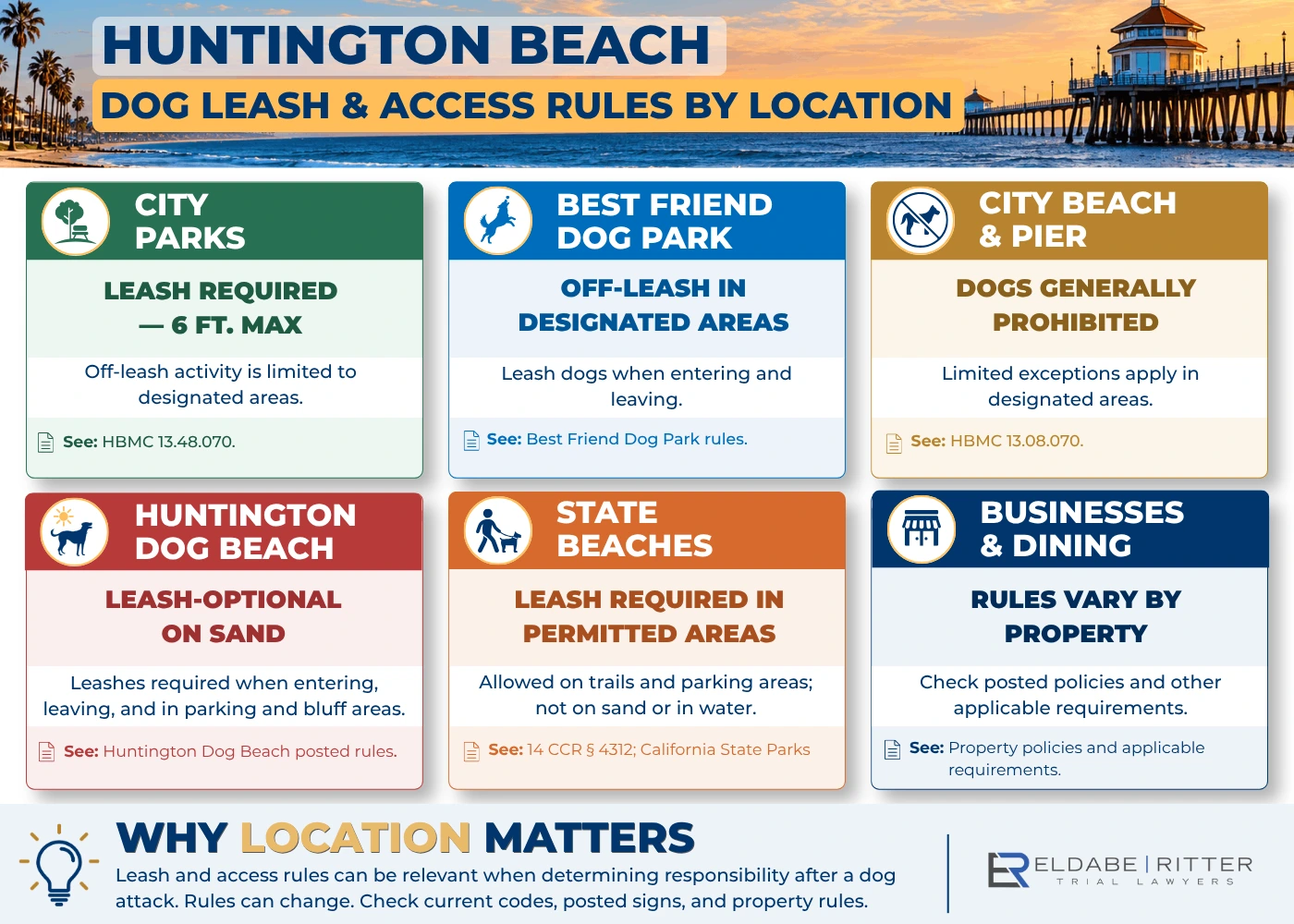
Here are some of the key local rules:
- City parks: Under HBMC § 13.48.070, dogs generally must be physically restrained by a leash no longer than six feet.
- Best Friend Dog Park at Huntington Central Park: This designated dog park allows dogs to be off-leash within the enclosed dog areas. However, an attack occurring there does not necessarily eliminate potential owner liability simply because the dog was allowed to be off-leash.
- Huntington Beach city beach and Pier: HBMC § 13.08.070 generally prohibits dogs on the Pier and most city beach areas. The code provides an exception for the designated northern beach area and states that dogs there must be restrained by a leash no longer than six feet.
- Huntington Dog Beach: Located along PCH between Goldenwest Street and Seapoint Street, Dog Beach operates as a leash-optional area on the sand under its posted visitor rules. Dogs must be leashed when entering and leaving the beach, in the parking lot, and on the upper bluff.
- Bolsa Chica State Beach and Huntington State Beach: These state-operated beaches follow California State Parks rules. Dogs are allowed on the multi-use trail and in parking areas but not on the sand or in the water. Under 14 CCR § 4312, dogs in permitted areas generally must be kept on a leash no longer than six feet and under the owner’s immediate control.
- Businesses and outdoor dining areas: Restaurants, shopping centers, and other private businesses may have their own rules for dogs on the property. Whether a leash was required can depend on the location and circumstances.
If an off-leash dog attack in Huntington Beach happens at a location where a leash was required, the violation may be relevant to an injury claim. But a leash violation does not automatically determine liability; how the attack happened still matters.
For a broader look at rules throughout the state, see our guide to California dog leash laws.
When Is a Dog Owner Liable for a Dog Attack in California?
Whether a dog owner is liable can depend on how and where the attack happened. California’s strict liability law for dog bites differs from the rules that may apply when a dog knocks someone down, chases them, or causes a fall without biting.
California Strict Liability for Dog Bites
Under California Civil Code § 3342, dog owners can be held strictly liable when their dog bites someone in a public place or while that person is lawfully on private property.
What makes this rule important is that liability does not depend on the dog having a history of aggression. You generally do not have to prove that the dog had bitten someone before or that the owner knew the dog might be dangerous. California does not follow the traditional “one-bite rule.”
What If the Dog Did Not Bite You?
Not every dog attack involves a bite. A loose dog might knock someone down, chase a cyclist, or cause someone to fall while trying to get away.
You may still have a claim, but different rules apply. For a non-bite injury, liability may depend on whether the dog’s owner or the person controlling the dog failed to use reasonable care and whether that failure contributed to the injury.
Evidence that the dog was uncontrolled, improperly restrained, or allowed to run loose may become important in these cases.
Does an Off-Leash Violation Make the Owner Liable?
If a dog was off-leash where a leash was required, that can be important evidence. But the violation alone does not by itself make the owner responsible for an injury.
A leash-law violation can sometimes create a presumption of negligence under California Evidence Code § 669. This can apply when the violation contributed to the injury and the injury was the type the leash law was designed to prevent.
For example, if an unleashed dog runs across a Huntington Beach park and knocks someone down, the leash violation could help show how the owner’s failure to control the dog contributed to the injury.
Can Someone Besides the Dog Owner Be Liable?
The dog owner is often the first person considered after an attack, but depending on what happened, someone else may also share responsibility.
That could include:
- Another person handling the dog: Someone walking or controlling the dog may be responsible if their own negligence contributed to the attack.
- A landlord: In some cases, a landlord may be liable if they actually knew a tenant’s dog was dangerous and had the ability to take steps that could have prevented the harm.
- A business or property operator: If an attack happens at a restaurant, shopping center, or other business, liability may depend on whether the business knew or had reason to know the dog posed a danger and whether reasonable steps could have been taken to protect customers.
For example, a dog attack on a patio near Main Street, Pacific City, or another Huntington Beach business does not automatically make the business responsible. What the business knew and the circumstances leading up to the attack can matter.
For a closer look at these situations, read our guide on who may be liable for a dog bite at a business.
What Should You Do After a Dog Attack in Huntington Beach?
Evidence from the scene can help show how the attack happened, whether a leash or access rule was violated, and who may be responsible. Because some evidence can disappear quickly, taking a few steps after the attack can help protect your claim:
- Get medical care. Dog bites can become infected even when the wound appears minor. Prompt treatment can protect your health and document your injuries for your claim.
- Identify the dog, owner, and handler. Get the name and contact information of the dog’s owner and the person who was handling the dog, if different. Ask for available information about the dog and its vaccination history. If possible, also get relevant insurance information, since coverage may be available depending on the circumstances.
- Document what happened. Take photos or video of your injuries, the location, the dog, and the leash or lack of one. Photograph and preserve torn clothing or damaged property, and document gates, warning signs, or anything else that may help show where and how the attack occurred.
- Look for witnesses and cameras. Get contact information from anyone who saw what happened. If the attack occurred near a restaurant, store, apartment building, or parking lot, note any surveillance cameras that may have captured it.
- Report the attack. Huntington Beach contracts with OC Animal Care for animal-control services. Reporting the incident can create a record of what happened and allow animal-control or public-health authorities to address any applicable rabies-control requirements.
Some evidence may not be available for long. Surveillance footage can be overwritten, witnesses can become harder to locate, and the scene may change after the attack. Documenting these details early can help preserve a clearer picture of what happened if responsibility is later disputed.
For more tips on preserving evidence, read our guide to properly documenting a dog bite injury.
What Compensation Can You Recover After a Dog Attack?
Dog attacks can cause cuts, infections, nerve or tendon damage, broken bones, scarring, and emotional harm. If someone else is legally responsible, compensation may include:
- Medical expenses and future care, including treatment for lasting injuries or scarring.
- Lost income and reduced earning capacity if the injury affects your ability to work.
- Pain and suffering and emotional distress resulting from the attack.
- Scarring or disfigurement and its impact on your life.
The damages available depend on the injuries, treatment, time away from work, lasting effects, and other circumstances.
What can ultimately be collected may also depend on available sources of recovery, such as homeowners or renters insurance, other applicable liability coverage, and the assets of a responsible party.
How Long Do You Have to File a Dog Attack Claim in California?
In California, you generally have two years from the date of the injury to file a personal injury lawsuit after a dog attack under Code of Civil Procedure § 335.1. This can apply to injuries caused by a dog bite as well as other types of dog attacks.
Different or shorter deadlines can apply in some cases. For example, if you have a claim against a city, county, or another public entity, a government claim generally must be presented within six months of the injury. An attack happening on public property does not by itself make a public entity liable. Because exceptions can apply, the deadline depends on the circumstances of the claim.
FAQs About Dog Attacks in Huntington Beach
Is a dog owner liable if the dog was on a leash when it bit me?
Yes, potentially. Under California Civil Code § 3342, a dog owner can generally be held liable for injuries caused by a dog bite when the injured person was in a public place or lawfully on private property. Whether the dog was on a leash does not by itself determine liability.
What if an off-leash dog knocked me down but didn’t bite me?
You may still have a claim if the knockdown caused an injury, but different liability rules apply. In a non-bite case, liability may depend on whether the dog’s owner or the person controlling the dog failed to use reasonable care and whether that failure contributed to your injury.
Can I recover after a dog bite at a Huntington Beach park?
Potentially. Under California Civil Code § 3342, a dog owner can generally be held liable for injuries caused by a dog bite when the injured person was in a public place, such as a public park, or lawfully on private property. Whether you can recover will depend on the circumstances and whether the requirements of the law are met.
What if I was attacked at Huntington Dog Beach?
Being attacked in a leash-optional area does not by itself prevent you from bringing a claim. If the dog bit you, California’s dog-bite law may apply. If there was no bite, liability may instead depend on how the attack happened and whether someone’s failure to use reasonable care contributed to your injuries.
What if the dog owner says I provoked the dog?
The circumstances leading up to the bite can matter. If the owner claims you provoked the dog, evidence showing what happened before the attack may become important. But an accusation of provocation does not automatically defeat a dog-bite claim.
Are service dogs or emotional support animals exempt from liability after an attack?
No. A dog’s status as a service animal or emotional support animal does not by itself eliminate potential liability for an injury it causes. Service animals have public-access protections under the ADA, but they generally must remain under the handler’s control. Emotional support animals do not have the same general public-access rights under the ADA.
Get Legal Help After a Huntington Beach Dog Attack
After a dog attack, you may be dealing with medical treatment, missed work, and questions about who should be responsible for your injuries. You do not have to sort through the insurance and legal issues on your own.
The Huntington Beach dog bite lawyers at El Dabe Ritter Trial Lawyers can investigate what happened, identify potentially responsible parties, and explain your options for seeking compensation.
Contact us today for a free consultation. We are available 24/7, and there are no upfront fees. You pay no attorney’s fees unless we recover compensation for you.
