
Getting stuck on the shoulder of a major Los Angeles freeway is one of the most stressful experiences a driver can face. With traffic barreling past on the 405 or the 101 at 70 miles per hour, a disabled vehicle is highly vulnerable to catastrophic collisions.
To combat a rising tide of roadside tragedies, California rolled out a major legal update that completely changes the rules of the road for drivers passing a stranded vehicle. Understanding this new law is critical, as it directly impacts who is held legally and financially responsible if a roadside collision occurs.
At a Glance: California’s Roadside Safety Update (AB 390)
- The California Move Over Law Expands: As of January 1, 2026, motorists in California are legally mandated to yield space or drop their speed for any disabled civilian car parked on the shoulder, expanding previous rules that only protected emergency crews.
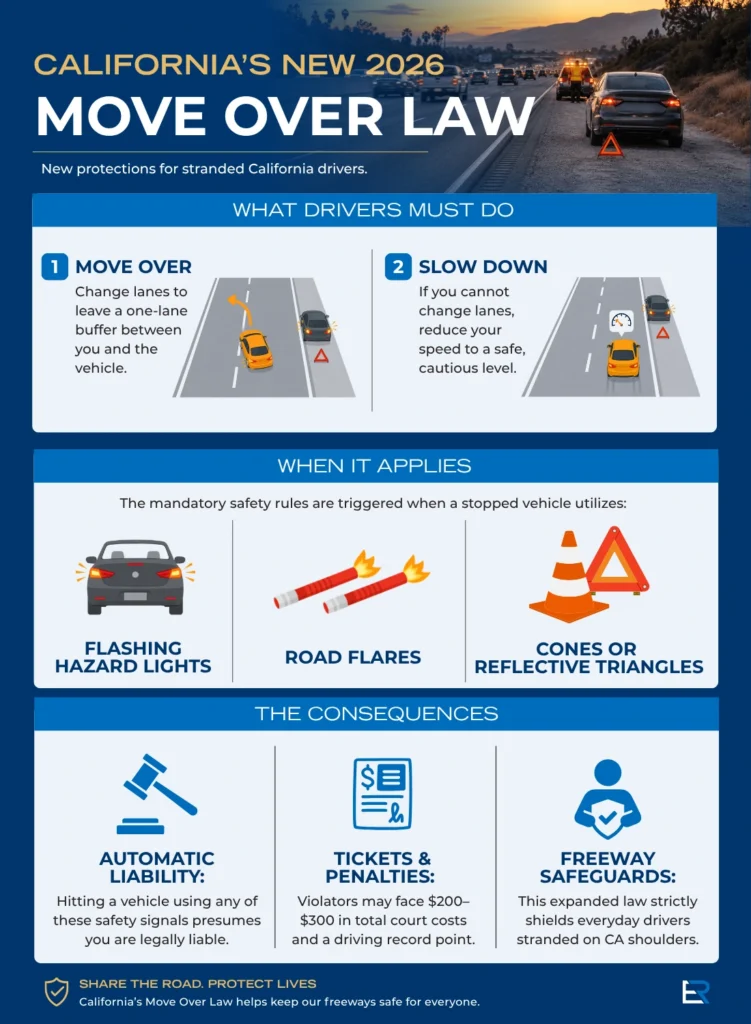
- Safety Signal Triggers: This statutory duty applies whenever a parked vehicle activates its hazard lights, sets out road flares, or sets up emergency cones or reflective triangles.
- Flipped Liability Framework: Shifting blame to a stranded driver is now much harder for insurers. Striking a car that has its emergency flashers on constitutes negligence per se (a presumed breach of law), holding the passing driver strictly accountable.
- Fines and DMV Record Impact: While the base infraction fine is $50, final court penalty assessments push the total cost of a citation to between $200 and $300 for non-compliance, which adds a moving violation point to the offender’s driving record.
- Our Proven Track Record: Shoulder collisions are incredibly high-stakes. Our Los Angeles car accident lawyers previously won a $7.4 million jury verdict for a client who sustained severe injuries when she was crushed between two cars on a California freeway shoulder.
The Shift: How AB 390 Updates the California Move Over Law
For years, California’s “Slow Down, Move Over” law only applied to emergency vehicles, tow trucks, and Caltrans highway workers. If you were an everyday commuter stuck changing a flat tire near the Hollywood Bowl or waiting for a tow on the 10, passing drivers were only expected to move over as a matter of courtesy.
That completely changed on January 1, 2026, when Assembly Bill (AB) 390 officially went into effect across the state, updating California Vehicle Code Section 21809. The law has now expanded to protect civilian drivers, making it a strict legal requirement to give space to any stationary vehicle displaying signs of distress.
Under the updated law, the legal mandate to slow down or move over is triggered by specific visibility markers. Drivers must comply if a stopped vehicle is utilizing any of the following:
- Flashing hazard lights (emergency flashers).
- Road flares placed behind the vehicle.
- Reflective emergency triangles or bright orange cones.
Whether you are an Uber driver waiting safely on the shoulder of Interstate 5 or a commuter dealing with an overheated engine, activating your hazards now grants your vehicle a strict layer of legal protection.
The Exact Rules: What are LA Drivers Legally Required to Do?
The updated vehicle code leaves no room for ambiguity regarding how motorists must behave when approaching a disabled vehicle.
Los Angeles drivers are now legally required to execute a two-step safety action plan the moment they spot emergency flashers ahead. These rules are designed to prevent the devastating sideswipe and rear-end collisions that frequently occur on narrow freeway shoulders.
Failing to follow these steps can result in heavy traffic fines, points on a driving record, and immediate civil liability if an accident occurs.
When approaching a stopped car with its hazards on, you must take these actions:
- Move Over: You must safely change lanes away from the stopped vehicle, putting at least one empty lane of traffic between your car and the stranded motorist.
- Slow Down: If bumper-to-bumper LA gridlock or unsafe road conditions make a lane change impossible, you must reduce your speed to a safe, cautious, and prudent level as you pass.
How AB 390 Impacts Car Accident Liability in Los Angeles
If you are hit while stranded on the side of an LA highway, the expanded law fundamentally alters how your personal injury claim will be handled. Previously, auto insurance companies blamed victims for parking too close to active traffic lanes.
Under California’s Move Over Law (CVC 21809), drivers striking a car with flashing hazards can be held strictly liable for damages. Violating this roadside safety statute means the law automatically presumes the passing driver was at fault.
To build a bulletproof injury claim under the new law, securing the right evidence is absolutely critical:
- Dashcam Footage: Video evidence proving your hazards were flashing before the impact eliminates any “he-said, she-said” disputes.
- CHP Traffic Reports: Ensure the California Highway Patrol or LAPD officer notes in their official report that your emergency signals or flares were properly deployed.
- Witness Statements: Statements from passengers or passing drivers who can confirm you took the proper steps to make your vehicle visible.
Recommended Reading: Understanding What Liability Insurance Covers in a Car Accident (And What It Doesn’t)
Real-World Case Study: Our $7.4 Million Jury Verdict for a Stranded Freeway Victim
Roadside and shoulder accidents are rarely minor fender benders—they frequently result in life-altering, catastrophic injuries. In fact, data from UC Berkeley’s SafeTREC Roadside Death Report highlights a severe crisis right here in our own backyard: Los Angeles County ranks number one in the state for fatal crashes involving parked vehicles, recording 63 tragic roadside fatalities in a single year. Our firm holds negligent parties accountable for these devastating freeway crashes.
In one notable case, our El Dabe Ritter Trial Lawyers secured a $7.4 million jury verdict for a 31-year-old woman who suffered catastrophic injuries on a freeway shoulder. After pulling over to exchange information following a minor collision, she was standing outside her vehicle when a passing commercial truck caused a multi-vehicle crash. The impact sent a careening car directly into the freeway shoulder, crushing her between the two vehicles.
Our client sustained a severely damaged popliteal artery that required emergency bypass surgery and extensive skin grafts. We successfully proved the hit-and-run truck driver’s ultimate responsibility at trial, ensuring the full scope of her medical and lifelong financial needs were covered. You can read more details about this case here: $7.4M Verdict for Woman Crushed Between Vehicles in Freeway Truck Crash.
What to Do If You Are Hit While Stranded on an LA Shoulder
The moments immediately following a high-speed freeway collision are chaotic and incredibly dangerous. Your immediate priority must always be your physical safety and protecting your legal rights.
Because cars are traveling at high speeds through corridors like the 110 or the 101, shoulder impacts often result in severe, delayed-onset injuries. Taking the right steps at the scene will ensure you can hold the negligent driver fully accountable for your medical bills and vehicle damage.
- Seek Immediate Medical Attention: Adrenaline can mask severe internal bleeding, concussions, and whiplash. Let emergency responders evaluate you immediately or go directly to an urgent care or ER.
- Document the Roadside Hazards: If it is safe, use your smartphone to take photos. Capture clear images showing that your vehicle’s hazard light switch was engaged and capture any deployed flares, cones, or triangles.
- Contact Law Enforcement and Gather Witness Info: Call 911 immediately to request an officer to the scene. A formal police report is vital. Additionally, collect contact information from any passing drivers or passengers who witnessed the crash.
- Decline Recorded Statements: Do not give a recorded statement to the at-fault driver’s insurance company. Adjusters are trained to twist your words to avoid liability; politely tell them your Los Angeles car accident attorney will handle all communication.
Frequently Asked Questions About the 2026 California Move Over Law
What is the penalty for violating the expanded Move Over Law in California?
A violation of California Vehicle Code Section 21809 is a moving violation infraction. While the base fine listed in the code text is up to $50, final court assessments, local penalty additions, and DMV administrative fees typically bring the total out-of-pocket cost of the citation to between $200 and $300, along with one point on your driving record.
Does the Move Over Law apply if a car is separated by a highway barrier?
No. Under CVC 21809(c), the legal mandate to slow down or change lanes does not apply if your vehicle is traveling on a section of the freeway that is completely separated from the stationary vehicle by a physical concrete median or guardrail.
What counts as a “warning device” under AB 390?
The 2026 legal update expanded the law to include any stationary vehicle displaying active factory hazard lights, lit road flares, bright orange traffic cones, or retroreflective warning triangles placed on the pavement.
What if I didn’t have time to put out flares or cones before being hit?
You are still protected. Under AB 390, the duty for passing motorists to slow down or move over is triggered if any of the safety markers are present. If you only had time to press your vehicle’s factory hazard light button before the impact, the passing driver is still in violation of CVC 21809 and can be held liable under negligence per se.
Can I still recover compensation if I was partially at fault for pulling over?
Yes. California follows a pure comparative negligence system. Even if an insurance company claims you pulled over unsafe or parked too close to the active lane, the passing driver shares liability if they failed to move over or reduce their speed. Any fault assigned to you will simply reduce your final financial recovery by that percentage, but it does not bar you from pursuing a lawsuit.
Does the 2026 Move Over Law apply to city streets or just major LA freeways?
The text of California Vehicle Code Section 21809 specifically states that it applies to a “person driving a vehicle on a highway.” Under California legal definitions, a “highway” is not restricted to high-speed freeways like the 405 or the 101—it broadly applies to any publicly maintained roadway open to vehicular traffic, including major local city avenues, boulevards, and undivided grid streets.
What if the passing driver claims they couldn’t see my hazard lights?
This is a standard tactic used by insurance adjusters to evade liability. The law requires motorists to maintain a vigilant lookout and adjust their driving behaviors according to visual roadway hazards. This is exactly why securing immediate traffic collision reports from the California Highway Patrol (CHP), witness contact info, or local dashcam footage is a priority to prove your hazard signals were functioning.
Speak with a Los Angeles Car Accident Lawyer Today
The updated California Move Over Law was passed to turn dangerous LA roadside stops into moments of safety, not tragedy. If a distracted or reckless driver ignored these updated rules and struck your vehicle on the highway, you should not have to pay for their negligence. Insurance companies are fully aware of these new regulations, but they will still try to minimize your payout if you handle the claim alone.
Contact our experienced car accident attorneys in Los Angeles today for a free consultation, and let us fight to secure the maximum compensation you deserve.
