
Not All Airbags Work the Same—And That Can Change Everything
If you’ve ever been in a car accident, you know how quickly everything happens. In that moment, the type of airbag that deploys can make a difference you may not notice right away.
Many people think all airbags function the same, but each type is designed for a specific kind of crash. That difference may influence how your body reacts during the impact and what you experience afterward.
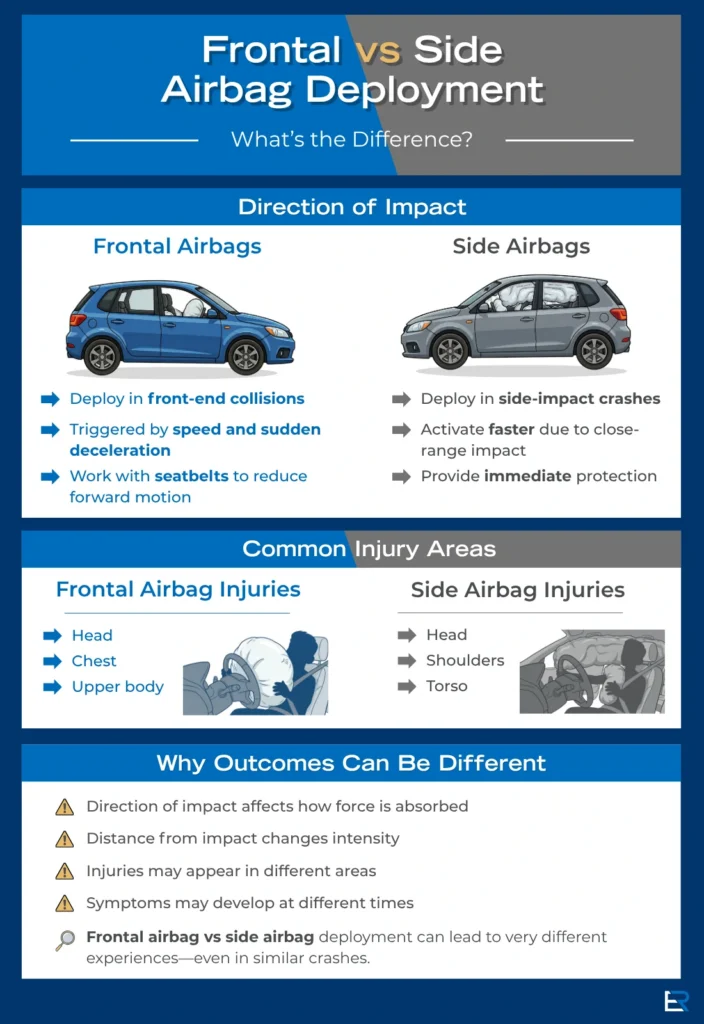
Looking at frontal airbag vs side airbag deployment can help explain why the same type of accident doesn’t always feel the same.
The Key Difference: Where the Force Comes From
Not all crashes affect the body in the same way. One of the biggest reasons comes down to the direction of the force.
When comparing the type of airbag involved, this difference can change how your body moves during the crash and how the impact is absorbed.
Here’s a simple way to understand it:
- Frontal crashes push your body forward
- Side crashes push your body sideways
- Side impacts often give you less space to absorb the force
Because of this, the type of airbag involved is not just about safety; it’s about how your body experiences the crash.
Frontal Airbags: Designed for Forward Motion
Frontal airbags are built to protect you during head-on or near head-on crashes. They work together with your seatbelt to slow your body as it moves forward.
These airbags help spread out the force of impact across areas like:
- Your chest
- Your face
- Your upper body
Small details, such as how close you are to the steering wheel, can affect how this protection works. This is one reason why frontal airbag vs side airbag deployment may lead to different outcomes.
Side Airbags: Built for Close-Range Impact
Side airbags are designed for a very different type of crash. They protect you when a vehicle is hit from the side, often with very little space between you and the impact.
Side airbags are designed to:
- Deploy faster than frontal airbags
- Protect your head and torso
- May include curtain airbags that drop from above
Because side impacts happen so close to you, the type of airbag involved may play an important role in how injuries develop.
Same Crash, Different Injuries—Here’s Why
Two people can be in the same accident but experience very different injuries. This often comes down to how the impact happens.
For example:
- In a frontal crash, your body moves forward into the airbag
- In a side crash, your body is pushed sideways toward the door
This difference in movement may affect:
- Which parts of your body are injured
- How the force is absorbed
- How symptoms appear after the crash
Understanding frontal vs side impact protection can help explain why injuries don’t always look the same.
Recommended Reading: The Hidden Risk of Airbags for Children After a Car Accident
Why Side Impacts Often Feel More Severe
Not all collisions feel the same, even at similar speeds. In side-impact crashes, the way force reaches your body is different from a head-on collision. This can make the experience feel more immediate and harder to anticipate.
Several factors contribute to this:
- There is less space between you and the point of impact
- The side of a vehicle has less structural protection
- The force reaches your body more quickly
As a result, these crashes can feel more intense and harder to react to. This is one way that frontal airbag vs side airbag deployment may lead to different experiences after an accident.
How Airbag Type May Affect Injury Documentation
After a crash, your injuries may not tell the full story right away. The type of airbag that deployed can provide insight into how those injuries happened. Looking at patterns in the body may help connect your injuries to the direction of impact.
For example:
- Frontal crashes may involve injuries linked to forward movement, such as:
- Chest bruising from the seatbelt or airbag
- Facial impact injuries (nose, mouth, or jaw)
- Wrist or forearm injuries from bracing against the steering wheel
- Side crashes may involve injuries closer to the point of impact, such as:
- Shoulder or upper arm injuries near the door
- Head injuries from contact with the window or side structure
- Neck strain from sudden side-to-side movement
Photos, medical records, and timelines may help show how your injuries developed. These details may provide a clearer picture of what occurred.
Recommended Reading: Chemical Burns from Airbag Deployment; Medical Treatment and Legal Options
Wondering What Your Next Step Should Be?
After a crash, small details can make a difference. A free consultation can help you get clarity on what may be relevant to your situation.
What Insurance Companies May Look At
After an accident, insurance companies often look at more than just whether the airbags deployed. They may review how the crash happened and what type of impact occurred. These details may influence how the situation is understood.
Some factors may include:
- The angle of the crash
- Where the vehicle was hit
- Which airbags deployed
- The location of the damage
In some cases, the type of airbag deployment may raise additional questions—especially if it does not seem to match the crash.
For example:
- A side airbag deploying in a lower-speed crash
- A frontal airbag not deploying when expected
These details may lead to a closer look at what happened and how the crash is evaluated.
What to Pay Attention to After Airbag Deployment
After a crash, it’s not always obvious how your injuries developed. Some symptoms may take time to appear, especially depending on how the impact occurred and which airbags deployed.
It may help to pay attention to:
- Where your body made contact
- Areas that feel sore or sensitive
- Symptoms that may show up later
These details may provide helpful context about how the crash affected your body. Looking at frontal airbag vs side airbag deployment may also help explain why injuries may appear differently or develop over time.
Looking for Answers After a Crash? We Can Help!
After an accident, the details can feel overwhelming. Between injuries, insurance questions, and uncertainty about what matters, it can be difficult to know where to start.
Our car accident lawyers can work with you to review what happened, explain what may be important, and help you move forward with a clearer understanding of your situation. We focus on giving you practical, easy-to-understand information so you can make the best decision for yourself.
A free consultation is a straightforward way to get the answers you’ve been looking for.
