
Navigating Los Angeles is a unique experience where high-speed state highways constantly merge with dense city streets, creating a complex environment for even the most seasoned drivers. While the city’s traffic is legendary, the safety trends shifting beneath the surface are what truly matter to local residents.
In this 2026 Report, staying informed means looking at the most recently finalized datasets. Our team analyzed over 6,000 recorded collisions from the 2025 calendar year to answer a critical question: How many daily crashes occur in Los Angeles? By examining these patterns, we can move past the general reputation of ‘bad traffic’ to look at the actual risks drivers face every day.
Note: This 2026 report utilizes finalized 2025 data from the LAPD and CHP, as official accident records typically have a reporting lag of 3–6 months.
Key Takeaways: 2025 Los Angeles Crash Data
- Daily Average: The city of Los Angeles saw roughly 18 car-on-car accidents every day.
- Peak Danger: Fridays from 3:00 PM – 6:00 PM are the most common times for crashes.
- Leading Cause: Unsafe speed triggered nearly 46% of all collisions.
- Common Injuries: 59% of victims reported a “Complaint of Pain,” which typically involves non-visible injuries that require medical evaluation.
- Top Collision Type: Rear-end impacts accounted for over half (53%) of all accidents.
Quick Facts: Los Angeles Car-on-Car Accident Statistics
When we analyze the raw data from the Transportation Injury Mapping System (TIMS), the reality of driving in the second-largest city in the U.S. becomes clear. While local headlines often focus on pedestrian safety, car-vs-car collisions remain the primary source of injury for Los Angeles residents and commuters.
- Total Annual Car Crashes: 6,782 (Passenger vehicle-to-vehicle only)
- The Victim Toll: 71 lives lost and 10,394 individuals injured within Los Angeles.
- The Highway Factor: Nearly 58.4% (3,958) of these accidents occurred on State Highways.
- Severity: Approximately 10.4% of victims in the city of Los Angeles suffered “Severe Injuries,” requiring immediate emergency intervention.
Behind every one of these numbers is a person whose life was interrupted. While these statistics help us drive more defensively through the city, they also serve as a reminder that even “minor” accidents on Los Angeles freeways like the 101 or 405 can lead to long-term medical challenges.
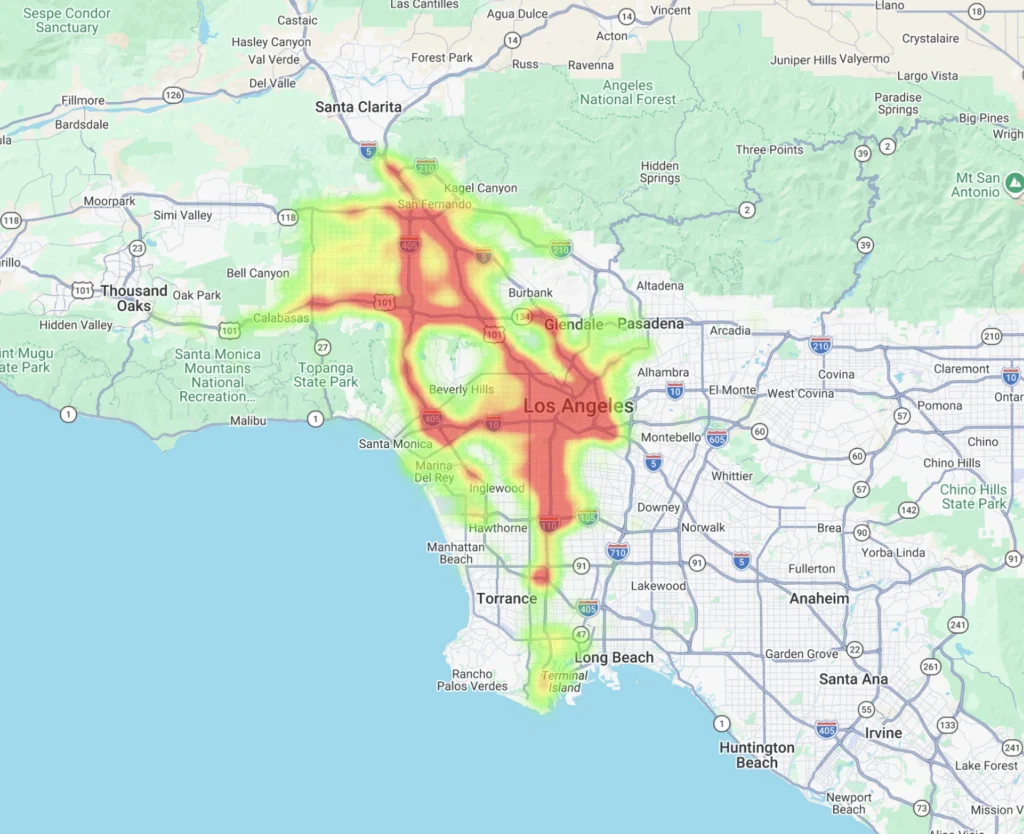
The “Danger Zone”: When Do LA Car Accidents Peak?
If you feel like your Friday commute is a high-stakes gamble, the data proves you’re right. Our analysis found that traffic rhythm dictates when you are most at risk of a collision.
The Deadliest Day to Drive in Los Angeles: Friday
Friday takes the top spot for accidents in Los Angeles, accounting for 1,083 crashes in a single year. As drivers rush to exit the city for the weekend or navigate the “Friday Night Lights,” fatigue and impatience often lead to costly errors.
The 3:00 PM – 6:00 PM Spike
The single most dangerous window to be on the road in Los Angeles is the late afternoon.
- In 2025, 1,272 crashes occurred between 3:00 PM and 6:00 PM.
- This three-hour window alone accounts for nearly 20% of all daily accidents.
Whether it’s the sun glare during the evening commute or the sheer volume of stop-and-go traffic on the I-110, this time slot is the “peak hour” for rear-end and sideswipe collisions.
Recommended Reading: Where Drivers Get the Most Cell Phone Citations in Los Angeles County
The Most Dangerous Intersections in Los Angeles
Our mapping of 2025 crash data identified specific “clusters” where car-on-car accidents are most frequent. If your daily commute takes you through these South LA and Valley hotspots, exercise extreme caution:
- Flower St & Vernon Ave (South LA): Situated directly alongside the I-110 (Harbor Freeway), this intersection is a notorious site for broadside collisions as heavy freeway traffic transitions onto local South Los Angeles streets.
- Hope St & Jefferson Blvd (Exposition Park/USC): Located blocks from BMO Stadium and the Coliseum, this intersection is a major hotspot for turning-related accidents due to the high volume of event-day traffic, student commuters, and Metro light rail crossings.
- Sepulveda Blvd & Flume Walk (Van Nuys/Lake Balboa): Located right near the Sepulveda Basin Wildlife Reserve, this stretch of Sepulveda handles massive valley commuter volume, often leading to high-speed rear-end crashes.
- Grand Ave & Vernon Ave: Another South Los Angeles hotspot where heavy commercial vehicle traffic mixes with passenger cars.
- Glendale Blvd & Palo Alto St (Echo Park): This hilly intersection near the 101 Freeway entrance is a frequent site for “fender benders” due to difficult sightlines and merging traffic.
Why Do These Accidents Happen? The “Big Three” Collision Types
In Los Angeles, the vast majority of car-on-car accidents aren’t mysterious. They are the direct result of the city’s unique blend of high-speed freeways and sudden, dense congestion. According to 2025 TIMS data, three types of collisions dominate the landscape:
- Rear-End Collisions (53.35%): Accounting for 3,618 crashes, rear-end collisions are the most common accident in LA. These typically happen on stop-and-go stretches of the I-405 or I-110 when drivers fail to react to sudden braking.
- Sideswipes (20.86%): With 1,415 incidents, sideswipes are a major issue on our multi-lane highways where aggressive lane-merging is a daily occurrence.
- Broadside “T-Bone” Crashes (19.88%): These 1,348 accidents are often the most dangerous, usually occurring at intersections like Flower St & Vernon Ave when a driver fails to yield the right of way.
The Primary Culprit of Car Accidents in Los Angeles: Unsafe Speed
The data is undeniable: Unsafe speed was the primary factor in 46.22% of all car accidents in Los Angeles. Even in heavy traffic, Angelenos tend to drive faster than conditions allow.
Other leading causes include:
- Improper Turning (11.08%)
- Unsafe Lane Changes (10.04%)
- Right-of-Way Violations (9.51%)
Recommended Reading: Catastrophic Injuries From High-Speed Car Accidents
Were you injured in a Los Angeles car accident?
Our car accident attorneys offer a free, no-obligation consultation — no fees unless we win your case.
Talk to a car accident lawyer → (213) 985-1120The True Cost of a “Minor” Accident: Complaint of Pain
One of the most revealing statistics from our research is the severity of injuries. A staggering 59.07% of victims (4,006 people) were classified under “Complaint of Pain.”
In the insurance world, this is often dismissed as a “minor” injury. However, for a victim, a “complaint of pain” often represents:
- Whiplash and Neck Trauma: Common in the 3,600+ rear-end collisions we tracked.
- Soft Tissue Injuries: Which may not show up on an X-ray but require months of physical therapy.
- Lower Back Strain: A frequent result of the jarring impact of a car-on-car crash.
While these injuries are often classified as ‘minor’ on a police report, the reality is that they are often masked by a surge of adrenaline at the scene. Adrenaline masks trauma for hours or days. A “Complaint of Pain” is a clinical starting point, not a final diagnosis.
Our research highlights that these are the most common outcomes of LA crashes, proving that what feels like a ‘minor’ impact in the moment often leads to major, long-term medical needs.
Recommended Reading: Airbag Deployment in Low-Speed Accidents: When Minor Crashes Cause Major Injuries
California’s “Fault” Laws: Protecting Your Rights
If you are one of the thousands of Angelenos involved in a crash this year, it’s important to understand how California law treats your claim.
Pure Comparative Negligence
California’s “Pure Comparative Negligence” rule allows you to recover compensation even if you are partially at fault for an accident. For example, if you were found 20% at fault for a sideswipe on the 101, you may be eligible to recover 80% of your damages.
It is important to remember that even if an accident wasn’t ‘100% the other person’s fault,’ you may still have a valid claim for the losses you sustained.
Don’t Lose Your Right to File: The Two-Year Legal Window in California
In California, the Statute of Limitations for personal injury claims is generally two years from the date of the accident. However, if a government vehicle was involved (like a City of LA truck or a Metro bus), that timeline can be as short as six months.
5 Critical Steps to Protect Your Rights After an LA Car Accident
If you are involved in a collision, the minutes following the impact are the most critical for your physical and legal recovery. In the chaotic environment of LA traffic, follow these steps:
- Safety First & Call 911: Move your vehicle out of the flow of traffic if possible. Notify the LAPD or CHP immediately if a crash involves injuries or property damage exceeding $1,000.
- Document the Scene: Use your phone to take photos of all vehicles, the “point of impact,” and any relevant road signs or skid marks. Given that 46% of LA crashes involve unsafe speed, photos of the surrounding environment can be vital evidence.
- Exchange Information (But Don’t Admit Fault): Collect names, insurance details, and driver’s license numbers. Avoid saying “I’m sorry” or “I didn’t see you,” as these statements can be used against you when determining fault.
- Seek Medical Attention Immediately: Even if you feel “fine,” remember that 59% of LA victims report “complaint of pain” injuries like whiplash that often stay hidden for 24–48 hours. A medical record created shortly after the crash is the backbone of any future claim.
- Notify Your Insurance and the DMV: Most drivers know to call their insurer, but you must also file an SR-1 Report with the DMV within 10 days if there are injuries or property damage exceeding $1,000. Reporting the accident promptly to both parties ensures you stay in legal compliance and avoids a potential license suspension.
Recommended Reading: What to Do After a Car Accident in Los Angeles (Even If You Think You’re Not Hurt)
FAQ: What Every LA Driver Should Know
How long do I have to file a claim after a crash in Los Angeles?
In California, the statute of limitations for personal injury claims is generally two years from the date of the accident. If you are filing a claim for property damage only, the limit is three years.
However, if your accident involved a government entity—such as a Metro bus or a city-owned vehicle—you must file a formal administrative claim within six months. Missing these deadlines can permanently bar you from recovering any compensation.
Can I still recover money if I was partially at fault for the accident?
Yes. California follows a “Pure Comparative Negligence” rule. This means you can still recover damages even if you were partially responsible for the crash. Your settlement will simply be reduced by your percentage of fault.
For example, if you sustained $100,000 in damages but were found 20% liable, you would receive $80,000. This is why accurately documenting the scene is vital to protecting your final recovery.
What kind of compensation can I recover after an LA car accident?
Victims of vehicle collisions in Los Angeles are entitled to both economic and non-economic damages to cover the full scope of their losses. This financial recovery typically includes compensation for medical expenses such as ER visits, surgeries, and long-term rehabilitation, as well as reimbursement for lost wages and the loss of future earning capacity.
Beyond these tangible costs, you can also recover damages for property repairs and “non-economic” impacts, which include physical pain, emotional distress, and the overall loss of enjoyment of life resulting from the crash.
Do I need a lawyer if my injury was just a “Complaint of Pain”?
While you aren’t legally required to have an attorney, even “minor” accidents can result in significant medical issues. Our 2025 data shows that nearly 60% of LA victims reported a “Complaint of Pain”—injuries like whiplash or soft-tissue strain that often worsen days after the initial impact.
Insurance companies frequently attempt to settle these claims quickly for the lowest possible amount; a lawyer ensures your injuries are properly documented and compensated.
How do I get a copy of my LAPD accident report?
You can request your traffic collision report online through the LAPD’s official website or via mail. It typically takes about 45 days for processing. You will need the DR (Division of Records) number provided by the officer at the scene, or the date, time, and location of the crash. If the accident involved a fatality or an arrest, the report cannot be released online and requires a written request to the Records and Identification Division.
Note: Navigating this paperwork while recovering can be overwhelming. Our car accident attorneys can handle the process of obtaining and analyzing your official police report for you, ensuring that every detail is correctly documented for your insurance claim.
What should I do to lower my risk of having a car accident in Los Angeles?
The best way to stay safe is to avoid “The Danger Zone.” Our research identifies Fridays between 3:00 PM and 6:00 PM as the riskiest time to drive in LA. Because over 53% of accidents are rear-ends, maintaining a safe following distance is the most effective defensive driving habit you can adopt.
Additionally, always scan intersections before entering on a green light to prevent T-bone collisions at local hotspots.
How much does it cost to hire a car accident attorney in Los Angeles?
Most local personal injury firms work on a contingency fee basis. This means there are no upfront costs or hourly fees for the client. The attorney only gets paid if they successfully recover a settlement or jury verdict on your behalf. This allows you to get legal help regardless of your current financial situation.
About the Data: Our Methodology
The statistics in this report were compiled by our legal team using the Transportation Injury Mapping System (TIMS), developed by The University of California, Berkeley.
We utilized the SWITRS Query tool to analyze 2025 data specifically for the City of Los Angeles, filtering for passenger vehicle-to-vehicle collisions to provide the most accurate insights for LA drivers.
Source: UC Berkeley SafeTREC / Statewide Integrated Traffic Records System (SWITRS).
How Our Los Angeles Car Accident Lawyer Can Help
Navigating the aftermath of a crash in a city with over 6,000 annual collisions is overwhelming, and the stakes are too high to go it alone. A Los Angeles car accident attorney doesn’t just manage your paperwork—they level the playing field against powerful insurance corporations by:
- Shutting Down Lowball Offers: Insurance adjusters are trained to settle quickly for the lowest possible amount. We put an immediate stop to their aggressive tactics, ensuring you don’t sign away your rights before the true extent of your injuries is known.
- Securing Critical Evidence Before It Vanishes: In complex freeway and intersection accidents, evidence disappears fast. We move instantly to secure dashcam footage, vehicle “black box” data, and witness statements to prove liability beyond a doubt.
- Fighting for Every Dollar You Deserve: A settlement should cover more than just car repairs. We fight for “hidden” damages that insurers often ignore, including future physical therapy, lost wages, and your pain and suffering.
Because we work on a contingency fee basis, you get elite legal representation with no upfront costs and zero financial risk—we only get paid when we win your case.
