
When a large truck causes a collision, it’s easy to focus on the person behind the wheel. But what if faulty maintenance or improperly loaded cargo contributed to the crash?
These are some of the questions that can complicate truck accidents on Orange County freeways. Determining liability means examining how each party’s actions may have contributed to the crash and resulting injuries.
Using 2025 crash data, we’ll examine where truck accidents occur most often on Orange County freeways, including the 91 and 5, who may be held liable, and how our Huntington Beach truck accident lawyer can help you navigate the legal process.
Which Orange County Freeways Had the Most Truck Accidents in 2025?
The 91 and 5 freeways recorded the most truck-involved crashes in Orange County in 2025, with a combined 125 collisions in the reviewed California Statewide Integrated Traffic Records System (SWITRS) records.
2025 Truck-Involved Crashes on Major Orange County Freeways
| Freeway | Truck-Involved Crashes |
|---|---|
| 91 Freeway (SR-91) | 69 |
| 5 Freeway (I-5) | 56 |
| 57 Freeway (SR-57) | 24 |
| 55 Freeway (SR-55) | 17 |
| 405 Freeway (I-405) | 14 |
The 91 Freeway led with 69 crashes, including 53 in Anaheim. The 5 Freeway followed with 56.
Together, these two freeways accounted for 63.1% of the 198 truck-involved collisions recorded on Orange County freeways and toll freeways in the reviewed 2025 SWITRS data.
While these figures show where crashes were recorded most frequently, they don’t necessarily establish which freeways are the most dangerous. Traffic volume and freeway length can affect collision totals.
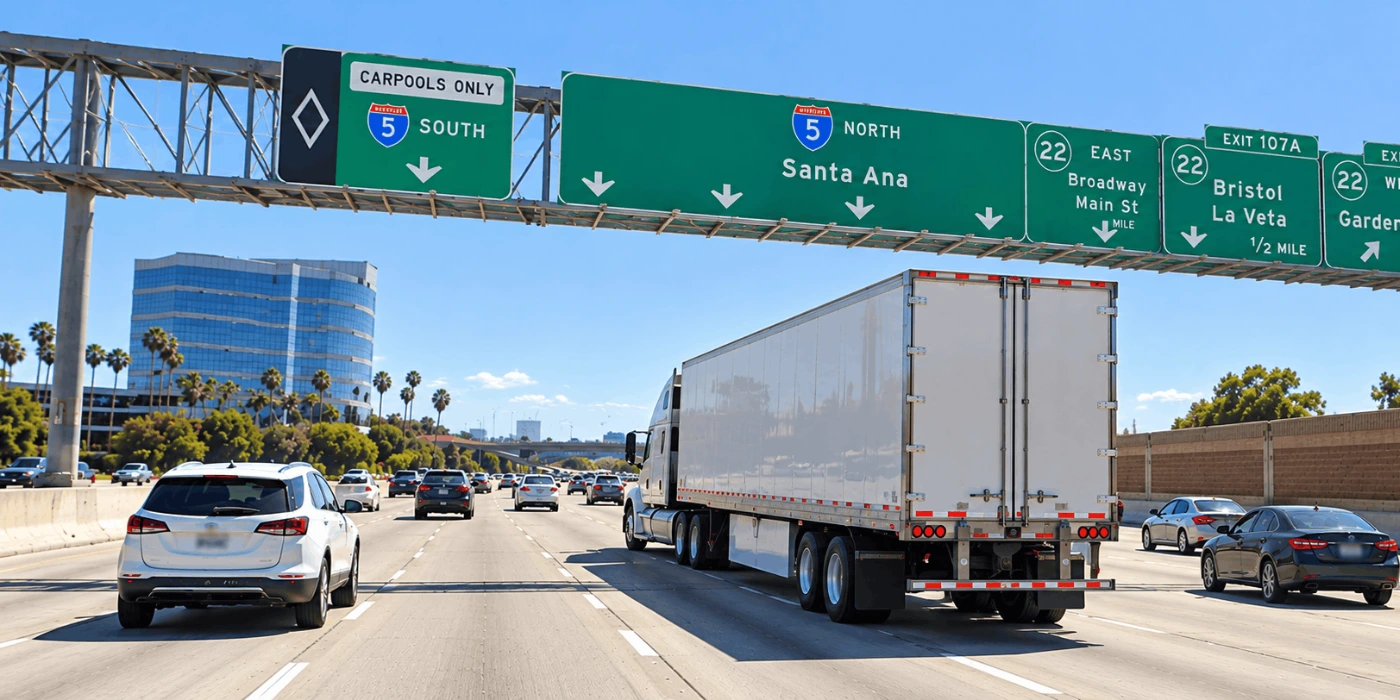
About the data: This analysis uses 198 unique 2025 Orange County SWITRS collision records flagged as truck-involved on freeways and toll freeways, including one collision recorded at the SR-133/I-5 interchange. Non-freeway routes and segments were excluded. The records don’t establish that the truck driver caused each crash or that every truck was operated by a commercial motor carrier.
What Do Orange County Truck Crash Statistics Reveal?
Where a truck accident happens is only part of the picture. Looking at collision types, reported violations, and the number of parties involved can also help explain what investigators may need to examine.
The reviewed 2025 freeway collision records reveal three notable patterns:
- Rear-end collisions: 106 crashes (53.5%) were rear-end collisions, making them the most common collision type. Investigators may need to examine following distance, braking, traffic conditions, and the actions of the drivers involved.
- Unsafe speed: 100 crashes (50.5%) listed unsafe speed as the primary violation. Under California Vehicle Code §22350, driving too fast for conditions can be illegal even below the posted speed limit. Many large trucks also have a 55 mph maximum speed limit under Vehicle Code §22406.
- Multiple parties involved: 58 crashes (29.3%) involved three or more reported parties. Determining liability in these collisions may require examining each party’s actions, since being involved in a crash doesn’t necessarily mean someone was at fault.
These findings show why identifying the type of collision or a reported violation is only the starting point. Determining who is legally responsible requires examining the circumstances of each crash.
Who Can Be Held Liable for a Truck Accident on an Orange County Freeway?
A truck driver may be held liable if their negligence causes a crash. Common examples include following too closely, making unsafe lane changes, driving too fast for traffic conditions, or driving while fatigued or distracted.
Truck drivers must also follow applicable safety regulations, including rules governing driving hours and vehicle inspections. Violating these rules may help establish negligence when the violation contributes to an accident.
However, the driver isn’t always the only party responsible. If poor maintenance, improperly secured cargo, or another party’s negligence contributed to the collision, liability may extend beyond the person behind the wheel.
How Does Multi-Party Liability Work in a Truck Accident?
Multi-party liability means two or more parties or companies may share legal responsibility for the same accident.
Determining who is liable for a truck accident involves examining whether each party’s negligence contributed to the crash and resulting injuries.
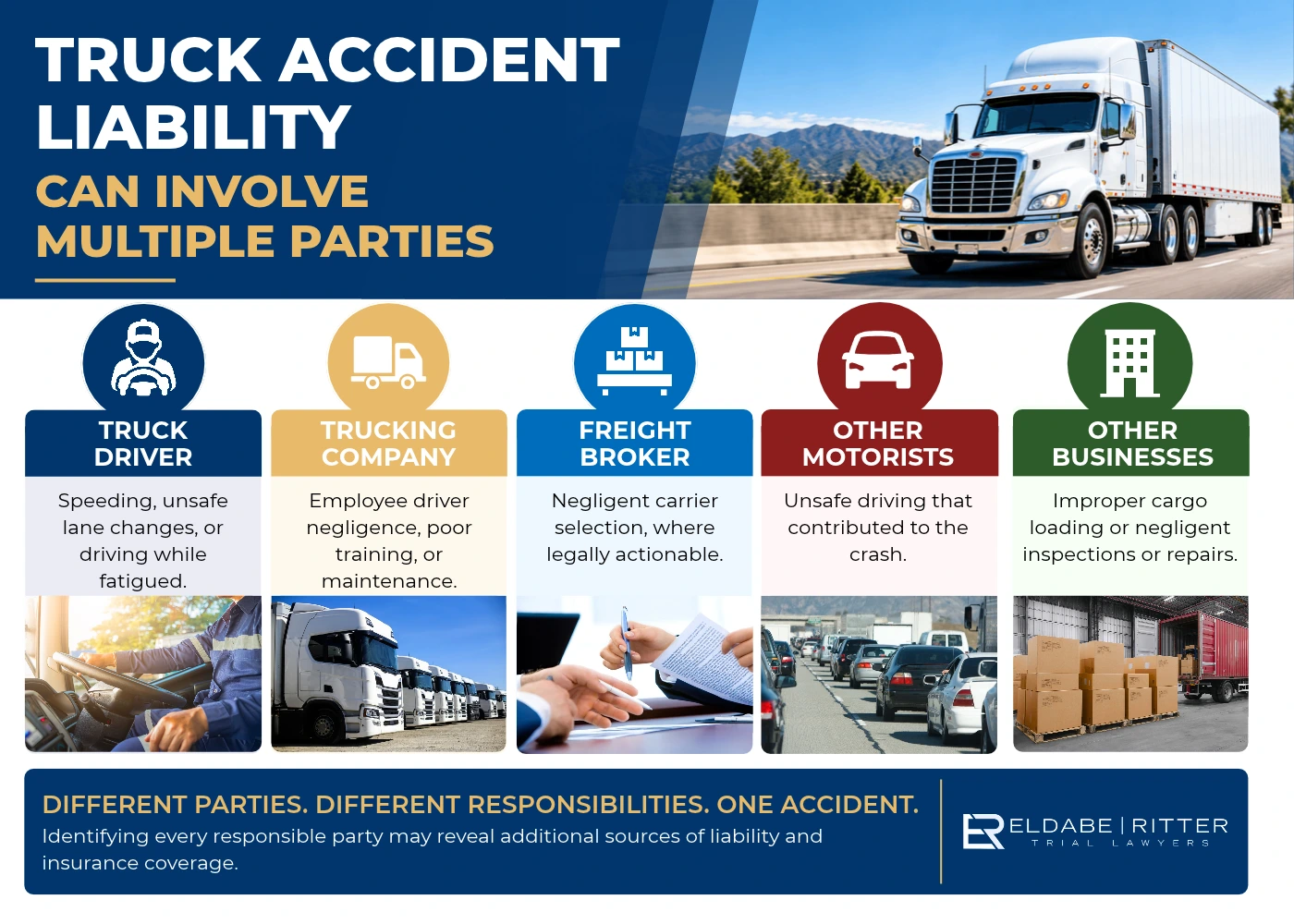
Depending on the circumstances, potentially liable parties include:
- Trucking companies: May be responsible for an employee driver’s negligence within the scope of employment or for negligent hiring, training, supervision, or maintenance.
- Other motorists: May share fault if their negligent driving contributed to the crash.
- Cargo loaders: May be liable if improperly loaded or secured cargo contributed to the accident.
- Maintenance providers: May be responsible if negligent inspections or repairs contributed to a mechanical failure that caused the crash.
- Freight brokers: May face liability for their own negligence in limited circumstances, subject to applicable federal law.
For example, if a truck’s brakes failed, an investigation might examine whether the problem resulted from inadequate maintenance, a negligent repair, or another cause. A maintenance provider wouldn’t automatically be liable simply because it worked on the truck. Its conduct would need to be connected to the failure and resulting injuries.
How Is Fault Divided Among Multiple Parties in California?
California’s comparative fault rules help determine each party’s share of responsibility when multiple parties contribute to an accident.
You may still recover compensation even if you were partly at fault. However, your recoverable damages are generally reduced by your percentage of responsibility.
For example, if your damages total $100,000 and you’re found 20% at fault, your recoverable damages would generally be reduced to $80,000.
California also treats two types of damages differently when multiple defendants are liable:
- Economic damages: Medical bills, lost wages, and other financial losses. When multiple defendants are jointly and severally liable for the same injury, each may be required to pay the full recoverable amount of economic damages, regardless of their individual percentage of fault.
- Non-economic damages: Pain, suffering, and other nonfinancial losses. Under California Civil Code §1431.2, each defendant is generally responsible only for the portion corresponding to their percentage of fault.
In serious truck accident cases, compensation may also account for future medical care and reduced earning capacity. Identifying all legally responsible parties can be especially important when the injured person’s losses exceed the insurance coverage available from one party.
How Does Insurance Work in a Multi-Party Truck Accident?
When multiple parties are responsible for a truck accident, more than one insurance policy may cover your injuries and losses. But which insurance company pays?
There isn’t a fixed payment order. It depends on who is legally responsible and which insurance policies apply.
Coverage may come from:
- The trucking company’s insurance: May cover the trucking company’s liability for the crash, depending on the policy and circumstances.
- Other responsible parties’ insurance: May apply if another driver or business contributed to the accident.
- Excess insurance: May provide additional coverage once the applicable underlying coverage requirements are met.
For example, if a truck driver and another motorist both caused a crash, insurance covering both parties may apply. Their insurers may negotiate payment, but the amount each owes depends on the applicable coverage and liability rules.
Certain commercial motor carriers must also meet federal financial responsibility requirements. Under 49 CFR §387.9, the minimum is generally $750,000 for covered interstate, for-hire carriers transporting nonhazardous property, with higher minimums of $1 million or $5 million for certain hazardous materials. These requirements don’t apply to every truck or guarantee a particular settlement.
If insurers disagree about coverage or payment, resolving the claim may require further investigation, negotiation, or litigation. Although multiple policies may apply, an injured person cannot recover twice for the same loss.
A truck accident lawyer can review applicable policies, identify coverage limits, and pursue compensation from the responsible parties.
What Evidence Can Help Establish Liability After a Truck Accident?
Police reports and scene photos are important pieces of evidence, but they may not provide all the information needed to determine what caused the crash and who was responsible.
Understanding how truck accident investigations work in California matters because commercial trucks and trucking companies may have records showing what happened before the crash.
Important evidence may include:
- Truck electronic data: Depending on the vehicle’s systems, onboard records may show speed, braking, and other activity before the collision.
- Driver logs: Electronic records may show driving hours and whether federal hours-of-service rules were followed.
- Maintenance records: Inspection and repair documents may reveal mechanical problems or maintenance issues.
- Cargo records: Loading and weight documents may show overloaded, improperly distributed, or inadequately secured cargo.
- Video and witnesses: Dashcam footage, surveillance recordings, and witness statements can help explain how the crash occurred.
- CHP collision reports: May document road conditions, statements, physical evidence, and potential traffic violations.
These records may also reveal violations of federal trucking safety rules.
Although violations of DOT regulations for truck drivers can help establish negligence, a violation alone doesn’t automatically prove liability. It must also be connected to the crash and resulting injuries.
Why Is Preserving Truck Accident Evidence Important?
After a serious truck accident, the trucking company and its insurer may begin investigating almost immediately, sometimes while you’re still receiving medical treatment.
But important evidence doesn’t always remain available indefinitely. Some information may be routinely deleted, physical evidence may be altered, and records may eventually be destroyed under applicable retention policies.
Once evidence is lost, it can become more challenging to establish what caused the crash and who was responsible.
That’s why acting early matters. A truck accident attorney can identify evidence that needs to be protected, send preservation requests to the appropriate parties, and take further legal steps when necessary to help prevent critical information from being lost.
What Should You Do After a Truck Accident on an Orange County Freeway?
A truck accident on a busy Orange County freeway can leave you shaken and unsure what to do next. Staying safe is the first priority, but knowing what to do afterward can also help protect your rights and your injury claim.
- Call 911 and get to safety. Report the crash and request medical help if needed. Move your vehicle out of traffic only if it’s safe to do so.
- Seek medical attention. Some injuries aren’t immediately obvious. Prompt treatment also helps document your injuries.
- Document the scene. If safe, photograph vehicle damage, road conditions, and the truck’s identifying information.
- Exchange information. Collect the drivers’ contact, license, registration, and insurance details, along with the trucking company’s name and any witness information.
- Be cautious with insurers. Report the crash as required, but avoid guessing about fault or signing a settlement before understanding your losses.
- Contact a truck accident lawyer. An attorney can investigate liability, identify available insurance coverage, and help preserve important evidence.
After taking care of your immediate safety and medical needs, you may be wondering what comes next. Understanding how to file a truck accident claim in California can help you know what to expect.
If you have questions or need help with the process, our team at El Dabe Ritter Trial Lawyers is here to help.
Frequently Asked Questions About Orange County Truck Accidents
What if the truck driver or trucking company blames me for the accident?
Being blamed doesn’t automatically make you responsible. Fault depends on the evidence, not simply what the truck driver or trucking company claims. Under California’s comparative fault rules, you may still recover compensation if you were partly responsible, although your recoverable damages are generally reduced by your percentage of fault.
Can I file a claim against an out-of-state trucking company?
Yes, potentially. An out-of-state trucking company may be sued in California if it is legally responsible for the accident and the court has jurisdiction over the company. Having its headquarters in another state does not automatically prevent a California lawsuit.
Can I sue the trucking company if its driver caused the accident?
Yes, potentially. A trucking company may be held responsible for an employee driver’s negligence if the driver was acting within the scope of employment. The company may also face liability for its own negligence, such as inadequate training, negligent hiring, or poor vehicle maintenance, if that negligence contributed to the accident.
Can I recover compensation from more than one party after a truck accident?
Yes. If multiple parties are legally responsible for your injuries, you may be able to pursue claims against more than one defendant. California law determines how damages are allocated among responsible parties, and you cannot recover twice for the same loss.
How long do I have to file a truck accident lawsuit in California?
In California, you generally have two years from the date of injury to file a personal injury lawsuit under Code of Civil Procedure §335.1.
If a public entity may be responsible, you generally must present a government claim within six months under Government Code §911.2. Separate deadlines apply to filing a lawsuit, and exceptions may apply.
What if the truck that hit me was from another state?
You may still be able to pursue a personal injury claim in California. A truck being registered in another state, or its trucking company being based elsewhere, doesn’t automatically prevent you from filing a lawsuit in California if the accident occurred in Orange County.
Out-of-state trucking companies may also be subject to federal trucking safety regulations, which can be relevant when investigating the crash and determining liability.
Who is responsible if a truck causes a chain-reaction accident on the freeway?
The truck driver, trucking company, or other motorists may be responsible, depending on what caused the chain-reaction accident. For example, if a truck driver fails to stop in time and pushes one vehicle into another, the driver may be liable for injuries resulting from the chain reaction.
However, other drivers may share fault if their negligence also contributed to the collisions. Under California law, liability depends on each party’s actions and how they contributed to the accident.
Injured in an Orange County Freeway Truck Accident? Contact El Dabe Ritter
When multiple parties may be responsible for a truck accident, figuring out who should pay for your injuries and losses can be complicated. Trucking companies and insurers may dispute fault, challenge your damages, or disagree over insurance coverage.
At El Dabe Ritter Trial Lawyers, we help people injured in truck accidents on Orange County freeways by:
- Investigating the crash: Gathering evidence and identifying parties whose negligence may have contributed to your injuries.
- Reviewing insurance coverage: Identifying available policies and addressing disputes with insurers.
- Evaluating your losses: Assessing medical expenses, lost income, future care needs, and other recoverable damages.
- Pursuing compensation: Negotiating with insurance companies and taking your case to court when necessary.
Contact our Huntington Beach truck accident lawyers for a free consultation, available 24/7. We handle truck accident cases on a contingency-fee basis, so you pay no attorney fees unless we win your case.
